
Even planets billions of years older than Earth may host only microbes if photosynthesis supplies too little energy.
Science fiction often imagines Earth’s galactic neighborhood teeming with hyper-advanced extraterrestrial civilizations, but the actual cosmos near us may be far quieter.
A study published in the International Journal of Astrobiology, led by Chris Doughty, a professor of ecoinformatics at Northern Arizona University, proposes that the evolution of complex life on exoplanets depends heavily on cumulative plant energy rather than just the passage of time. Although many of the planets orbiting Earth’s stellar neighbors are several billion years older than our world, worse conditions for cumulative photosynthesis mean life on those planets likely evolved much more slowly.
Among 29 nearby exoplanets, worlds outside our solar system that could potentially have liquid water, the team identified only two where life might have progressed beyond Earth’s evolutionary stage. Those planets, GJ 1061c and K2-3d, are larger, hotter, brighter, and older than most Earth-like planets in our stellar neighborhood. Three others could have reached a stage roughly comparable to Earth’s Mesozoic Era, the age of dinosaurs.
Photosynthesis as an evolutionary clock
Warm, wet regions on Earth generally support more plant growth and more species than cold, dry regions. Scientists believe that greater plant growth provides more energy and ecological space for animals, linking the conditions that favor photosynthesis to opportunities for life to diversify. Photosynthesis converts light into chemical energy, and the researchers hypothesize that the amount captured over a planet’s entire history could influence its evolutionary development. Under that relationship, a younger, warmer, wetter planet could support more evolutionary development than an older, colder, drier one.
During the 3.2 billion years before more efficient vascular plants evolved on Earth, photosynthesis fixed roughly 2.4 × 10²⁵ grams of carbon, incorporating it into organic matter. After the emergence of those plants, which have specialized tissues that transport water and nutrients, another 7 × 10²⁵ grams were fixed before humans evolved. Those quantities gave the researchers a way to compare Earth’s evolutionary history with the amount of photosynthesis other planets might have sustained.
Older worlds under dimmer stars
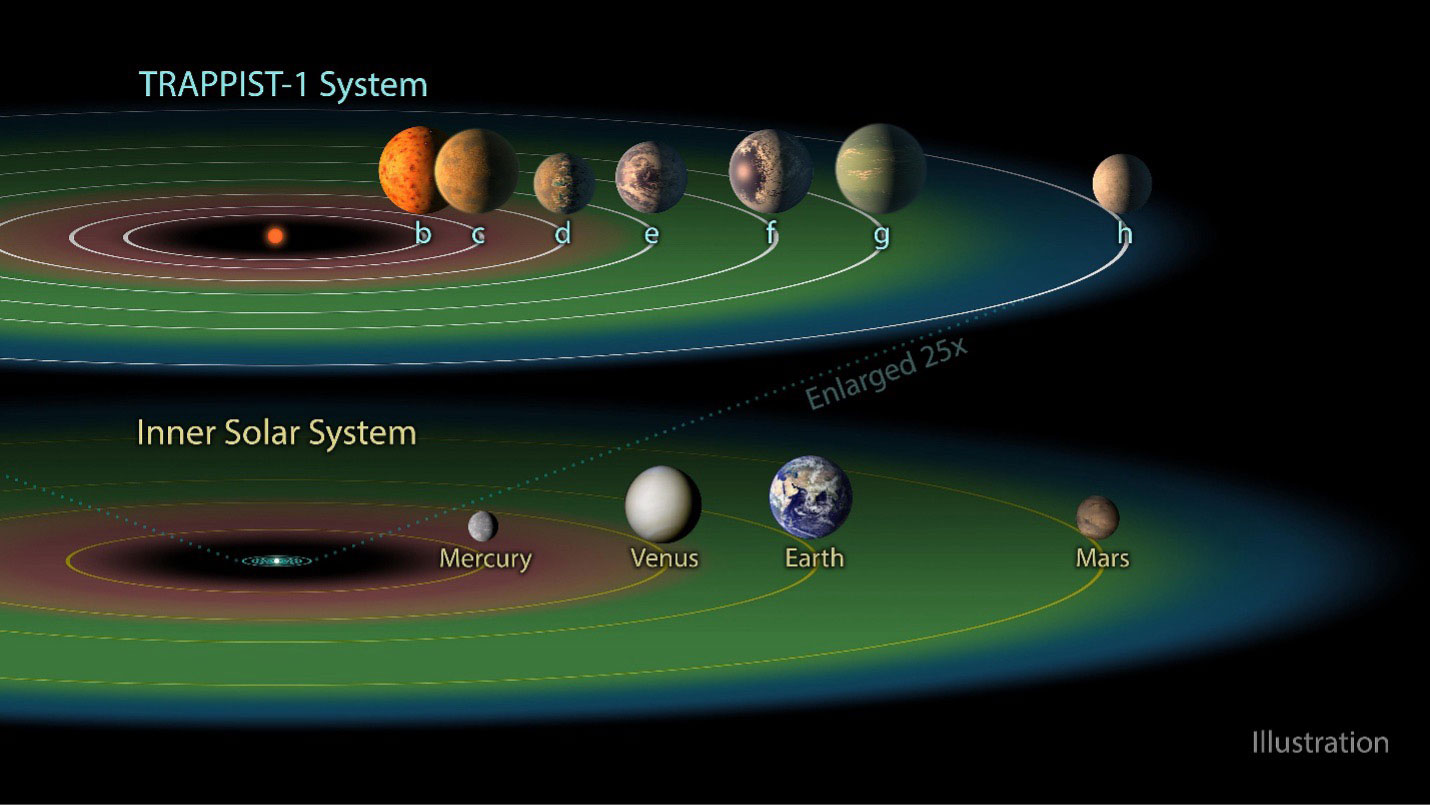
Planets orbiting red dwarfs, the most common stars in our galaxy, are considered among the likeliest places to find life, but their growing conditions differ from Earth’s. Many are tidally locked, meaning the same side always faces their star while the other faces away.
“If photosynthetic life evolved on these planets, that life has been photosynthesizing for potentially billions of years longer than on Earth,” said Michael Gowanlock, a study coauthor and associate professor of informatics at Northern Arizona University. “However, the total annual photosynthesis is likely lower because there is less light and half the planetary surface area available for photosynthesis. Who is ahead? That is the mystery we are quantitatively trying to solve.”
Because plant growth also depends on temperature and rainfall, estimating photosynthesis required more than knowing how much light a planet receives. Coauthor Denis Sergeev, a lecturer at the University of Bristol in the United Kingdom, had simulated possible exoplanet climates, producing maps of temperature, light, and precipitation. The team used those maps, which describe the main variables used to predict plant growth on Earth, to estimate potential growth over the planets’ lifetimes and infer how far evolution might have progressed.
For TRAPPIST-1e, a planet 40 light-years from Earth, the calculation yielded potential lifetime carbon fixation of just 21% of Earth’s total, despite the planet being several billion years older.
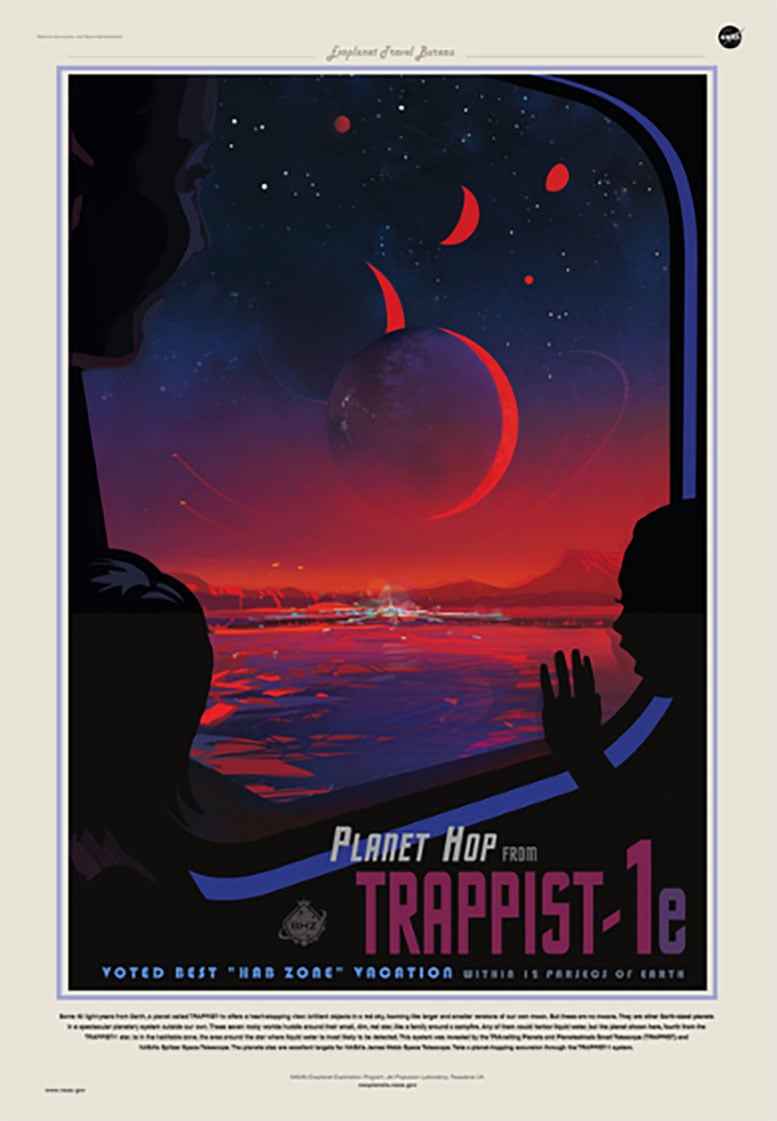
“Since this is less than the Earth had fixed before the evolution of more efficient vascular plants, we estimated that TRAPPIST-1e may only be at the microbial stage of evolution,” said coauthor Cameron Hrabak, a Northern Arizona University alumnus. “That’s well behind Earth.”
The atmosphere surrounding TRAPPIST-1e or any of the other planets could profoundly change its climate and capacity for photosynthesis, altering the evolutionary stage predicted by the model. Future observations with the James Webb Space Telescope could provide atmospheric data to refine those estimates, which assume that life exists and develops much as it did on Earth. The calculations therefore leave open the possibility of advanced extraterrestrial life nearby while suggesting conditions that could make it less likely.
“Physicist Enrico Fermi famously asked, given the high likelihood of intelligent life in the galaxy, ‘Where are they?’” Doughty said. “This paper suggests that our exoplanet stellar neighborhood may be quiet because most Earth-like planets near us are likely to be evolutionarily behind us and still at the microbial stage. Which means we can sleep well, because if life on those exoplanets evolved just like on Earth, most of those planets will just be filled with microbes and not advanced aliens.”
Scarce rain could shape alien civilizations
Rainfall was generally the main constraint on plant growth among the worlds most likely to surpass Earth’s total carbon fixation and evolutionary stage. On Earth, growth can be limited by light, temperature, or precipitation, and a desert can receive abundant sunlight while supporting relatively little plant growth because water is scarce. Such restrictions also shape which organisms thrive, helping explain why desert life has little overlap with life in tropical forests.
If intelligent creatures evolved on those exoplanets, the researchers suggest, the ecosystems shaping them might therefore resemble deserts or temperate environments. Humans could offer a parallel, having likely evolved in savanna woodlands where rainfall limited plant growth.
“To use two pop culture references, the ecological characteristics that shape advanced life on those exoplanets might be more ‘Dune’ than ‘Avatar,’” Doughty said.
Reference: “Calculating potential cumulative carbon fixed and evolutionary stage for Earthlike planets in our solar neighborhood” by Christopher E. Doughty, Cameron Hrabak, Benjamin C. Wiebe, Zephyr Kennan, Denis E. Sergeev and Michael Gowanlock, 22 September 2026, International Journal of Astrobiology.
DOI: 10.1017/S1473550426100378
Never miss a breakthrough: Join the SciTechDaily newsletter.
Follow us on Google and Google News.