
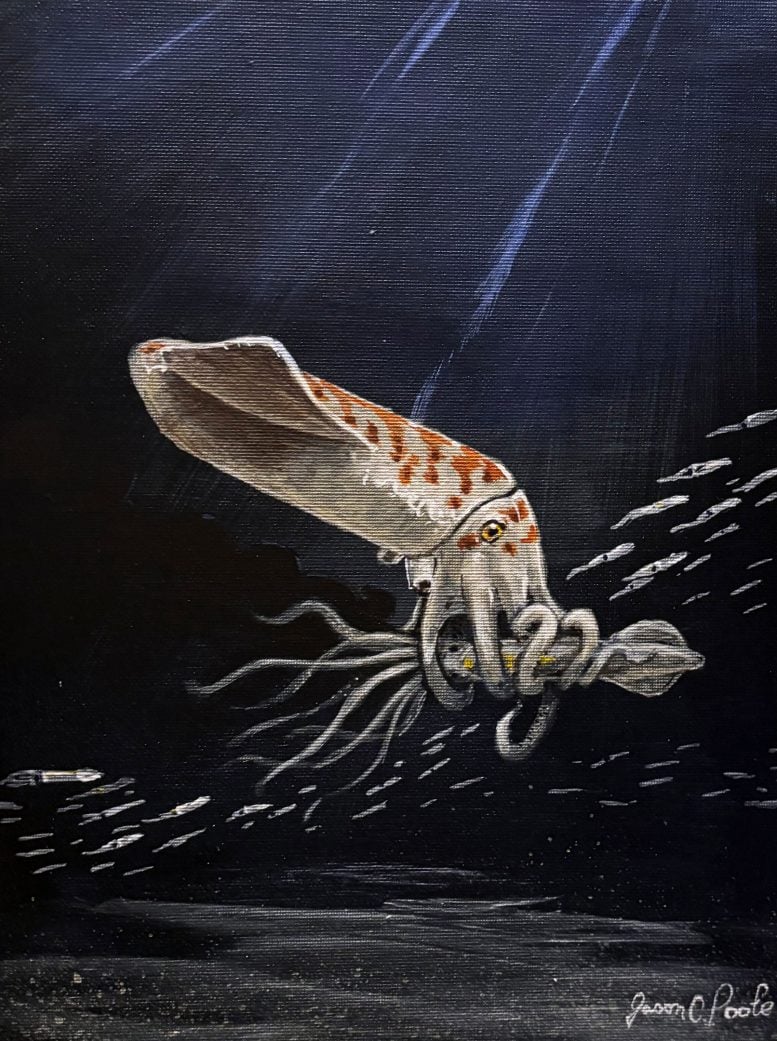
Two rare Wyoming fossils have revealed the chunkiest squid relative ever discovered, a Jurassic animal whose family was thought to have vanished millions of years earlier.
Researchers have identified Wyoteuthis linsterorum, a new species of belemnite that lived about 160 million years ago. These extinct relatives of squid and octopuses usually left behind slender, bullet-shaped fossils, but the Wyoming animal had the thickest internal support structure ever recorded in the group.
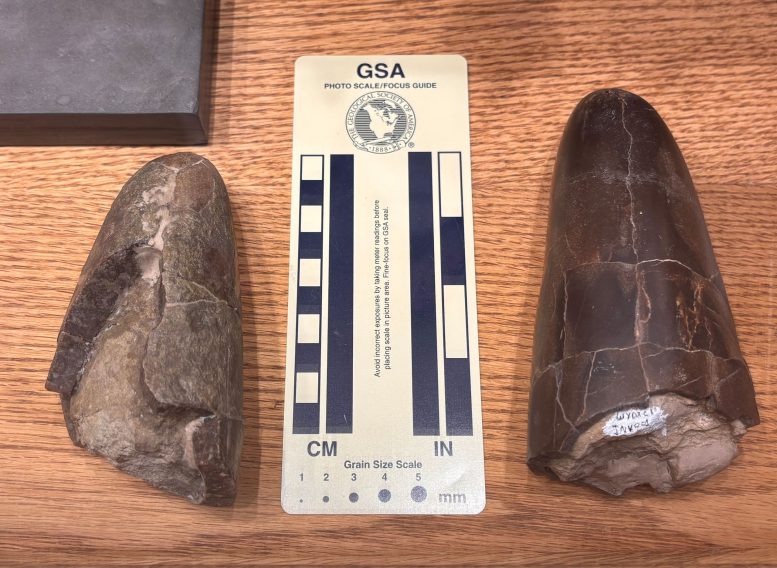
The discovery, described in Papers in Palaeontology, comes from an international team of researchers from the United States, the United Kingdom, and New Zealand. Although millions of belemnite fossils have been found in Wyoming, only two specimens of this unusually bulky species are known.
A Belemnite With An Extraordinary Build
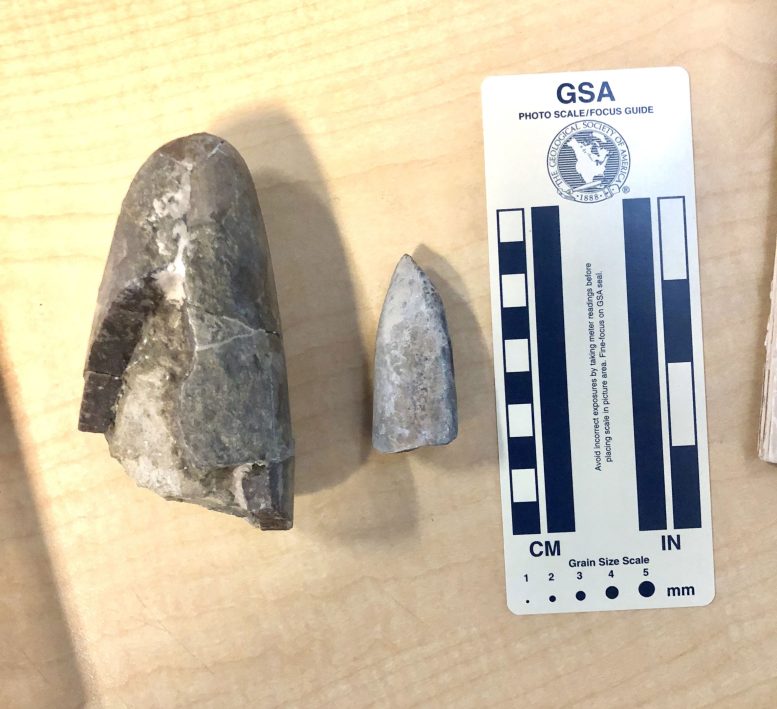
The familiar belemnite fossil is a hard internal structure called a rostrum or guard. Wyoming specimens typically measure 5 to 10 centimeters (2 to 4 inches) long and only 1 to 2 centimeters (0.4 to 0.8 inches) wide. The guard of Wyoteuthis was about 10 centimeters (4 inches) long but reached 6 centimeters (2.4 inches) across, giving it a barrel-shaped profile.
That exceptional width prompted researchers to describe it as the “chunkiest” or “fattest” belemnite ever discovered. The fossil represents only part of the animal: with its arms included, the living cephalopod probably measured around 60 centimeters (24 inches) long.
Wyoming paleontologist Bill Wahl launched the investigation after recognizing that the specimens “stuck out like a sore thumb.” He brought together specialists, including belemnite expert and PhD student Alexey Ippolitov, now at Victoria University of Wellington in New Zealand.
Computed tomography (CT) scanning allowed the team to look inside the fossils without cutting or damaging them. Their internal features connected the species to a belemnite family thought to have disappeared millions of years before this animal lived.
An Unusual Hunter In Wyoming’s Ancient Sea
The fossils come from the Sundance Formation, which preserves evidence of an inland sea that once covered parts of the western United States. Belemnites are so abundant in its Wyoming deposits that, according to co-author and local paleontologist Jessica Lippincott, collectors nickname them “squid butts.”
Ippolitov said he was “deeply surprised” to encounter something so different within a group studied for more than 200 years. Its build may have offered an advantage when pursuing smaller cephalopods, although the researchers have not established why it evolved such a broad guard.
“A possible explanation is that their relatively large size gave them an advantage when hunting co-occurring smaller belemnites of the genus Pachyteuthis. Modern squid, after all, are hardly picky when it comes to prey: they readily hunt not only other species of cephalopods but sometimes even their own kind,” Ippolitov explained.
“After spending years fossil hunting in Wyoming and collecting countless fossils of the common Pachyteuthis belemnites here in Wyoming, this one is unlike anything I have ever seen! It goes to show that we are still finding new species of fossils all the time, and people who rockhound or collect invertebrate fossils can also contribute to science,” Lippincott said.
Two Fossils and Nearly Three Decades
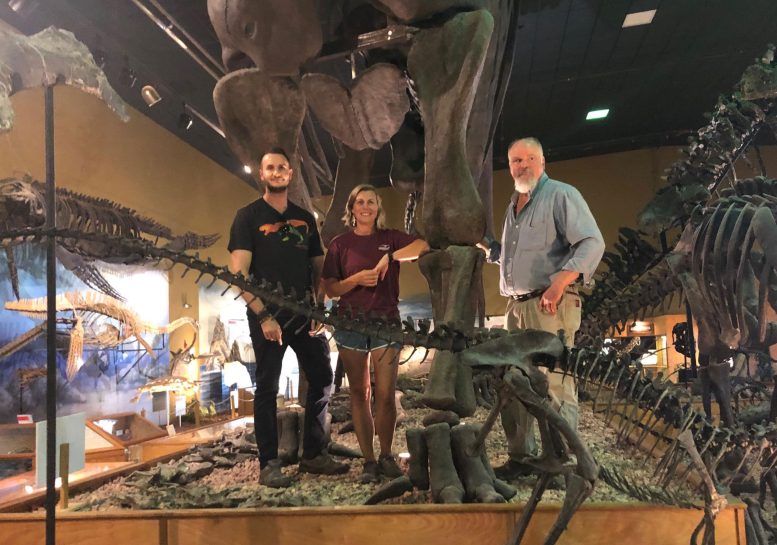
The discovery began in the late 1990s, when Dr. Burkhard Pohl, founder of the Wyoming Dinosaur Center, spotted a belemnite larger than any he had seen before. The specimen then spent years in a museum collection drawer without being studied.
The missing piece arrived when fossil collector Cliff Linster found another specimen near Ten Sleep, Wyoming, and donated it to the center in 2019. Comparing the two fossils gave researchers the evidence needed to formally recognize the new species.
A Rare Fossil Honors A Lifelong Collector
The name Wyoteuthis means “a squid from Wyoming,” while linsterorum honors Linster and his family. Their fossil discoveries also include the dinosaur Bambiraptor. Linster died in June this year, knowing that researchers were studying his belemnite and looking forward to its scientific description.
For co-author Dr. Dean Lomax, an honorary research fellow at the University of Manchester and an 1851 research fellow at the University of Bristol, the tribute was personal. He had excavated dinosaurs with Linster and his wife, Sandy, as a teenager.
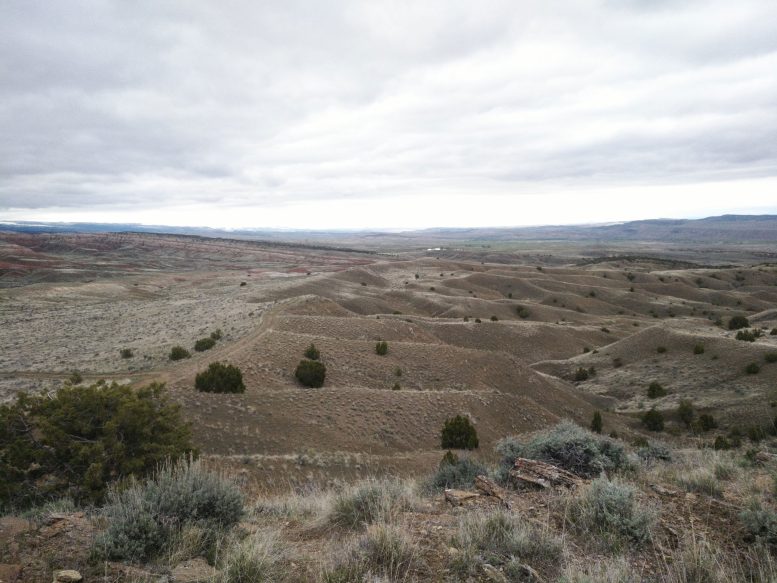
“I met Cliff and Sandy in 2009, when I spent a week digging up a dinosaur bonebed on their property in northern Montana. I have fond memories of that dig, listening to Cliff share his passion for fossils, including this belemnite. I’m honored to help name this fossil after Cliff. It’s bittersweet that he didn’t get to see it published, but it’s wonderful that we can immortalize him and his family name in the history of paleontology. The find is incredibly rare, which might be due to some ecological adaptations to the environment at the time. Perhaps its rarity is a result of narrow specialization,” Lomax said.
Both specimens are on display at the Wyoming Dinosaur Center in Thermopolis, Wyoming, USA.
Reference: “‘The big chunky belemnite’: a new relict megateuthidid from the Oxfordian (Late Jurassic) of Wyoming, USA, and its place in the evolutionary history of the group” by Alexey P. Ippolitov, Jessica L. Lippincott, William R. Wahl and Dean R. Lomax, 9 September 2026, Papers in Palaeontology.
DOI: 10.1002/spp2.70123
Never miss a breakthrough: Join the SciTechDaily newsletter.
Follow us on Google and Google News.