
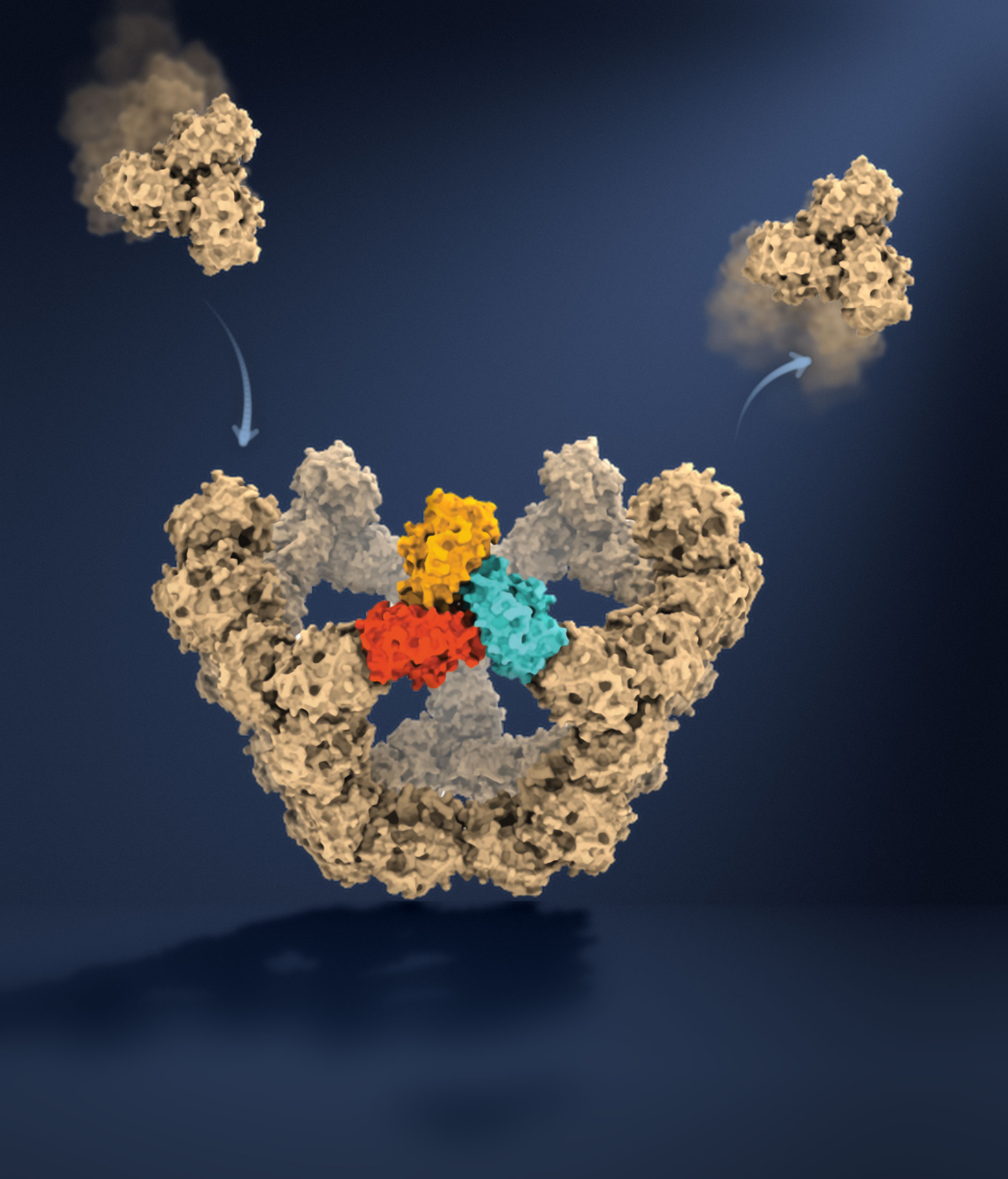
A new single-molecule approach has exposed fleeting stages in viral shell formation that were previously hidden.
Oxford University researchers have watched a virus-like particle assemble one step at a time, revealing how protein components navigate countless possible arrangements to build a stable shell.
The study, published in Nature, shows that assembly depends on weak, reversible interactions followed by a small number of stable structures that guide further growth.
How the Assembly Process Works
Viruses protect their genetic material inside protein shells called capsids. These structures can contain hundreds or thousands of components, yet many assemble spontaneously without a molecular machine directing the process.
The Oxford team found that protein building blocks initially form weak connections. Incorrect arrangements can fall apart and try again, while certain closed structures become much more stable and act as molecular checkpoints.
A key step occurs when five larger protein building blocks form a closed pentagonal ring. After this structure appears, fewer additional components are needed to reach each new stable stage, allowing assembly to speed up.
Co-lead author Dr. Roi Asor (Department of Chemistry and Kavli Institute for Nanoscience Discovery, University of Oxford) said: “A virus has to solve an extraordinary construction problem. Its components somehow have to find the right arrangement among a huge number of possibilities, without a blueprint or machinery directing the process. We can now watch what happens molecule by molecule and see the physical rules that make it possible.”
Watching Particles Grow in Real Time
To observe the process directly, the researchers studied an engineered virus-like particle made from 60 protein units.
They combined mass photometry, which measures the mass of individual molecules from the light they scatter, with a method that confines molecules so they can be monitored continuously. This allowed the team to repeatedly measure the same particle as proteins joined or detached.
Co-first author PhD student Dan Loewenthal (Department of Chemistry and Kavli Institute for Nanoscience Discovery, University of Oxford) said: “This method lets us study the assembly process directly, we just take a video!”
Co-lead author Professor Philipp Kukura (Department of Chemistry and Kavli Institute for Nanoscience Discovery, Oxford University) said: “Until now, much of our understanding of how these structures assemble has had to be reconstructed from snapshots or theoretical models. Being able to both quantify the underlying interactions and follow one particle as it grows changes that. We can see the important intermediate structures appear and deduce a detailed model of the construction process.”
Possible Applications
The findings help explain why viral assembly can remain reliable despite the huge number of possible molecular arrangements.
Dr. Asor added: “The weak interactions give the system room to make mistakes. Most encounters don’t have to be successful: the components can separate and try again. But once enough of them come together in the right closed arrangement, the structure becomes stable, and assembly can move forward. That combination of trial and error followed by locking in successful structures is what makes the process so reliable.”
Understanding these steps could eventually help researchers develop antivirals that disrupt viral assembly or improve vaccine design.
Co-author Dr. Jack Tan (MRC Weatherall Institute of Molecular Medicine and CAMS-Oxford Institute) noted: “The ability to understand these processes at the molecular level could have important applications in vaccine development and antivirals that disrupt viral assembly.”
The same method could also be used to study other forms of biological self-assembly, including protein complexes and cellular structures.
Reference: “Molecular-level observation of the self-assembly of a virus-like particle” by Roi Asor, Dan Loewenthal, Diana Melnyk, Tiong Kit Tan and Philipp Kukura, 16 September 2026, Nature.
DOI: 10.1038/s41586-026-10948-z
Never miss a breakthrough: Join the SciTechDaily newsletter.
Follow us on Google and Google News.