
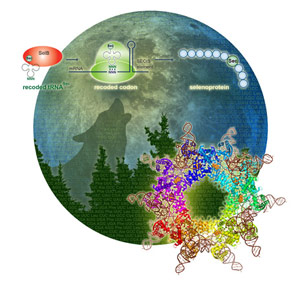
Using bacteria, Yale researchers rewrite most of the genetic instructions that encode all 20 amino acids, creating a specific 21st amino acid.
Yale researchers have discovered a targeted way to make proteins not generally found in nature by expanding the information encrypted in the genetic code.
Working with bacteria, the Yale team rewrote most of the genetic instructions that encode all 20 amino acids – the building blocks of any protein – to create a specific, 21st amino acid, researchers report in the January 2014 issue of the journal Angewandte Chemie.
The finding adds another method to the quest of synthetic biologists goal of expanding life’s genetic code to produce novel proteins that do not exist in nature but may be valuable for a wide variety of industrial, medical, or pharmaceutical purposes.
“Achieving this would open the doors to a whole new world of designer proteins with novel catalytic and mechanistic properties and possibly even biomedical applications,’’ said Markus Bröcker, postdoctoral associate in molecular biophysics and biochemistry at the Yale School of Medicine and lead author of the paper.
The authors used a decoding system that occurs naturally in the cell to insert the information for the additional amino acid selenocysteine, the 21st amino acid.
Living organisms use 64 different codons – or combinations of three of the four nucleic acids that comprise DNA – as the basis for the 20 amino acids that are found in regular proteins. To test whether they could change this genetic recipe, the Yale team took advantage of the extra molecular decoding step involved only in the insertion of the amino acid selenocysteine into proteins. The researchers succeeded in using this seleoncysteine-specific machinery to alter the meaning of 58 out of 64 codons. As a result, the bacteria specifically inserted seleoncysteine instead of other amino acids into proteins.
The technique is different than one recently described by Yale and Harvard researchers that involved recoding and engineering throughout the entire genome of bacteria. The goal of the two approaches however is the same – to create novel forms of proteins that can speed up chemical reactions, create stronger or more flexible materials, even create more potent antibodies, or improve nutritional value of food.
“Both recent studies highlight the relevance genetic recoding nowadays has as a foundation for engineering of novel proteins,” said Dieter Söll, Sterling Professor for Biochemistry and Chemistry and senior author of the paper.
Patrick O’Donoghue of Western University in Canada was co-corresponding author of the study, which was funded by the U.S. Department of Energy and the National Institutes of Health.
Publication: Dr. Markus J. Bröcker, et al., “Recoding the Genetic Code with Selenocysteine,” Angew. Chem. Int. Ed.; doi: 10.1002/anie.201308584
Reference: “Recoding the Genetic Code with Selenocysteine” by Markus J. Bröcker, Joanne M. L. Ho, George M. Church, Dieter Söll and Patrick O’Donoghue, 25 November 2013, Angewandte Chemie International Edition.
DOI: 10.1002/anie.201308584
Never miss a breakthrough: Join the SciTechDaily newsletter.
Follow us on Google and Google News.
1 Comment
Is 21St amino acid meant to create a Frankenstein? Sorry! the amino acid ‘sec’ which is selenocystein produced by the scientists in E coli probably to recode the stop codon UGA, is good for cancer studies. The new proteins are not meant for producing any new organic matter but only as pharmaceutical aid to catalyse any enzymatic reactions in the body. Thank You.