
Close Menu
    Facebook X (Twitter) Instagram
    SciTechDaily
    • Biology
    • Chemistry
    • Earth
    • Health
    • Physics
    • Science
    • Space
    • Technology
    Facebook X (Twitter) Pinterest YouTube RSS
    SciTechDaily
    Home»Space»New Colorized Images of Vesta
    Space

    New Colorized Images of Vesta

    By Jia-Rui Cook, Jet Propulsion Laboratory; NASADecember 17, 2013No Comments3 Mins Read
    Facebook Twitter Pinterest Telegram LinkedIn WhatsApp Email Reddit
    Share
    Facebook Twitter LinkedIn Pinterest Telegram Email Reddit
    Dawn Creates New Colorized Images of Vesta
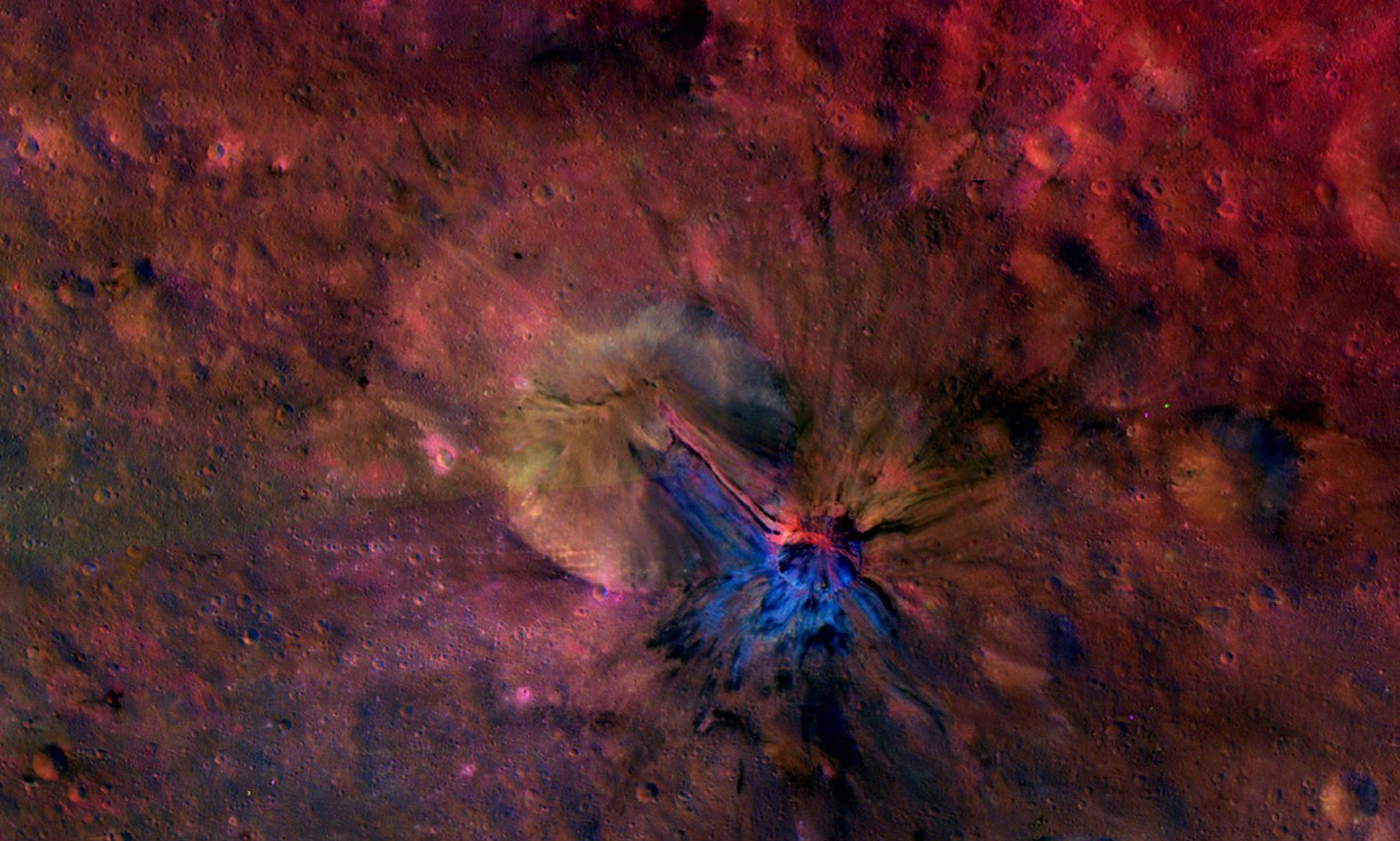
    This colorful composite image from NASA’s Dawn mission shows the flow of material inside and outside a crater called Aelia on the giant asteroid Vesta. Credit: NASA/JPL-Caltech/UCLAMPS/DLR/IDA

    New colorized images reveal geological structures on the surface of Vesta in unprecedented detail.

    Some beauty is revealed only at a second glance. When viewed with the human eye, the giant asteroid Vesta, which was the object of scrutiny by the Dawn spacecraft from 2011 to 2012, is quite unspectacular color-wise. Vesta looks grayish, pitted by a variety of large and small craters.

    But scientists at the Max Planck Institute for Solar System Research in Katlenburg-Lindau, Germany, have re-analyzed the images of this giant asteroid obtained by Dawn’s framing camera. They assigned colors to different wavelengths of light and, in the process, revealed in unprecedented detail not only geological structures that are invisible to the naked eye, but also landscapes of incomparable beauty.

    Researchers at Max Planck can now see structures such as melts from impacts, craters buried by quakes, and foreign material brought by space rocks, visible with a resolution of 200 feet (60 meters) per pixel.

    “The key to these images is the seven color filters of the camera system on board the spacecraft,” said Andreas Nathues, the framing camera team lead at Max Planck. Since different minerals reflect light of different wavelengths to different degrees, the filters help reveal compositional differences that remain hidden without them. In addition, scientists calibrated the data so that the finest variations in brightness can be seen.
    Dawn Creates Colorized Images of Vesta
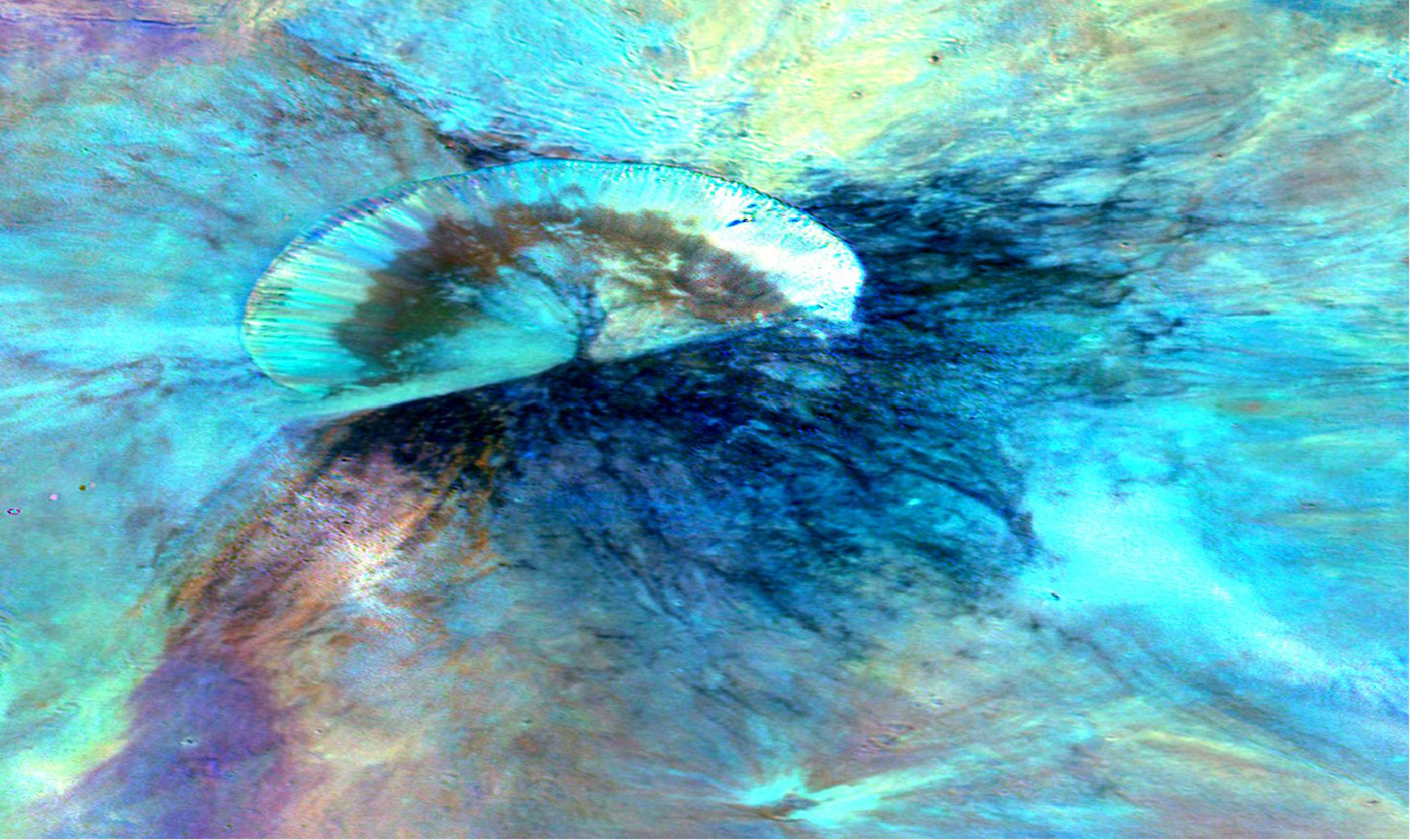
    This colorized composite image from NASA’s Dawn mission shows the crater Antonia, which lies in the enormous Rheasilvia basin in the southern hemisphere of the giant asteroid Vesta. Credit: NASA/JPL-Caltech/UCLAMPS/DLR/IDA

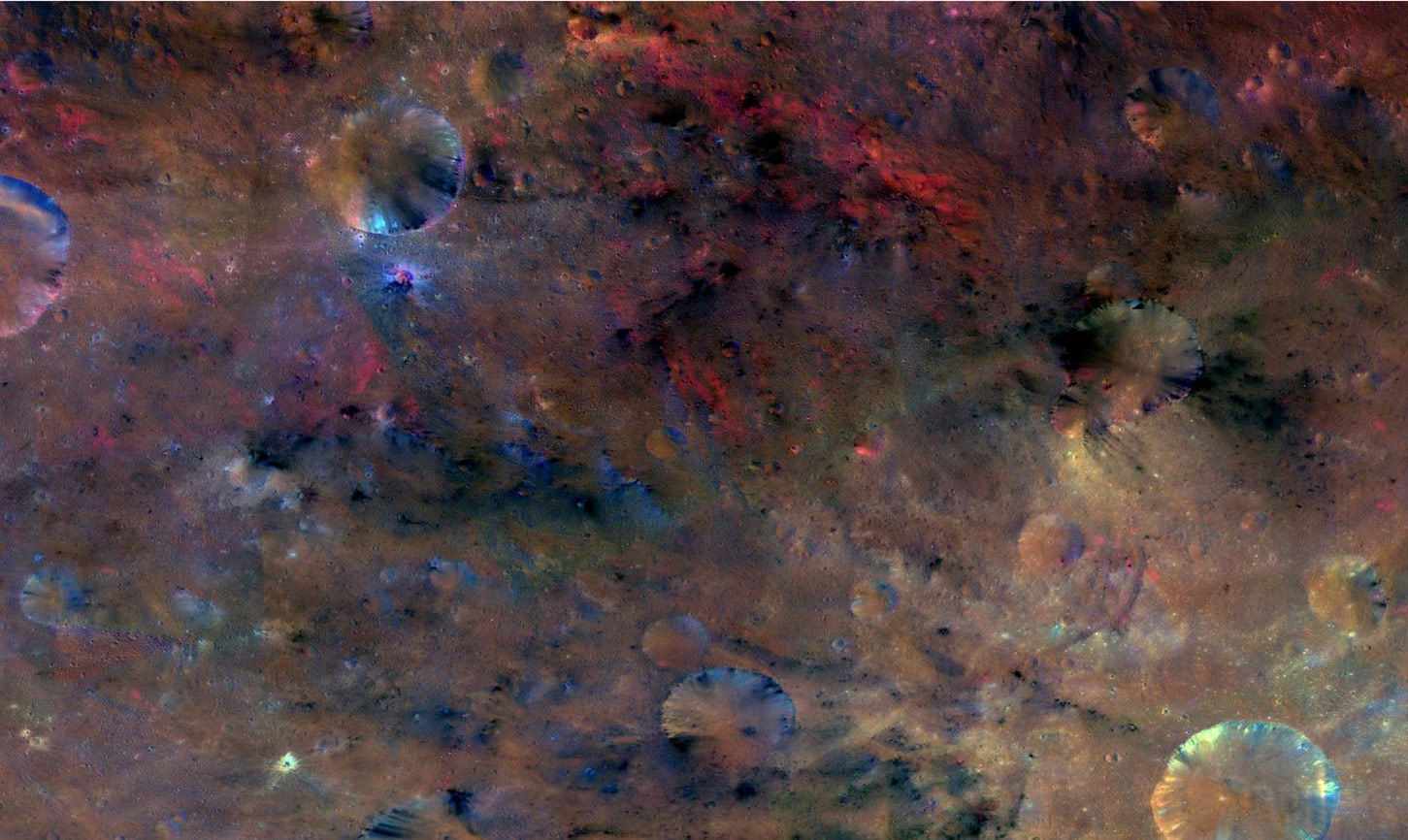
    In the new colorized images, different colors indicate different materials on the surface of Vesta. They reveal impressive formations and a wide range of geological diversity, said Nathues. But above all, the color-coded images are impressive because of their beauty.

    “No artist could paint something like that. Only nature can do this,” said Martin Hoffman, a member of the framing camera team also at Max Planck. Pictures of the crater Aelia, the crater Antonia, and an area near the crater Sextilia show some of Vesta’s most impressive sites.

    Dawn visited Vesta from July 2011 to September 2012. The spacecraft is currently on its way to its second destination, the dwarf planet Ceres. Ceres is the largest object in the main asteroid belt between Mars and Jupiter.
    New Images of Vesta
    This colorful image from NASA’s Dawn mission shows material northwest of the crater Sextilia on the giant asteroid Vesta. Sextilia, located around 30 degrees south latitude, is at the bottom right of this image. Credit: NASA/JPL-Caltech/UCLAMPS/DLR/IDA

    The Dawn mission to Vesta and Ceres is managed by NASA’s Jet Propulsion Laboratory, a division of the California Institute of Technology in Pasadena, for NASA’s Science Mission Directorate, Washington. UCLA is responsible for overall Dawn mission science. The Dawn framing cameras were developed and built under the leadership of the Max Planck Institute for Solar System Research, Katlenburg-Lindau, Germany, with significant contributions by DLR German Aerospace Center, Institute of Planetary Research, Berlin, and in coordination with the Institute of Computer and Communication Network Engineering, Braunschweig. The framing camera project is funded by the Max Planck Society, DLR, and NASA.

    Never miss a breakthrough: Join the SciTechDaily newsletter.
    Follow us on Google and Google News.

    Astronomy JPL Max Planck Institute NASA Popular Vesta
    Share. Facebook Twitter Pinterest LinkedIn Email Reddit

    Related Articles

    NASA’s Dawn Gets a Close Up View of the Canuleia Crater on Vesta

    NASA’s Dawn Mission Reveals Hydrated Minerals on Vesta

    Cassini Images Show Signs That the Seasons Are Turning On Saturn’s Moon Titan

    Heat from Within the Planet Powers Saturn’s Jet Streams

    Cassini Detects Methane Lakes on Titan

    Fermi Detects the Highest-Energy Light Ever Associated With an Eruption on the Sun

    Black Hole Rips Apart a Helium Rich Star

    Dawn Images Shine New Light on Vesta

    Searching for “Bubbles” in the Milky Way

    Leave A Reply Cancel Reply

    • Facebook
    • Twitter
    • Pinterest
    • YouTube

    Don't Miss a Discovery

    Subscribe for the Latest in Science & Tech!

    Trending News

    New Study Reveals Why Ozempic Works Better for Some People Than Others

    Climate Change Is Altering a Key Greenhouse Gas in a Way Scientists Didn’t Expect

    New Study Suggests Gravitational Waves May Have Created Dark Matter

    Scientists Discover Why the Brain Gets Stuck in Schizophrenia

    Scientists Engineer “Tumor-Eating” Bacteria That Devour Cancer From Within

    Even “Failed” Diets May Deliver Long-Term Health Gains, Study Finds

    NIH Scientists Discover Powerful New Opioid That Relieves Pain Without Dangerous Side Effects

    Collapsing Plasma May Hold the Key to Cosmic Magnetism

    Follow SciTechDaily
    • Facebook
    • Twitter
    • YouTube
    • Pinterest
    • Newsletter
    • RSS
    SciTech News
    • Biology News
    • Chemistry News
    • Earth News
    • Health News
    • Physics News
    • Science News
    • Space News
    • Technology News
    Recent Posts
    • JWST Reveals a “Forbidden” Planet With a Baffling Composition
    • New Research Challenges 30-Year-Old Theory of Eye Development
    • The Protein “Sabotaging” Aging Muscle Recovery Could Be Key to Surviving Aging
    • This Diet–Gut Interaction Could Transform Fat Into a Calorie-Burning Machine
    • Why Some People Reach 100: New Study Reveals Key Biological Differences
    Copyright © 1998 - 2026 SciTechDaily. All Rights Reserved.
    • Science News
    • About
    • Contact
    • Editorial Board
    • Privacy Policy
    • Terms of Use

    Type above and press Enter to search. Press Esc to cancel.