
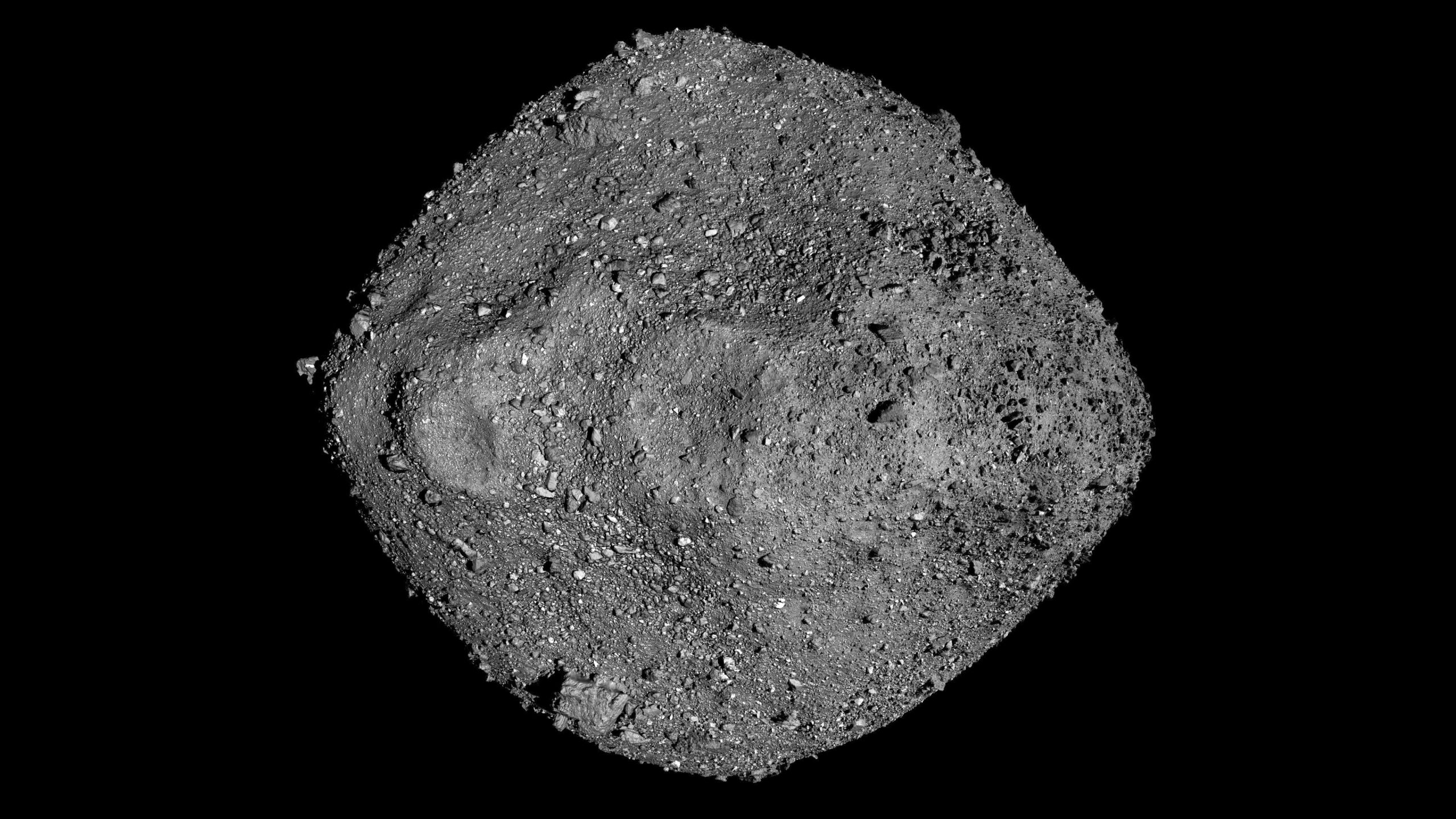
Instead of forming far out where comets took shape, Bennu may have emerged near the young solar system’s water-ice line, where Jupiter helped shape the mixture of dust that built the asteroid.
Understanding exactly how the planets formed 4.5 billion years ago requires looking at material that has hardly changed since the solar system was just a swirling disk of gas and dust.
Because the asteroid Bennu orbits the Sun every 1.2 years and swings within about 186,000 miles, or 300,000 kilometers, of Earth every six years, it offered a rare opportunity to grab one of these primordial relics. On September 23, 2026, NASA’s OSIRIS-REx probe dropped a sample container into the Utah desert carrying roughly 120 grams, or about 4 ounces, of Bennu’s surface material.
Astronomers previously assumed that asteroids like Bennu formed relatively late in the solar system’s evolution, far out where comets are thought to have taken shape. The chemical fingerprint locked inside the returned material instead traces Bennu to a very different environment.
Isotopes link Bennu to Ryugu
A small portion of the sample traveled to ETH Zurich, where Maria Schönbächler, a professor of isotope geochemistry, received half a gram for analysis. Her team measured isotopes of iron, titanium, and chromium, with the findings published in Science Advances. Isotopes are forms of the same element that differ slightly in mass, and the proportions in which they occur can preserve a chemical fingerprint of the material from which an asteroid formed.
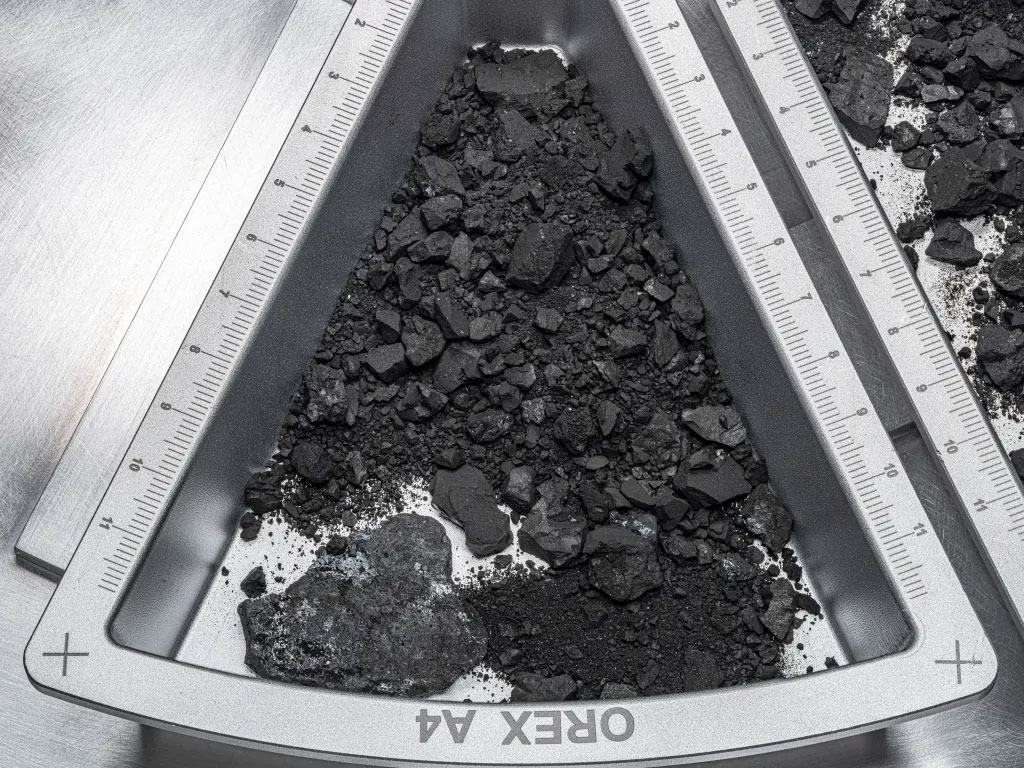
The measurements showed that titanium and iron are distributed uniformly throughout Bennu’s material. They also revealed a close chemical connection with the asteroid Ryugu and CI meteorites, a rare class of primitive, carbon-rich meteorites found on Earth. All three share a similar isotopic fingerprint that sets them apart from other known asteroids, meteorite groups, and planets.
A birthplace near the water-ice line
That similarity suggests Bennu, Ryugu, and the parent bodies of CI meteorites formed from the same reservoir of cosmic dust. Pinning down where such a reservoir existed led the researchers away from the distant outer Solar System and toward a boundary known as the water-ice line.
About 4.5 billion years ago, the young Sun was surrounded by a rotating disk of gas, dust, and water ice. The water-ice line marked the region where temperatures became low enough for water vapor to freeze. Material arriving from the inner and outer parts of the disk could mix near this transition, while ice helped the finest dust particles stick together.
“Bennu is a hybrid: the material does not clearly match either the inner or the outer solar system,” says Schönbächler.
Its mixed chemical character is consistent with an asteroid forming where material from both regions came together. Schönbächler and her colleagues propose that Jupiter played an important part in creating those conditions.
Jupiter may have sorted the dust
The gas giant formed very early, within about one million years of the Sun’s birth. As planets and asteroids were beginning to grow through the gradual accumulation of smaller material, Jupiter rapidly became massive enough to affect how solids moved through the surrounding disk.
The researchers suggest that the growing planet acted as a barrier to much of the coarser material. Fine dust could still flow around it, allowing particles from different regions of the disk to mix more evenly near the water-ice boundary. The precursors of Bennu, Ryugu, and the CI meteorites could then have assembled from this finely mixed material.
That scenario also helps explain why Bennu contains so much water. Ice near the boundary could evaporate, with some of the resulting water vapor later condensing again in the same region where Bennu’s precursor material accumulated.
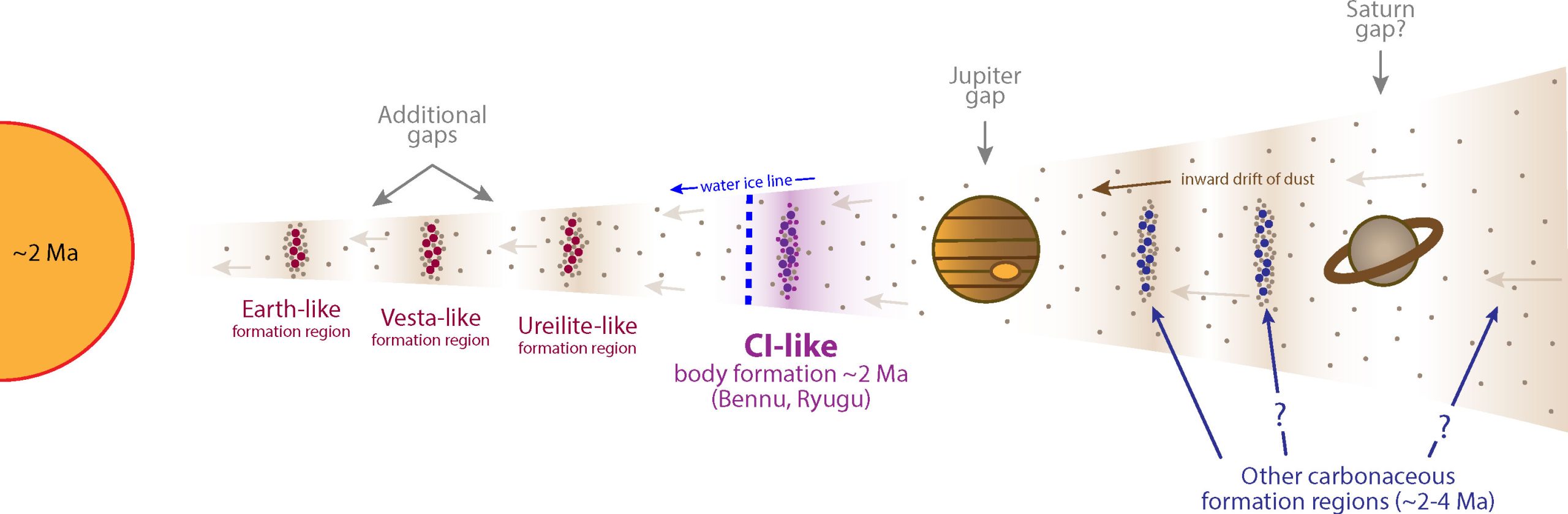
Jupiter’s influence may also explain why Bennu formed largely from fine dust. Small particles moving through the disk could become thoroughly mixed, producing material whose overall chemistry more closely resembles that of the Sun. The researchers compare the process to fine household dust, which gradually spreads throughout its surroundings.
“Bennu may offer our best glimpse of the original mix of chemical elements from which the terrestrial planets were ultimately built,” as Schönbächler states.
Bennu can preserve that record because it is a highly primitive asteroid. Its material dates back to the birth of the Solar System around 4.5 billion years ago and has changed little since then, leaving researchers with a sample of matter from the period when planets were still assembling.
Its water and organic material make that record useful for another question as well. Studying where those substances accumulated could help researchers better understand the conditions under which the terrestrial planets formed and how the young Earth acquired some of the materials associated with the building blocks of life.
Bennu’s isotope trail remains incomplete
The proposed formation picture is not complete. Researchers still do not know how strongly the young Jupiter influenced the process that allowed mainly fine dust particles to clump together, and they do not yet know how widespread Bennu’s isotopic fingerprint may be among other asteroids.
“We are now wondering whether other asteroids have the same isotopic signature as Bennu and Ryugu,” Schönbächler goes on to state.
Additional returned samples could help answer that question. With the Bennu analysis complete, Schönbächler is now looking toward a Japanese sample-return mission to Phobos, one of Mars’ moons, which is due to launch at the end of October. She plans to apply to the Japanese space agency JAXA for some of the material once it returns to Earth.
“It would be exciting to also obtain this material to analyze it in my laboratory,” she says.
The wait will be a long one. The capsule carrying material from Phobos is not expected to return to Earth until 2031.
Reference: “Nucleosynthetic constraints on the origin of Bennu and CI-like asteroids” by Maria Schönbächler, Mattias Ek, Manuela A. Fehr, Katarzyna M. Liszewska, Lara A. E. Meyer, Miriam Rüfenacht, James M. J. Ball, Paul Frossard, Jan Render, Quinn R. Shollenberger, Greg A. Brennecka, Thomas S. Kruijer, Josh Wimpenny, Martin Bizzarro, Jessica J. Barnes and Ann N. Nguyen, 23 September 2026, Science Advances.
DOI: 10.1126/sciadv.aei9107
Never miss a breakthrough: Join the SciTechDaily newsletter.
Follow us on Google and Google News.