
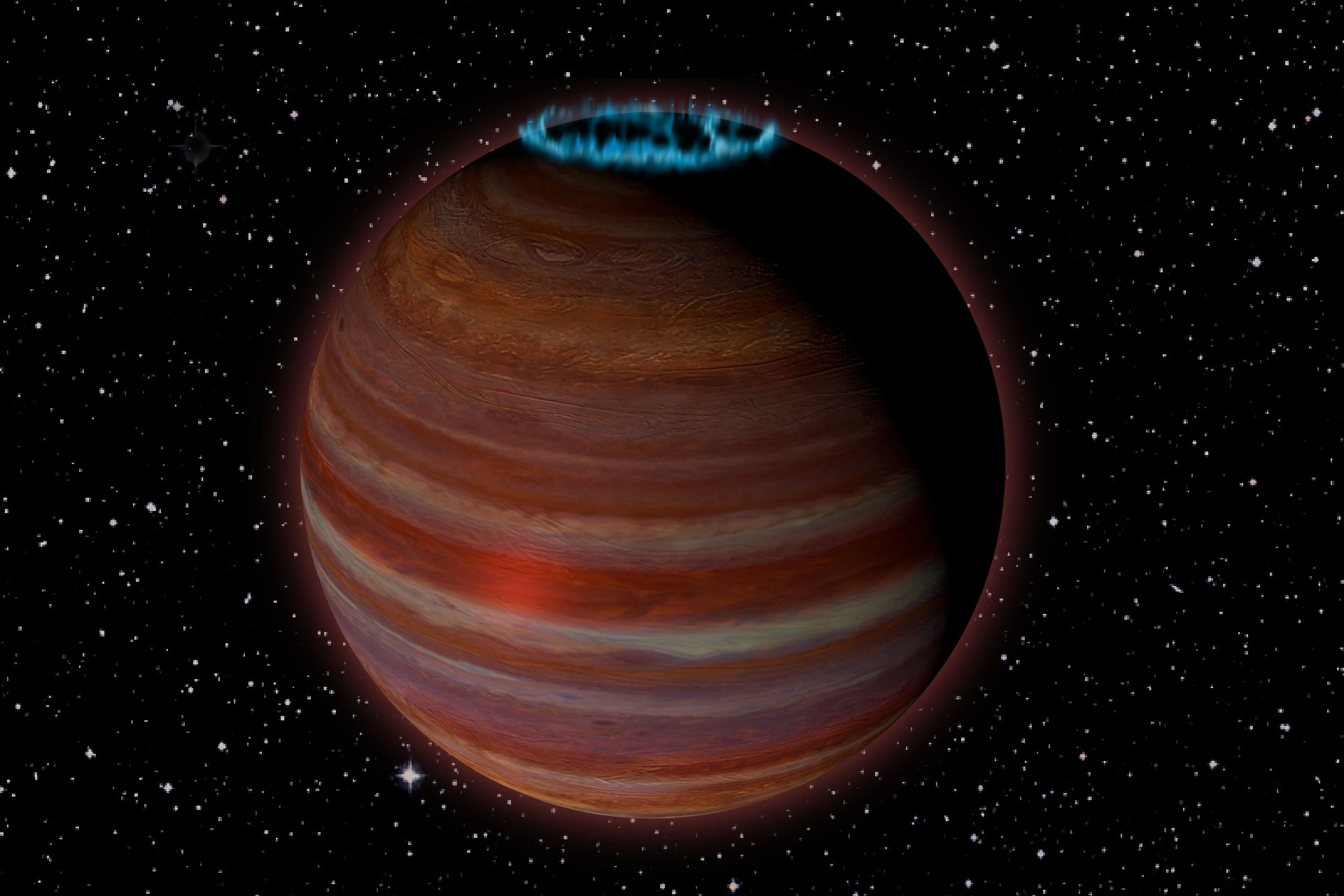
JWST observations reveal that the changing atmosphere of brown dwarf SIMP 0136 may be governed by just a few underlying processes.
A world 20 light-years from Earth appears to have a much more orderly atmosphere than its constantly changing clouds suggest.
Using observations from NASA’s James Webb Space Telescope (JWST), scientists at Trinity College Dublin found that most of the atmospheric variability on the brown dwarf SIMP 0136 can be traced to just two dominant processes: changes in temperature and changes in the vertical structure of its clouds. Those processes appear to combine into three recurring weather states that rotate in and out of view.
The result offers a new way to separate the underlying physics of distant atmospheres from the complicated brightness changes astronomers actually observe. The study was published in Astronomy & Astrophysics.
Three Weather States Dominate the Atmosphere
SIMP 0136 is larger and hotter than a gas giant planet but does not have enough mass to sustain the hydrogen fusion that powers a star. Its atmosphere contains enormous, rapidly changing cloud systems, making it more comparable to an extreme version of Jupiter than to Earth.
As SIMP 0136 rotates, different regions of its atmosphere face Earth. JWST can detect extremely small changes in the object’s brightness across different wavelengths, allowing astronomers to infer how temperature and clouds vary across the visible hemisphere.
The new study indicates that much of this changing signal can be explained by three recurring atmospheric states. Some regions are hotter with thinner clouds, while others are cooler and contain thicker clouds that extend farther vertically through the atmosphere. Rather than reorganizing randomly, these broad atmospheric patterns persisted across more than a dozen rotations.
“We also discovered that these drivers of the weather patterns on SIMP-0136 persist over time, even as the detailed appearance of the atmosphere evolves over more than a dozen rotations,” said first author Merle Schrader, a PhD candidate in Trinity’s School of Physics.
Pulling Weather Patterns Directly From the Data
To identify the dominant atmospheric changes, the researchers used a statistical method called Principal Component Analysis (PCA). The technique reduces a complicated data set to a smaller number of patterns that account for most of its variation.
PCA allowed the researchers to identify which changes in SIMP 0136’s light tended to occur together. The two strongest components were consistent with variations in atmospheric temperature and cloud structure, while weaker fluctuations could be separated from those dominant signals and from random noise.
The approach differs from methods that begin with detailed assumptions about an atmosphere and then test whether a model reproduces the observations. Instead, PCA can first identify the major sources of variability present in the data, giving researchers a simpler starting point before they turn to more computationally intensive atmospheric models.
“In relative terms, SIMP 0136 is one of the easier brown dwarfs for us to capture high-quality data from. These data have been studied before by established methods, allowing us to compare some of the results from this new technique to what we already know about this object. The technique has also helped us develop a better understanding of what drives the weather on this faraway world and how these weather patterns interact and co-exist, but perhaps even more importantly, it shows how this approach can be further refined and applied to other, less well-known brown dwarfs in different parts of space.”
A Test Case for Distant Atmospheres
Brown dwarfs offer a clearer view of atmospheric processes such as cloud formation, circulation, and heat transport than most exoplanets, which are harder to observe directly. Studying SIMP 0136 could therefore help astronomers interpret the atmospheres of giant worlds beyond the Solar System.
“Our findings will transform how astronomers analyze future JWST observations. Since our approach rapidly identifies the dominant components of the atmosphere, it offers an efficient first step before we begin computationally intensive modeling,” said Prof. Johanna Vos, associate professor in Trinity School of Physics.
“Applying this technique to a wide range of brown dwarfs and giant exoplanets will help us better understand the diverse weather systems that shape worlds far beyond our Solar System.”
Twenty Years of Light in a Single Pixel
SIMP 0136 also provided an unusual coincidence for Schrader. The brown dwarf lies about 20 light-years away, meaning the light recorded by JWST in 2023 had been traveling through space for roughly two decades. It was emitted in the same year Schrader was born.
“Light travels at around 300,000 km/s but, even at that speed, it took two decades to reach us, peering through the JWST lenses,” she said.
That speed is about 186,000 miles per second. Light traveling from Earth reaches the Moon in a little more than a second.
“When you consider light takes just over a second to reach the Moon after leaving Earth, that gives a sense of how far away SIMP 0136 is, and how incredible astrophysical progress has been. I think it’s amazing that we have been able to discern the intimate weather patterns of a distant world and map their interactions from our cozy little corner of the universe, when all we observe directly of these objects is a single pixel spread across the light spectrum.”
Extending the method to more brown dwarfs and giant exoplanets could help astronomers determine which atmospheric processes dominate on worlds with different temperatures, cloud compositions, and circulation patterns. Better measurements of those atmospheres can also improve understanding of their chemistry, an essential part of assessing the physical conditions present on distant planets.
Reference: “The JWST weather report: Unravelling the atmospheric variability of isolated worlds using principal component analysis” by Merle A. Schrader, Johanna M. Vos, Evert Nasedkin, Jennifer Kestell, Nicolas B. Cowan, Roman Akhmetshyn, Samuel Beiler, Beth A. Biller, Ben Burningham, Jacqueline Faherty, Eileen C. Gonzales, Allison M. McCarthy, Caroline V. Morley, Barry O’Donovan, Cian O’Toole, Genaro Suárez, Xianyu Tan, Channon Visscher, Niall Whiteford and Yifan Zhou, 16 September 2026, Astronomy & Astrophysics.
DOI: 10.1051/0004-6361/202660109
Never miss a breakthrough: Join the SciTechDaily newsletter.
Follow us on Google and Google News.