
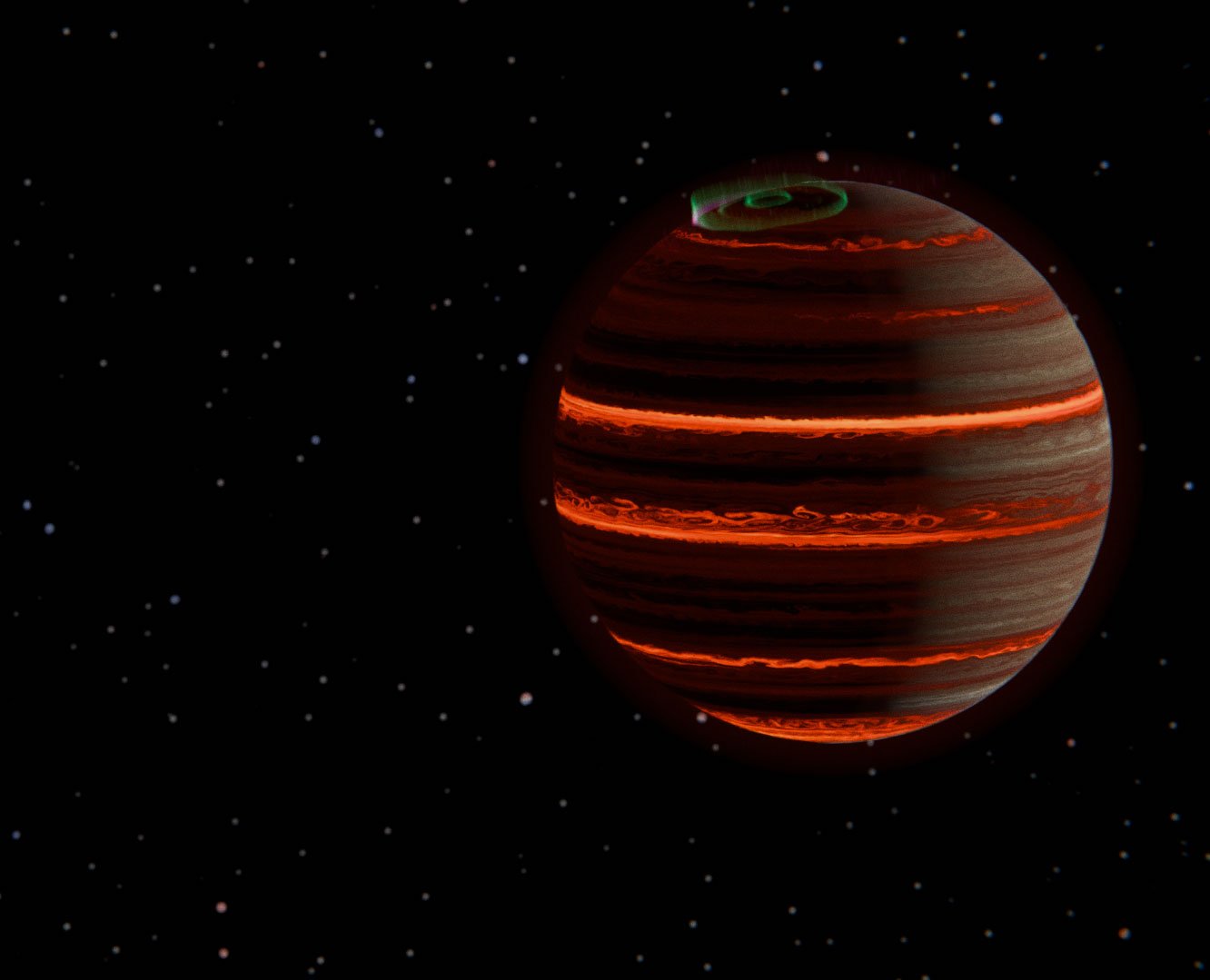
Using JWST, astronomers uncovered auroras, exotic clouds, and storms on a blazing rogue planet.
Brilliant aurora-like displays, much like Earth’s Northern Lights, are the highlight of an unusual weather forecast. Instead of coming from a television studio, this report originates from a distant world beyond our solar system.
Astronomers at Trinity College Dublin used the NASA/ESA/CSA James Webb Space Telescope to investigate the turbulent atmosphere of a nearby free-floating planet known as SIMP-0136.
With the telescope’s highly sensitive instruments, researchers were able to measure tiny variations in the planet’s brightness as it spun. These subtle shifts revealed information about its temperature, cloud cover, and chemical makeup.
In an unexpected discovery, the data also revealed that SIMP-0136 experiences intense auroral activity. These shimmering light shows resemble the Northern Lights on Earth and the even stronger auroras on Jupiter, and they play a role in heating the planet’s upper atmosphere.
Temperatures and Atmospheric Shifts
“These are some of the most precise measurements of the atmosphere of any extra-solar object to date, and the first time that changes in the atmospheric properties have been directly measured,” said Dr. Evert Nasedkin, a Postdoctoral Fellow in Trinity College Dublin’s School of Physics, who is the lead author of the research article just published in leading international journal, Astronomy & Astrophysics.
“And at over 1,500 °C, SIMP-0136 makes this summer’s heat wave look mild,” he continued. “The precise observations we made meant we could accurately record temperature changes smaller than 5 °C. These changes in temperature were related to subtle changes in the chemical composition of this free-floating planet, which is suggestive of storms – similar to Jupiter’s Great Red Spot – rotating into view.”
Another surprise finding was the lack of variability of the clouds on SIMP-0136. One might expect changes in the cloud coverage to lead to changes in the atmosphere, similar to observing patches of clouds and blue sky here on Earth. Instead, the team found that the cloud coverage was constant over the surface of SIMP-0136. At the temperatures of SIMP-0136 these clouds are unlike those on Earth, instead composed of silicate grains, similar to sand on a beach.
This is the first publication from the new ‘Exo-Aimsir’ group led by Prof. Johanna Vos in Trinity’s School of Physics, and includes contributions from all the group members, including PhD candidates Merle Schrader, Madeline Lam, and Cian O’Toole.
These data were initially published by a similar team led by Allison McCarthy at Boston University, but the new analysis has revealed more details about the atmosphere.
Reading the Skies with Light
“Different wavelengths of light are related to different atmospheric features. Similar to observing the changes in color over the surface of the earth, the changes in the color of SIMP-0136 are driven by changes in the atmospheric properties,” added Dr. Nasedkin. “So by using cutting-edge models, we could infer the temperature of the atmosphere, the chemical composition, and the position of the clouds.”
Prof. Vos said: “This work is exciting because it shows that by applying our state-of-the-art modelling techniques to cutting-edge datasets from JWST, we can begin to piece together the processes that drive weather in worlds beyond our solar system. Understanding these weather processes will be crucial as we continue to discover and characterize exoplanets in the future.”
“While for now these types of spectroscopic variability observations are limited to isolated brown dwarfs, like this one, future observations with the Extremely Large Telescope and eventually the Habitable Worlds Observatory will enable the study of the atmospheric dynamics of exoplanets, from Jupiter-like gas giants to rocky worlds.”
Reference: “The JWST weather report: Retrieving temperature variations, auroral heating, and static cloud coverage on SIMP-0136” by E. Nasedkin, M. Schrader, J. M. Vos, B. Biller, B. Burningham, N. B. Cowan, J. K. Faherty, E. Gonzales, M. B. Lam, A. M. McCarthy, P. S. Muirhead, C. O’Toole, M. K. Plummer, G. Suárez, X. Tan, C. Visscher, N. Whiteford and Y. Zhou, 26 September 2025, Astronomy & Astrophysics.
DOI: 10.1051/0004-6361/202555370
Funding: Royal Society – Research Ireland University Research Fellowship
Never miss a breakthrough: Join the SciTechDaily newsletter.
Follow us on Google and Google News.