
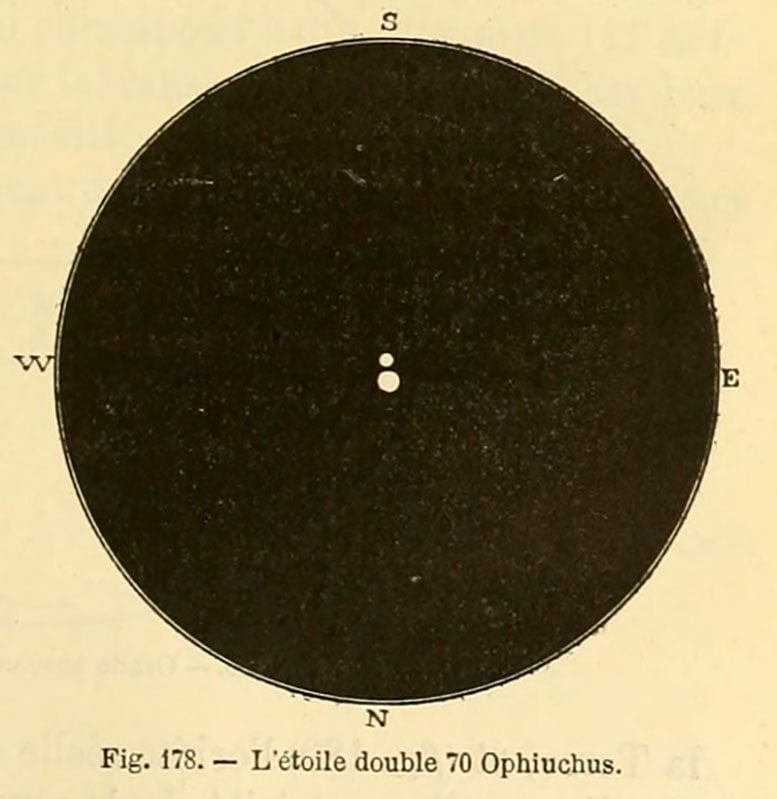
Coming up empty in a search for giant planets could help astronomers find smaller worlds in the habitable zones of the nearby two-star system 70 Ophiuchi AB.
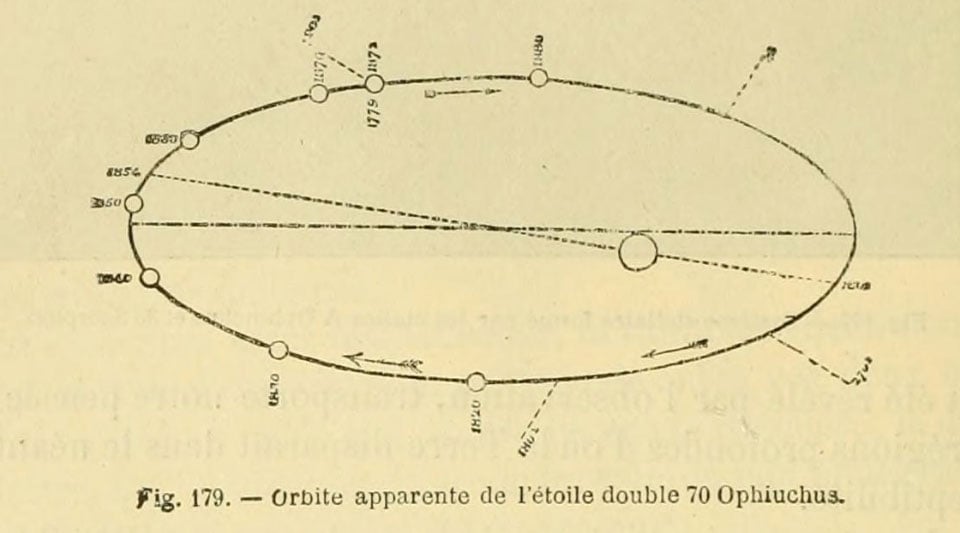
Two stars circling each other about 16 light-years from Earth have kept astronomers returning to a possibility first raised in 1855: that a planet might be orbiting nearby. British astronomer William Jacob’s claim that year made the system, 70 Ophiuchi AB, or 70 Oph AB, the host of the first official exoplanet candidate. His claim did not survive scrutiny, but increasingly sophisticated measurements over the following 171 years still could not rule out Jupiter-sized planets in the system’s inner regions.
University of Michigan researchers have now narrowed that possibility with the most sensitive modern search for giant planets in 70 Oph AB. Their study, published in The Astrophysical Journal, found no large planets and excluded worlds with Jupiter’s mass or greater from specific regions around both stars.
Stellar activity mimics a planet’s pull
Astronomers searching for an unseen planet can look for its gravitational pull on a star, which can make the star wobble as the two orbit their shared center of mass. That motion can appear in measurements of radial velocity, the star’s speed toward or away from Earth. Even modern measurements of 70 Oph AB contained a wobble that could have been explained by a Jupiter-sized planet, said Yiting Li, a postdoctoral researcher in U-M’s Department of Astronomy. Changes on a star’s surface can mimic that signal, however, so the measurements left astronomers with competing explanations for what they were seeing.
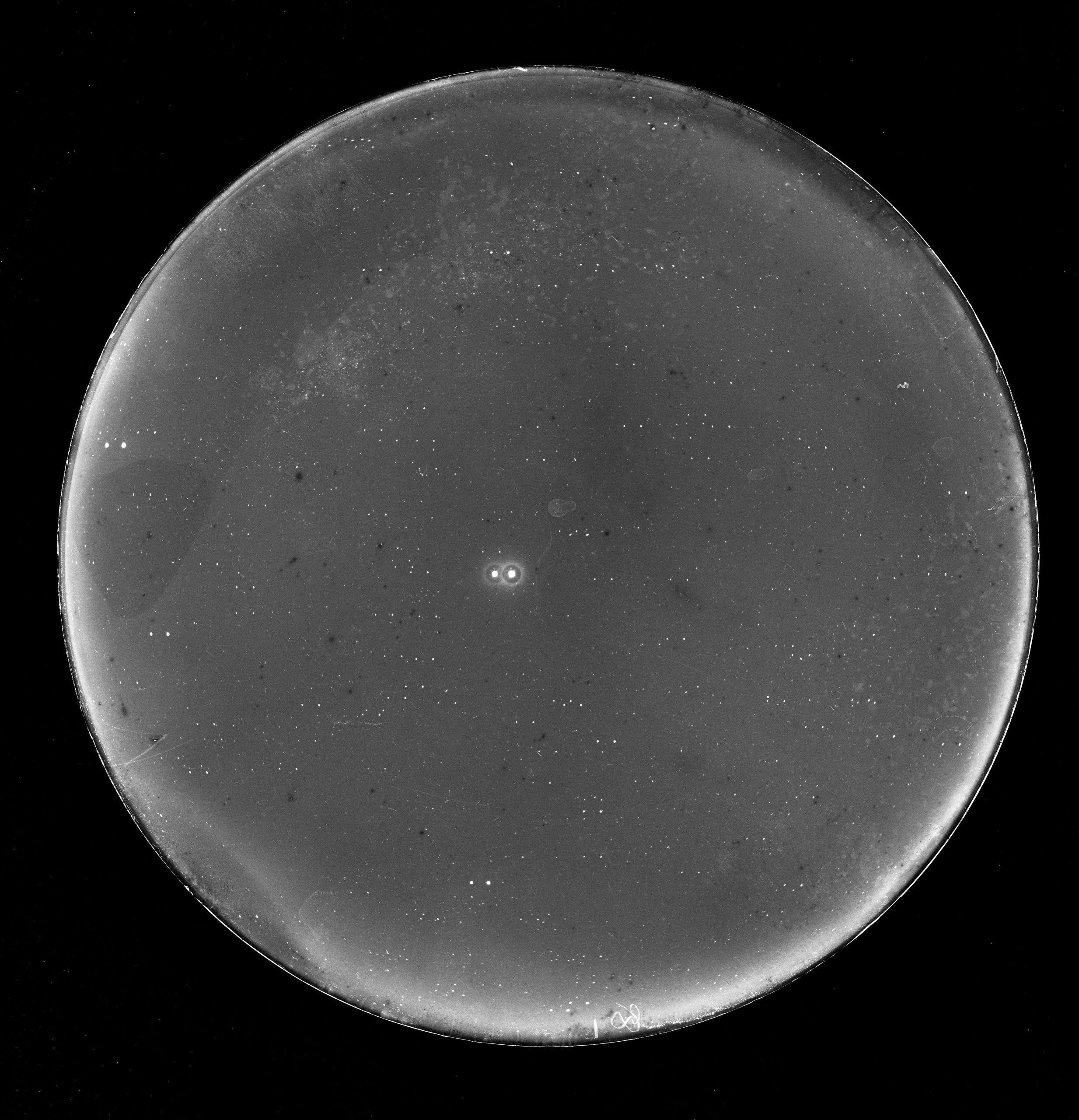
Li assembled a century’s worth of data alongside key new observations from the 6.5-meter (21-foot) Magellan Clay Telescope at Las Campanas Observatory in Chile and the 2.7-meter (8.9-foot) Harlan J. Smith Telescope at McDonald Observatory in Texas. Working with experts from more than a dozen institutions, including NASA’s Jet Propulsion Laboratory and IPAC at the California Institute of Technology, the team reached the sensitivity needed to attribute the wobble to variations on the stars’ surfaces over time. The analysis, supported in part by NASA, removed the need for a planet to explain that signal.
“Yiting assembled an absolutely huge amount of data from all over the world and carefully explored all possibilities,” said Michael Meyer, a senior co-author and chair of U-M’s astronomy department. “It’s a cautionary tale about how stellar activity can mimic planet signals using the radial velocity.”
Where Jupiter-mass planets are ruled out
Around 70 Oph A, the team ruled out planets at least as massive as Jupiter within 5 astronomical units of the star. Around 70 Oph B, that limit extends to half an astronomical unit. An astronomical unit is the distance between Earth and the Sun, so the findings exclude giant planets across a much wider region around the first star. For a system that has been linked to possible planets since the nineteenth century, those boundaries resolve part of a long-standing uncertainty.
“It’s a mix of disappointment and excitement,” Li said. “We’re finding out that there isn’t a Jupiter-sized planet, but we’re also opening the latest chapter on this historic system.”
Saturn-sized planets and smaller worlds could still occupy the system’s habitable zone because the study was not designed to detect them. Within that zone, temperatures could allow liquid water to persist on a rocky planet’s surface, making any such worlds potential targets for future observatories seeking evidence that life exists beyond Earth. Liquid water is a key ingredient for life as we know it, but this search cannot establish whether a rocky planet is there to hold it. “The study sets an upper limit, not a ban, on planets,” Li said.
Future missions eye 70 Oph AB
70 Oph AB offers a nearby place to explore how planets form, evolve, and potentially support life in surroundings different from our single-star solar system. Roughly half of the Milky Way’s stellar systems contain at least two stars, so understanding planets around stellar companions would address a common setting across the galaxy. The University of Michigan describes 70 Oph AB as Earth’s third-closest binary system, behind Alpha Centauri at 4.2 light-years and 61 Cygni at 11.4 light-years.
The two stars’ orbits are now also among the best characterized in the sky, giving astronomers firmer information to work with as they plan future observations.
“The new limit enables us to design optimum search strategies in the future,” Meyer said. “In fact, the University of Michigan is part of a team studying a space mission called SHERA that will focus on binaries, where this system is one of a handful of targets. 70 Oph AB will certainly be a target of flagship missions, such as NASA’s Habitable World Observatory.”
The two stars will keep circling each other as astronomers develop the observatories that could search their surroundings for smaller worlds.
“Given how prevalent planets are in our universe and in the Milky Way, I would wager that we’ll find there are other planets there,” Li said.
Reference: “A Century of Radial-velocity and Astrometric Monitoring of 70 Oph AB: New PFS Data and Constraints on Possible Planetary Companions*” by Yiting Li, Michael R. Meyer, Skylar D’Angiolillo, Stephen R. Kane, R. Paul Butler, Stephen A. Shectman, Eric E. Mamajek, Johanna Teske, Jack Lubin, Paul Robertson, Jessie L. Christiansen, Howard Isaacson, Caleb K. Harada, Bradford Holden, William D. Cochran, Michael Endl, Jennifer Burt, Juliette Becker, Alyssa Jankowski, Peter Tuthill, Catherine A. Clark, Rachael M. Roettenbacher, Eric Nielsen, Eduardo Bendek, Armen Tokadjian, William Roberson, Kaitlin M. Kratter, Edwin Bergin, Dave Osip, Jeffrey D. Crane, Alex Davis and Gautam Vasisht, 29 September 2026, The Astrophysical Journal.
DOI: 10.3847/1538-4357/ae9f52
Additional support for the research was provided by the Heising-Simons Foundation
Never miss a breakthrough: Join the SciTechDaily newsletter.
Follow us on Google and Google News.