
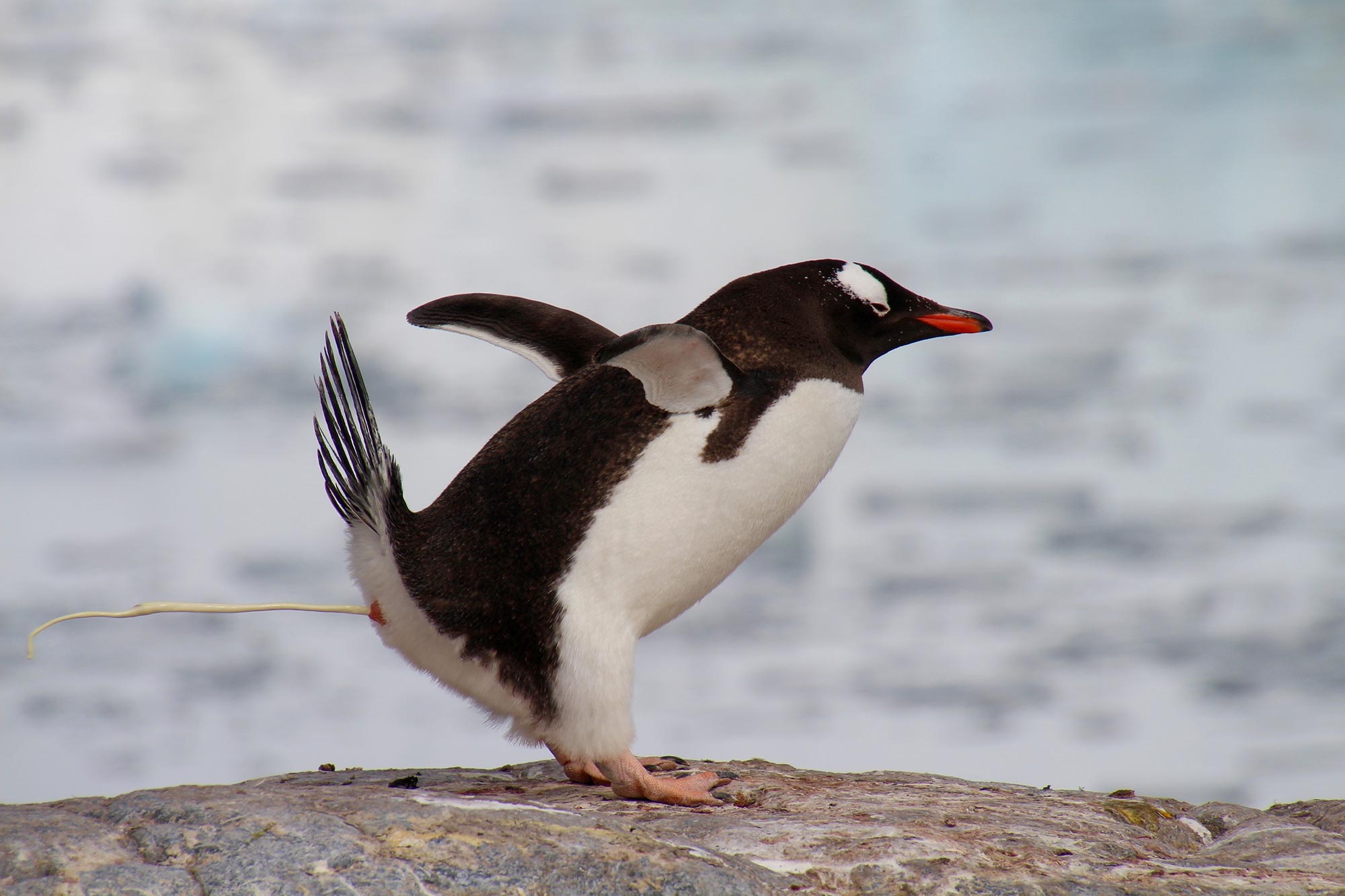
Penguins are playing an unexpected role in Antarctica’s changing landscape.
Penguin droppings are helping turn parts of Antarctica’s snowy coastline green, and the resulting algae blooms could be accelerating the loss of coastal snow. A new study has found that nutrients deposited by penguins support dense growths of microscopic algae that absorb more sunlight, potentially contributing to the expansion of ice-free areas along the Antarctic Peninsula.
The color of these blooms makes a substantial difference in how much solar energy the snow absorbs. Red algae-covered snow absorbs about 20% more sunlight than clean, white snow, while green snow absorbs roughly 40% more. As Antarctic coastal temperatures rise and suitable habitats expand, these biological changes could intensify local snowmelt.
Why Antarctic Snow Turns Green or Red
Snow algae can produce striking red or green patches across the Antarctic landscape, depending on their growing conditions. When nutrients are plentiful, the organisms produce chlorophyll and other green pigments that support photosynthesis, allowing them to grow rapidly during the short Antarctic summer.
Under harsher conditions or when nutrients become scarce, the algae shift toward a protective state. They produce red pigments that act like sunscreen, shielding their cells from intense sunlight while slowing growth. Researchers found that phosphate, a nutrient abundant in penguin droppings, helps explain why some snow algae remain green rather than entering this protective red stage.
Investigating the Connection Between Penguins and Snow Algae
To investigate this relationship, researchers collected red and green snow samples along the West Antarctic Peninsula, covering five degrees of latitude. Their sampling locations included coastal areas both with and without penguin colonies. The team traveled across the Drake Passage by boat before gathering algae-stained snow with ceramic spoons, sometimes working close to large accumulations of penguin droppings.
“[Penguin] poop can visually look similar to the red snow algae,” said Alia Khan, a cryosphere biogeochemist at the University of Colorado Boulder and senior author of the study. “It’s very stinky working near penguins. They’re just waddling around in their poop and tracking it all over the snow.”
Back in the laboratory, lead author Elise Ryan and colleagues examined the samples under microscopes to count algae cells and analyzed their pigments and nutrient concentrations. Snow dominated by green algae contained substantially more phosphate than samples dominated by red algae, providing evidence that nutrients from bird droppings help sustain the green blooms.
How the Ocean Fertilizes Antarctic Snow
Penguins acquire nutrients through their marine diets, then transport them onto land through their droppings. Other seabirds, including skuas, contribute to the same process, depositing nutrients (including phosphate) across coastal snow. These nutrients support algae growth in an environment where essential resources can be limited.
“This finding links the marine food web to snow ecology,” Khan said. “The penguin guano acts as a fertilizer… that fuels these dense green snow algae blooms.”
By supporting larger populations of actively growing green algae, this natural fertilization process can increase the amount of sunlight absorbed by coastal snow. The darkening effect could reinforce warming and melting already occurring in parts of Antarctica.
A Missing Factor in Antarctic Melting Predictions
“The link between wildlife, nutrients, and snow algae is a critical missing component in projections of expansion of ice-free areas in Antarctica,” said Khan, who began the research while at Western Washington University. “Without accounting for these biological darkening effects, we are likely underestimating how rapidly coastal snowpacks are melting and how fast ice-free terrain will expand across Antarctica.”
Penguin populations may also shift farther south as Antarctic conditions change, potentially bringing nutrient-rich droppings to additional snow algae habitats. Such changes could extend the influence of these blooms across a larger area, although their future extent and effect on melting remain uncertain.
Reference: “Phosphate Enrichment From Wildlife Inputs Shapes the Distribution and Pigmentation of Green and Red Snow Algae Along the West Antarctic Peninsula” by Elise L. Ryan and Alia L. Khan, 7 October 2026, Journal of Geophysical Research: Biogeosciences.
DOI: 10.1029/2026JG009918
Never miss a breakthrough: Join the SciTechDaily newsletter.
Follow us on Google and Google News.