

Rutgers’ research reveals the widespread presence of mercury pollution in Earth’s polar regions.
In 1962, environmentalist and author Rachel Carson published Silent Spring, warning the world about the dangers of the pesticide DDT. Her work drew attention to the reproductive harm it caused in birds, most notably the bald eagle, and inspired widespread environmental action.
Sixty years later, researchers at Rutgers University-New Brunswick are studying another global pollutant by drawing comparisons to the crisis Carson exposed. This time, the focus is on mercury, and the warning signs are coming from penguins inhabiting the remote regions of the Antarctic Peninsula.
“With mercury, there’s an analogy to DDT,” said John Reinfelder, a professor in the Department of Environmental Sciences at the Rutgers School of Environmental and Biological Sciences and co-author of a study published in Science of the Total Environment that examines mercury levels in these flightless, aquatic birds.
“In the 1960s, we were discovering DDT in remote places where it wasn’t being used,” Reinfelder said. “It’s a similar story today with mercury. There are no human sources near the Southern Ocean, but because of long-distance transport through the atmosphere, it has the potential to accumulate in penguins.”
Mercury’s toxic impact on wildlife and ecosystems
Mercury is a dangerous neurotoxin that bioaccumulates in aquatic and terrestrial food sources. Fish-eating animals are at the highest risk of contamination. Chronic exposure affects reproduction and can cause neurological problems, such as lethargy and weakness. It is fatal in high doses.
To assess mercury’s geographic reach and establish a new baseline for mercury in Antarctic penguins, Reinfelder and Philip Sontag, a postdoctoral researcher in the Department of Environmental Sciences at Rutgers–New Brunswick, and lead author, analyzed adult penguin feathers retrieved from a breeding site near Anvers Island in the West Antarctic Peninsula.
Comparing penguin species and feeding zones
Feathers from three penguin species – Adelie, gentoo, and chinstrap – were collected during the 2010-11 breeding season by William R. Fraser, lead investigator with the Polar Oceans Research Group, in Sheridan, Montana. Agricultural safety precautions prevented the samples from being sent to the U.S. for analysis until recently.
In addition to mercury, the Rutgers researchers measured the proportions of the isotopes carbon-13, a tracer of foraging location, and nitrogen-15, a tracer of food chain position, in the samples, which helped identify the sources of mercury in penguins throughout the Southern Ocean. They also assessed size distribution of West Antarctic Peninsula krill, a favorite food of Antarctic penguins.
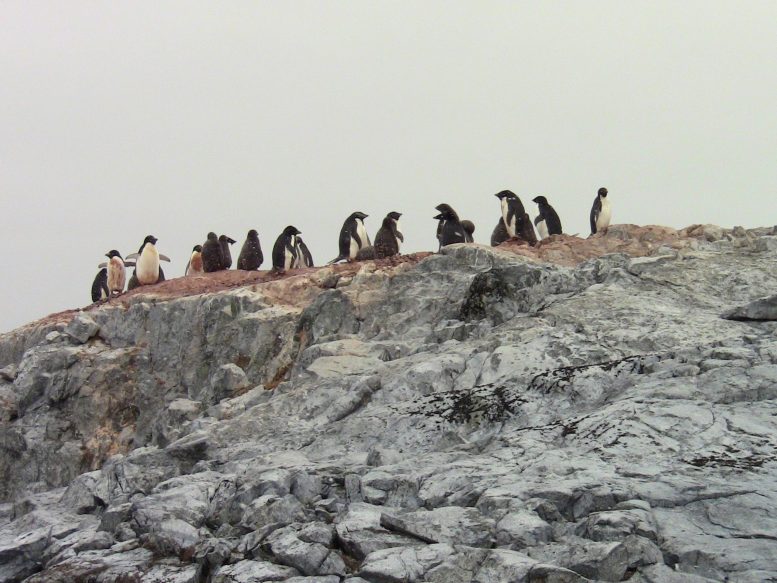
With the combined datasets, the researchers identified important variations in mercury accumulation. In Adelie and gentoo penguins, mercury levels “were some of the lowest for any species of penguin observed to date in the Southern Ocean,” they wrote. Levels of mercury for chinstrap penguins, however, were “significantly higher.”
Carbon isotopes reveal foraging behavior and exposure
Sontag said the discrepancy is likely because chinstrap’s feeding patterns differ from the other species studied. During the nonbreeding winter season, chinstraps migrate to lower latitudes farther north, where they and other penguins accumulate higher concentrations of mercury than penguins living to the south. This conclusion was confirmed by the strong relationship between foraging location (carbon-13) and mercury in penguin feathers and is the first study to show carbon-13, not nitrogen-15, best explains mercury concentrations in penguins throughout the Southern Ocean.
The granular details presented by these findings contribute to the global effort to map mercury pollution in marine animals, Reinfelder said.
“Before this study, we didn’t know that penguins migrating farther north had higher exposures to mercury,” he said. “These data give us a way to learn not only about mercury accumulation, but about penguin ecology more broadly.”
Changing sources of mercury pollution
Sources of mercury contamination have shifted in recent decades. For years, airborne mercury entered the atmosphere as a byproduct of coal-fired power plants.
Efforts to reduce mercury pollution – particularly with the Minamata Convention on Mercury adopted by 140 countries in 2013 – have helped lower releases to the environment. A 2024 study by researchers at the Massachusetts Institute of Technology found atmospheric levels of mercury dropped by about 10% between 2005 and 2020. The shuttering of coal-fired power plants has contributed to this decline.
But other sources, such as small-scale gold mining in developing countries, continue to push the toxin into the environment. Miners use elemental mercury to extract gold from ore, producing more than 1,000 tons of mercury tailings and vapor annually.
Reinfelder said the study offers a snapshot of how feeding patterns affect penguin health and how mercury pollution circulates in the world’s oceans.
“Just like DDT in the 1960s, the scientific community today is focused on monitoring mercury,” he said. “Are we going to see a decrease in levels in the fish that people and animals eat? That’s the hope.”
Reference: “Influence of migration range and foraging ecology on mercury accumulation in Southern Ocean penguins” by Philip T. Sontag, Linda V. Godfrey, William R. Fraser, Jefferson T. Hinke and John R. Reinfelder, 15 August 2024, Science of The Total Environment.
DOI: 10.1016/j.scitotenv.2024.175154
Never miss a breakthrough: Join the SciTechDaily newsletter.
Follow us on Google and Google News.
2 Comments
“Rutgers’ research reveals the widespread presence of mercury pollution in Earth’s polar regions.”
The article defines the areas of interest and then focuses on just Antarctica, which they acknowledge is farther away from anthropogenic sources than the Arctic. This is not a new discovery. There have been concerns about salmon and swordfish since at least the 1970s. What isn’t acknowledged is that mercury can be natural, such as in emissions from Black Smokers and buried terrestrial sediments in regions that undergone past vulcanism and tectonic activity. Unlike, DDT, it is not obvious what the source is for the mercury. Further complicating the problem is that the ‘mercury’ is usually in the form of organic mercury — methylmercury — which is usually produced by anaerobic bacteria in stagnant waters.
Two questions: 1) are there any pathologies demonstrated by the penguins or krill that can be attributed to mercury; and, 2) is there an analog in the Arctic, such as high methyl mercury in walruses that consume filter-feeding clams?
“Before this study, we didn’t know that penguins migrating farther north had higher exposures to mercury,”
Because methylmercury is produced biologically, one might expect that feeding in warmer waters would result in greater concentrations of mercury simply because chemical reactions and biological activity increase with increasing temperatures. This might be perfectly normal, just something that hadn’t been documented previously.
The authors also remark, “Mercury is a dangerous neurotoxin that bioaccumulates in aquatic and terrestrial food sources. Fish-eating animals are at the highest risk of contamination. Chronic exposure affects reproduction and can cause neurological problems, such as lethargy and weakness. It is fatal in high doses.”
This statement promises more than it can deliver. In fact, I think it would be fair to call it a ‘logical fallacy.’ Just because something CAN happen doesn’t mean that it WILL. The end result depends on the sensitivity of an organism and the individual members, the ability to sequester methylmercury in fat, and the rate and total dose received; the total dose may be related to the average longevity of individuals. That is, as with humans and cancer, individual penguins may die of other causes before they exhibit methylmercury pathologies.
What benchmarks did the researchers use to determine if this is a problem of concern? Are similar elevated levels observed in top-of-the-food-chain predators like Kodiak/brown bears, polar bears, walruses, and Arctic seals?
So many questions, so little time.