
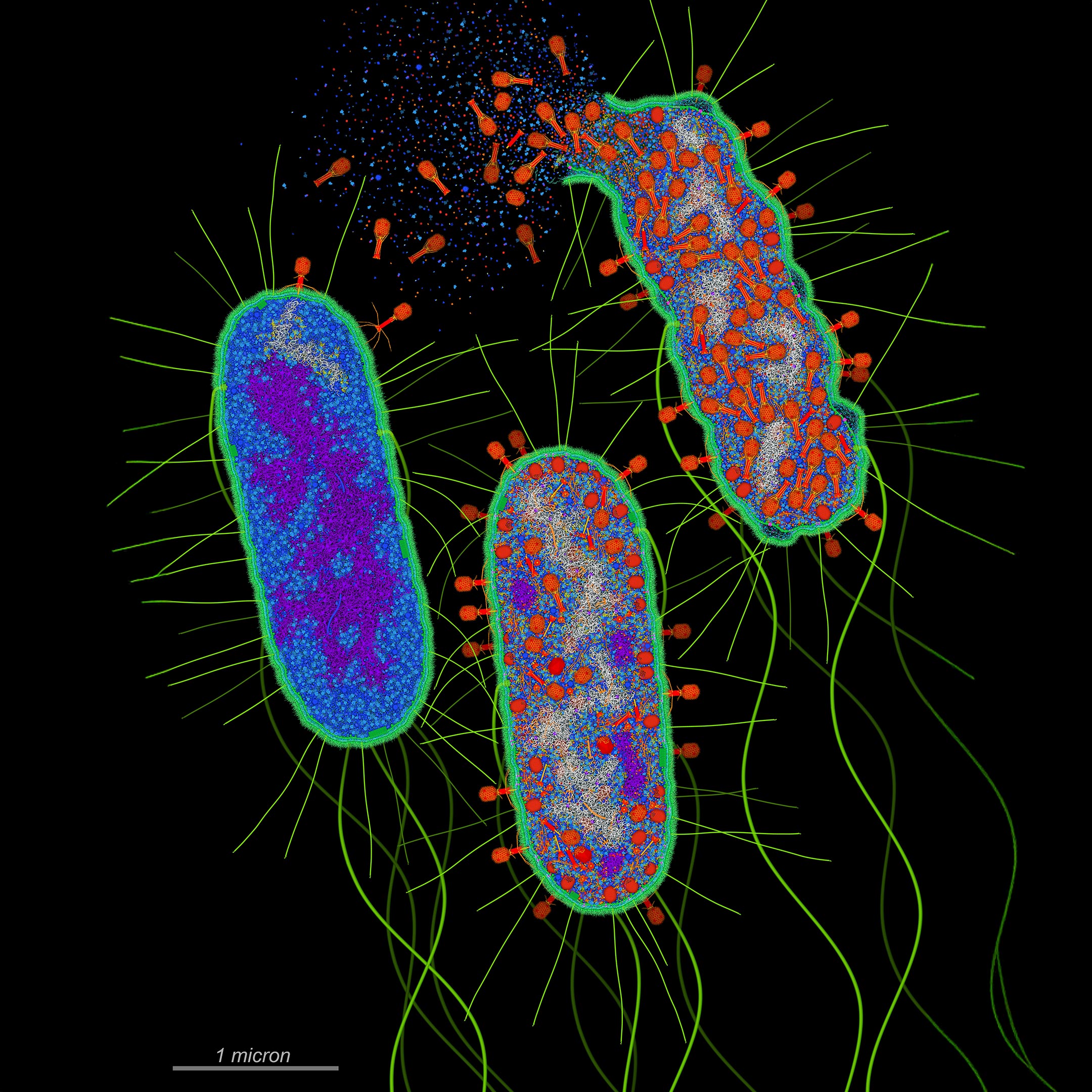
Researchers have found the trigger behind a powerful bacterial defense against viruses.
Viruses that prey on bacteria could become an increasingly important tool for treating bacterial infections, particularly as antibiotic resistance makes some infections harder to control. These viruses, known as bacteriophages (phages), can infect and destroy harmful bacteria without damaging human cells.
Using phages as treatments, however, comes with a major challenge. Bacteria are not defenseless against viruses. They possess their own immune systems, and understanding those defenses could help scientists design phage therapies that are better able to overcome them.
Researchers have now uncovered a surprising mechanism that bacteria use to recognize an incoming viral attack. Instead of simply sensing viral genetic material, bacteria can detect the activity of an enzyme the virus itself needs. When that viral enzyme cuts an important sensor molecule inside the bacterium, it sets off an immune response.
The discovery could ultimately help scientists develop more effective phage therapies capable of avoiding or overcoming bacterial immune defenses.
“This is one of the most common forms of bacterial immunity, so when we finally figured it out, it was a total eureka moment,” says Sam Hobbs, PhD, assistant professor of biochemistry at University of Utah Health and the first author on a paper describing the research.
The results are published in Science.

Bacteria’s Last Resort Against Viruses
The immune system involved is known as CBASS. When activated, it can trigger an extreme defensive strategy: the infected bacterium kills itself before the invading virus has a chance to multiply and spread into neighboring bacterial cells.
Because activating this response costs the bacterium its life, the system needs a reliable way to determine that a genuine viral attack is underway.
Hobbs and his colleagues found that the bacterial sensor responds to a molecule that the invading virus depends on for survival. Some phages produce enzymes called proteases, which cut and break down proteins.
“Certain kinds of phages have a protein called a protease, which degrades other proteins,” he explains. “We found that the protease from the phage actually acts directly on the host protein, and that is the signal that turns on the whole signaling pathway.”
In other words, the virus effectively reveals itself through one of the molecular tools it uses during infection. When its protease cuts the bacterial protein, that action serves as the warning signal that activates CBASS.
A Surprising Viral Trigger
The mechanism differs sharply from related antiviral defenses that recognize the genetic material of invading viruses. Rather than detecting viral DNA or RNA, this bacterial system senses the activity of a viral protein.
“This is a totally new mechanism for how these host proteins are activated,” Hobbs says. “I never would have guessed that this was the way it was going to work.”
Understanding this molecular trigger could be especially important for improving phage therapy. If researchers know exactly how bacteria recognize certain phages, they may be able to develop therapeutic viruses that are less likely to activate those defenses.
That could make bacteriophages more effective against harmful bacteria, including strains that have developed resistance to conventional antibiotics.
An Ancient Link to Human Immunity
The findings may also have implications beyond bacteria. CBASS is related to an immune pathway found in humans, suggesting that fundamental elements of this antiviral defense have extremely ancient evolutionary origins.
According to the researchers, the connection indicates that the pathway has existed at least since the distant common ancestor shared by bacteria and humans.
Bacteria also reproduce and evolve rapidly, making them useful systems for investigating basic questions about immunity. Scientists can study immune mechanisms in bacteria relatively quickly and then test whether similar principles apply in biological models that are more closely related to humans.
“The fact that these systems are conserved between bacteria and humans suggests that they’ve been maintained in these different organisms for that entire evolutionary trajectory,” Hobbs says. “The cells are telling us that this is a really important pathway because they’ve maintained it for billions of years. It’s incredibly fascinating, and it’s a cool window into what’s important in maintaining the ability to fight viruses.”
This research is published in Science as “Phage proteases activate CBASS antiphage immunity.”
Reference: “Phage proteases activate CBASS antiphage immunity” by Samuel J. Hobbs and Philip J. Kranzusch, 1 October 2026, Science.
DOI: 10.1126/science.aeg3949
This work was supported by the Pew Biomedical Scholars program, the Burroughs Wellcome Fund, the G. Harold and Leila Y. Mathers Foundation, the Cancer Research Institute (CRI3996), the Parker Institute for Cancer Immunotherapy, the Massachusetts Consortium on Pathogen Readiness, and the National Institute of General Medical Sciences of the National Institutes of Health (1DP2GM146250-01). Content is solely the responsibility of the authors and does not necessarily represent the official views of the National Institutes of Health.
Never miss a breakthrough: Join the SciTechDaily newsletter.
Follow us on Google and Google News.