
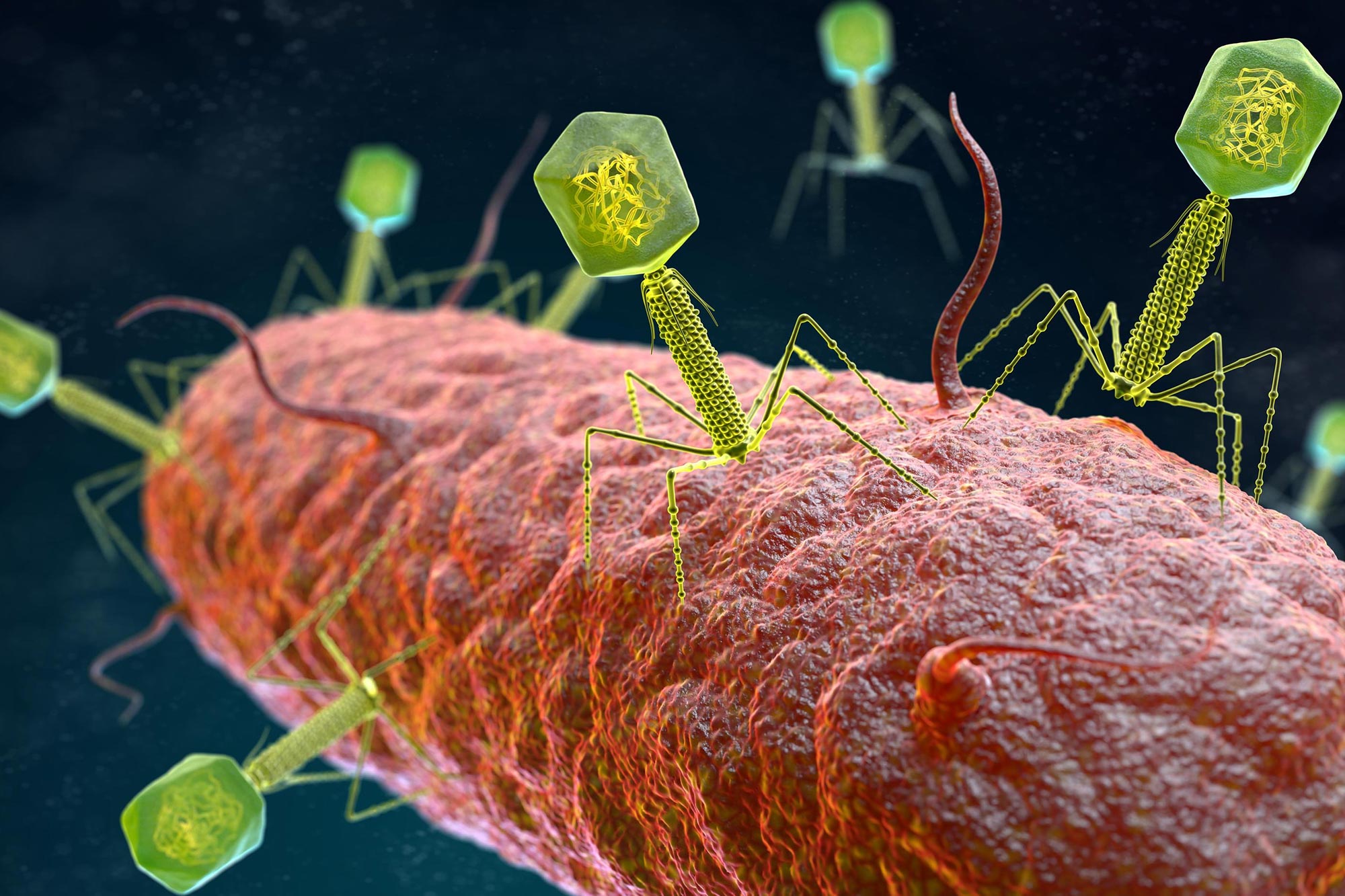
A new study reveals how a single species of bacteria can sustain a diverse community of phage species, with implications for designing effective phage therapies.
Researchers from NYU, Oxford, and Yale demonstrated that phages can coexist by exploiting different growth rates within a bacterial population, suggesting that multiple phages can be used together to prevent the development of resistance.
Viral “Social Lives” Key to Developing Phage Treatments for Bacterial Infections
Viruses that infect and kill bacteria, known as phages, show promise as treatments for dangerous infections, including antibiotic-resistant strains. However, scientists still understand little about how phages survive within bacterial populations, making it challenging to develop effective phage-based therapies.
A study published today (December 12) in the journal Science provides the first evidence that a single bacterial species can support a diverse community of competing phages. Researchers from NYU Grossman School of Medicine, Oxford, and Yale University discovered that multiple phage species can coexist within a genetically identical strain of E. coli, a bacterium commonly found in the human gut that includes both harmless and disease-causing variants.
Mechanisms of Phage Diversity
The researchers found that, despite competition between the viruses, different phage species preferred slower or faster-growing cells that randomly appeared in the population. In this way, each phage species was able to find a separate niche on the same host, leading to stable coexistence.
Lack of local access to nutrients (starvation), for instance, may slow the growth of some cells to preserve scarce resources. In the current study, two species of phage, labeled N and S, co-existed because N was more fit to survive in fast-growing bacterial cells, while phage S was better in slow-growing cells.
Designing Effective Phage Therapies
The designers of phage therapies hope to avert the problem in treatment with antibiotics, where a certain drug kills bacteria but leaves alive the fraction that by chance are the most resistant to that drug’s mechanism of action. These survivors are a major concern because they have become resistant to available treatments.
“Knowing how more than one kind of phage can survive over time on a single bacterium could help in designing next-generation phage cocktails,” said first study author Nora Pyenson, PhD, a post-doctoral scholar in the lab of co-author Jonas Schluter, PhD, of the Institute of Systems Genetics at NYU Langone Health. “For example, each phage species might attack the bacterium in a different part of its lifecycle and enabling the whole population to be killed before resistance to the treatment evolves.”
“No phage therapies have yet become standard treatments for bacterial infections, either because in past attempts a single phage did not kill all the targeted bacteria or because the bacteria evolved to be resistant, similar to the evolution of antibiotic resistance,” adds Dr. Pyenson.
Phage Therapy in Clinical Trials
Labs are already testing phage treatments as an alternative to antibiotics. A co-author of the current paper, Paul Turner, PhD, at Yale University, for instance, leads a clinical trial that uses phages against the species Pseudomonas aeruginosa, which can contribute to severe inflammation in the lungs of patients with cystic fibrosis. Dr. Schluter’s lab is studying the role of phages in the gut ecosystem of humans and mice that could shape future therapies for infections like Salmonella. A main goal is to anticipate the impact of phage administration and design phage therapies that, unlike current versions that must be tailored to a single patient, work universally across many patients.
Phage Ecology and Viral Diversity
Understanding species diversity is a fundamental question in ecology and evolutionary biology. A major factor enabling diversity, from birds to plants to bacteria, is that species find ways to coexist while still competing for resources. However, viruses were not traditionally thought of in this “social” context.
The current research team experimentally tested the long-held assumption that the genetic diversity of bacteria limits the diversity of viral species. This led to an expectation that one phage type would outcompete all others to be the lone survivor. However, just as multicellular organisms host a wide array of bacterial species within their microbiome, the new results show that a single bacterial strain can, itself, host a diverse community of phage species.
“Our study contributes to the burgeoning field of studying the social lives of viruses,” adds Dr. Pyenson. “We often think of viruses purely in terms of their impact on the host, but they also exist in the context of other viral species. These phage communities show how diversity emerges even among the simplest bits of biology.”
Impact on Health and Disease
Interestingly, the presence of a diverse population of bacteria in the human gut is a sign of health, as the diverse set of species (microbiome) is better able to resist attempts at dominance by any invading, disease-causing species. By the same token, the population of viruses occupying the bacteria that live in the gut is also emerging as an important regulator of health, with abnormal phage mixes thought to contribute to conditions like sepsis.
“This work represents a shift in our understanding of phage ecology,” said Dr. Schluter, also a professor in the Department of Microbiology at NYU Langone. “Thanks to Nora’s work, which she carried through a pandemic and across four labs, we can now begin to understand the evolution of phages when they are in community with diverse viral species and how this shapes their role in health and disease.”
Reference: “Diverse phage communities are maintained stably on a clonal bacterial host” by Nora C. Pyenson, Asher Leeks, Odera Nweke, Joshua E. Goldford, Jonas Schluter, Paul E. Turner, Kevin R. Foster and Alvaro Sanchez, 12 December 2024, Science.
DOI: 10.1126/science.adk1183
Along with Drs. Pyenson and Schluter at NYU Langone, and Dr. Turner at Yale, study authors were Asher Leeks and Odera Nweke in the Department of Ecology and Evolutionary Biology at Yale University; Joshua Goldford in the Division of Geological and Planetary Sciences at the California Institute of Technology in Pasadena; Kevin Foster in the Department of Biology at the University of Oxford; and Alvaro Sanchez of the Institute of Functional Biology & Genomics, CSIC & University of Salamanca in Spain. Drs. Foster and Sanchez were corresponding authors alongside Dr. Pyenson.
Funding for parts of the work was through the Life Science Research Foundation and the Simons Foundation provided to Dr. Pyenson, and through a New Innovator Award to Dr. Schluter (DP2AI164318) from the National Institute of Autoimmune and Infectious Diseases, part of the National Institutes of Health.
Never miss a breakthrough: Join the SciTechDaily newsletter.
Follow us on Google and Google News.