
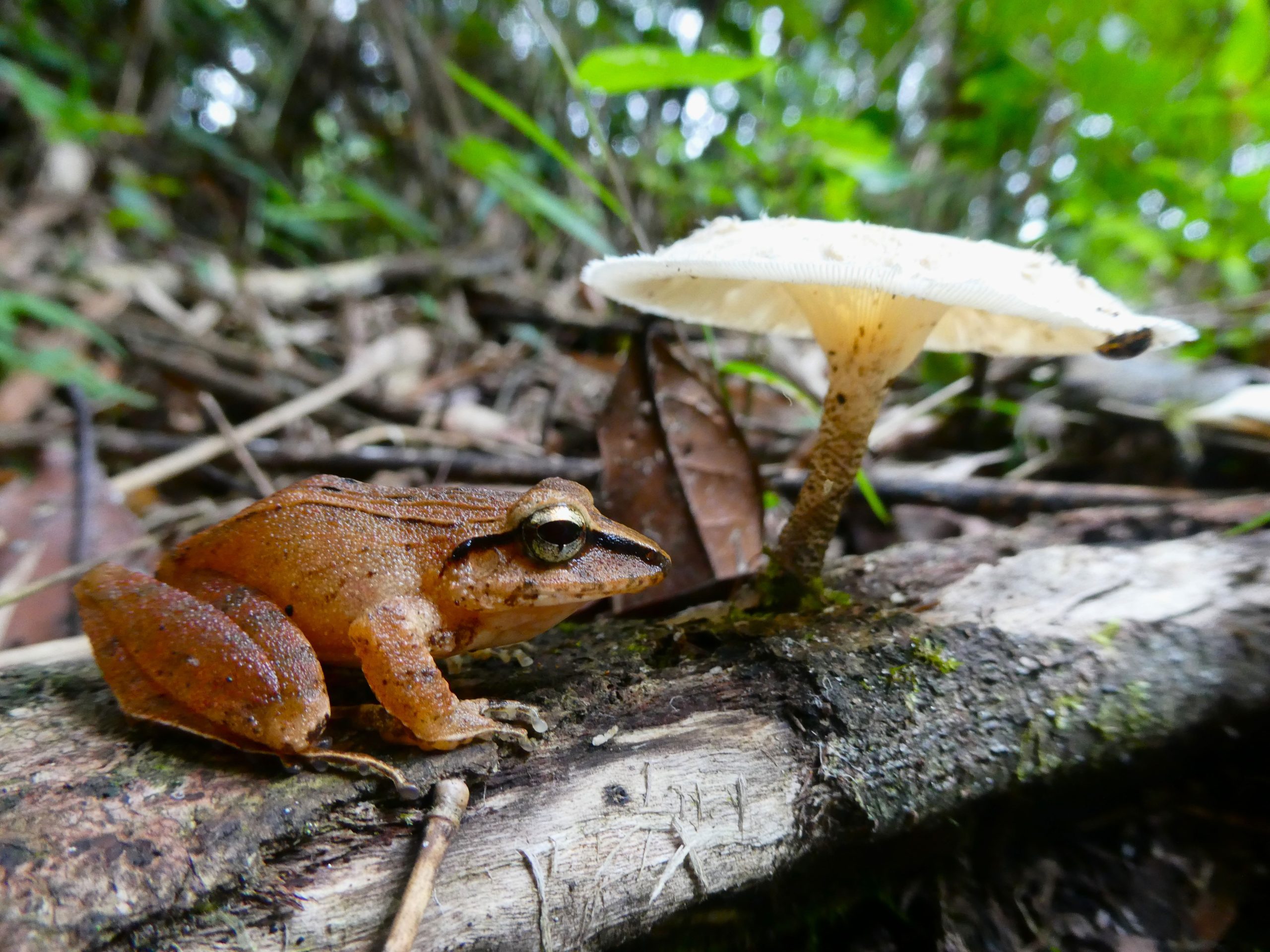
Museum specimens are helping scientists trace a deadly fungus linked to mysterious frog disappearances in Brazil nearly half a century ago.
Frog species that escaped a wave of population declines in Brazil carried widespread infections with a deadly fungus. Yet museum specimens from the species that suffered the steepest losses showed no detectable infection.
These findings come from an investigation that points to amphibian chytridiomycosis, commonly called chytrid, as the likely cause of die-offs at Boracéia Biological Station between 1979 and 1982.
Caused by the microscopic fungus Batrachochytrium dendrobatidis, the disease can have very different consequences for different species. Scientists at the Center for Conservation Genomics at the Smithsonian’s National Zoo and Conservation Biology Institute (NZCBI) and Pennsylvania State University (PSU) reported their findings in Molecular Ecology.
The preserved amphibians came from collections made at Boracéia by William Ronald Heyer, a former curator of amphibians and reptiles, and held at the Smithsonian’s National Museum of Natural History. The researchers suspect that differences in susceptibility could explain why the species hit hardest left no detectable infections in the specimens available for testing.
“It’s important to keep in mind that not all species suffered catastrophic losses at Boracéia,” said Jack Boyette, an NZCBI graduate fellow and doctoral candidate at PSU who led the study. “The species that didn’t decline may have naturally tolerated the fungus, allowing them to become infected without suffering mass mortality. By contrast, the species that declined most dramatically may have been so susceptible that infected frogs died before Heyer could collect them.”
The timing points to chytrid
Comparing collection dates revealed a different pattern. Tests detected no chytrid infection in specimens collected before 1979, whereas more than half of those collected during the 1980s tested positive. Evidence of the fungus therefore appeared around the period when amphibians were disappearing.
The comparison covered more than 370 museum specimens representing 17 species. Heyer had collected them during five field campaigns, two in the 1970s before the sudden declines and three in the 1980s afterward. That record allowed the NZCBI researchers to investigate both the pathogen’s arrival and changes in how commonly it infected amphibians.
Climate change and extreme weather had previously been proposed as explanations for Boracéia’s losses.
“While environmental factors could have played a role, our findings most directly implicate the chytrid fungus, revealing that regional invasion of the pathogen coincided with these unexplained amphibian disappearances,” Boyette said.
The infection timeline, considered alongside the differences among species, suggests that the fungus spread rapidly through a community of amphibians that had not previously encountered it. Establishing such a history is difficult when the suspected pathogen was unknown at the time of the deaths.
Researchers began observing drastic amphibian declines across Brazil’s Atlantic Forest, a global hotspot of frog biodiversity, in the 1970s. Chytrid is believed to have originated in Asia and likely spread worldwide during the 1970s and 1980s, but scientists did not formally describe the fungus until 1999. By then, catastrophic population losses had pushed hundreds of amphibian species around the world to the brink of extinction or beyond.
“After almost 50 years, we still aren’t confident what caused many historical amphibian die-offs, making these declines some of the most enduring cold cases in wildlife epidemiology,” Boyette said.
Signs of recovery despite persistent chytrid
To see how Boracéia’s amphibians were faring decades later, the team made six visits between 2022 and 2024, working with researchers from the University of São Paulo. They located 12 of the 17 species represented in Heyer’s collection. The other five remain unaccounted for. Their absence raises the possibility that they have disappeared locally, although their fate is still uncertain.
Most amphibian species at the station now appear to have recovered since the early 1980s, despite continued chytrid infections. The researchers interpret modern infection patterns as evidence that widespread tolerance has evolved among species that previously declined, likely helping them persist and recover. DNA collected from museum samples is now being used to investigate the genomic mechanisms that shaped these amphibians’ historical responses to the fungus.
Filling gaps in chytrid’s history
Boracéia provides evidence from one site, and the researchers caution against extending its findings to the Atlantic Forest as a whole. The approach nevertheless offers a model for investigating other historical outbreaks, particularly those that unfolded before scientists recognized the disease involved.
“Museum collectors could not have anticipated how important their collections would be to our modern conservation challenges, but without them, we would never be able to detect pathogens that went unnoticed for decades and reconstruct disease outbreaks that would otherwise remain a mystery,” said Michael Campana, a genomicist at NZCBI who participated in the study.
Other ongoing projects aim to fill gaps in historical specimen records using ancient environmental DNA, genetic material preserved in the environment. Together with research on museum samples, these efforts seek to reconstruct chytrid’s emergence, spread, and effects over the past century, building a clearer picture of its toll on biodiversity.
Reconstructing past outbreaks may also help researchers anticipate the consequences of emerging fungal threats. Another pathogen, B. salamandrivorans, is already threatening salamanders in Europe and could pose a serious risk to salamander populations in North America.
Reference: “Overcoming Detection Lag in a Cryptic Panzootic: Chytrid Invasion Linked to Historically Enigmatic Amphibian Declines in the Brazilian Atlantic Forest” by Jack L. Boyette, Tamilie Carvalho, David Rodriguez, Wesley J. Neely, Daniel Medina, Renato A. Martins, Robert J. Ossiboff, Zaira Gomez, William C. Vuyk, Shannon M. Buttimer, Karen A. Paniagua Torres, Ananda Brito de Assis, Carlos A. Navas, Carly R. Muletz-Wolz, Michael G. Campana, Corinne L. Richards-Zawacki and C. Guilherme Becker, 14 October 2026, Molecular Ecology.
DOI: 10.1111/mec.70573
Never miss a breakthrough: Join the SciTechDaily newsletter.
Follow us on Google and Google News.