
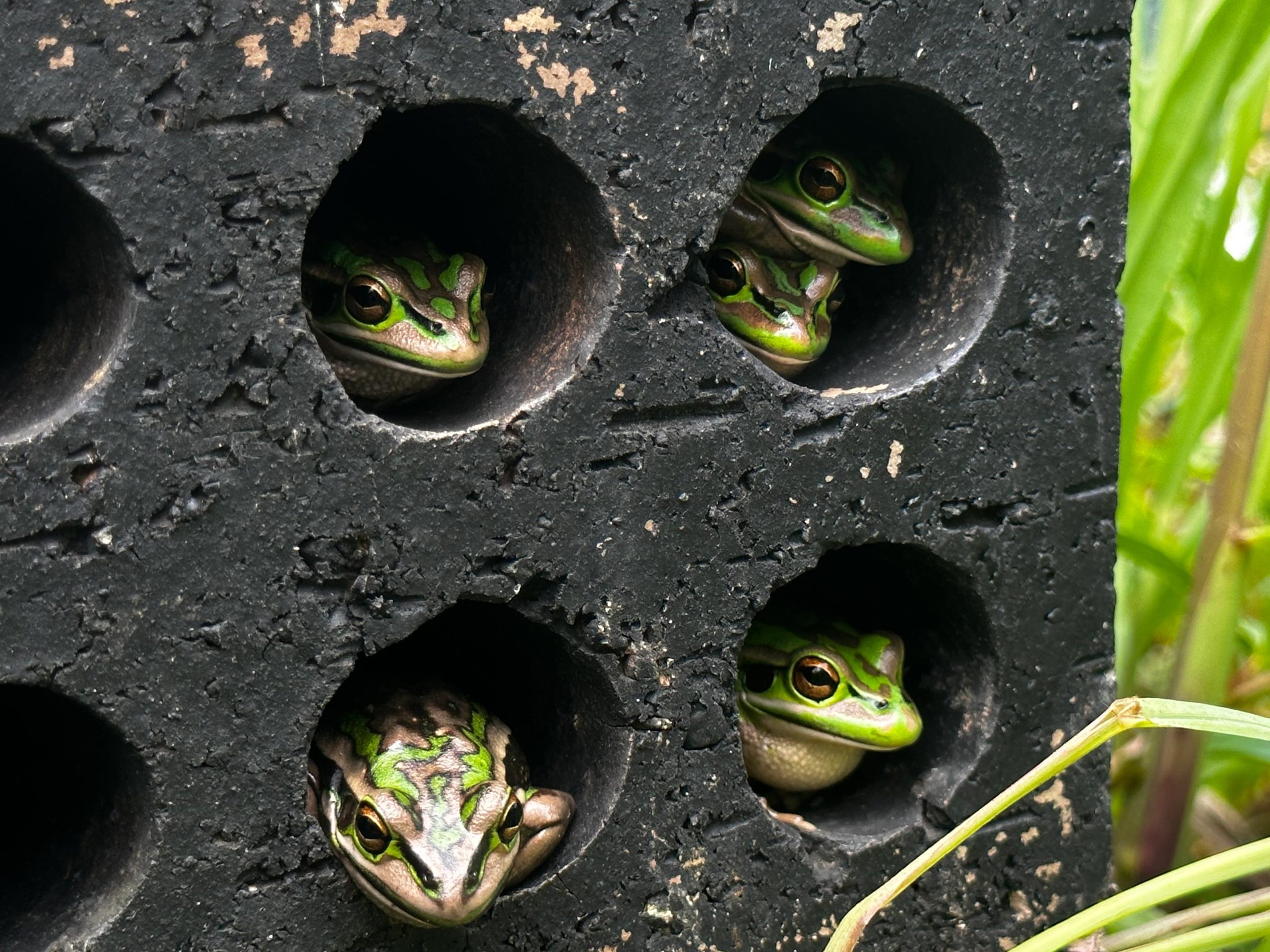
A novel conservation method employing “frog saunas” helps green and golden bell frogs fight off the lethal chytrid fungus by raising their body temperatures.
Successful trials in both controlled and natural environments suggest this technique could significantly aid in conserving this species.
Impact of Chytrid Fungus on Amphibians
As global diversity continues to decline due to a range of factors, amphibians have been particularly hard hit by infectious diseases. A pernicious fungal disease called chytridiomycosis, more commonly shortened to “chytrid,” has led to the extinction of 90 species of amphibians and has pushed another 500 species into decline.
New research, though, offers hope in the form of “frog saunas.” Imagine not a traditional wood sauna beloved by Finns and Estonians, but rather a large, sun-heated brick structure with cubby holes where frogs can find refuge from colder weather. During winter, chytrid hits frogs harder, and the researchers speculated that if green and golden bell frogs were given an opportunity to get warmer in artificial saunas, they would take it. It turns out not only would they take the opportunity, raising their body temperature helped them clear the infection as well.
Frog Saunas: A Novel Conservation Strategy
Experiments were carried out in both lab and natural settings, where the frogs had both shaded and unshaded options and no inducement to access the saunas. But they took to the saunas like Finns in winter. The researchers also found that frogs that were initially infected and then fought off the infection after spending time in the sauna were significantly less likely to be reinfected.
The paper, “Hotspot shelters stimulate frog resistance to chytridiomycosis,” was published in Nature. Of the 14 people listed as co-authors, 12 hail from Australia, where the research was conducted. The lone North American co-author is Erin Sauer, a postdoctoral fellow in biological sciences at the University of Arkansas.
Development and Impact of Thermal Gradients
In fact, the team’s work on frog saunas was inspired by Sauer’s previous research into how amphibian thermoregulatory behavior influences resistance to chytrid. For that study, done in 2018, Sauer designed thermal gradients she could keep frogs in for longer periods of time while measuring their thermal preferences.
In practical terms, this meant putting a Plexiglas lid on sections of aluminum gutter that had a heating element on one end and cooling element on the other, providing a range of temperatures in between the two ends. She ultimately found that species that preferred warmer temperatures were able to clear their infections when they hung out on the warmer parts of the thermal gradients.
“Anthony Waddle, the lead author on the Nature paper, got in touch with me because he wanted to build my thermal gradients in Australia and replicate my study with green and golden bell frogs,” Sauer explained. “So, I helped him design his setup and experiment in 2020-2021, and then helped with the data analysis for the lab study.
“Very similar to my 2018 study, we found that the green and golden bell frogs preferred warm temperatures and were able to better resist their chytrid infections at those warm temperatures. Anthony and his colleagues in Australia then applied the findings from the lab experiment to build the frog saunas and run the mesocosm experiment.”
Limitations and Applications of Amphibian Thermal Therapy
While the findings suggest that the general public can play a role in saving green and golden bell frogs from extinction by building low-cost saunas in gardens or wetlands, Sauer cautions that this will not help all species of frogs.
“My research has shown that while warm-adapted species have better disease outcomes at warm temperatures, cold-adapted species actually have worse outcomes at warm temperatures,” Sauer said. “My colleagues and I have termed this phenomenon the ‘thermal mismatch hypothesis’ and did a global study testing our hypothesis across systems a few years ago that was published in Science. So, unfortunately, the frog saunas won’t work for all species but work beautifully for the warm-preferring green and golden bell frogs.”
For more on this research, see Frog ‘Saunas’ – Pandemic Protection for Endangered Frogs Facing a Deadly Global Fungus.
Reference: “Hotspot shelters stimulate frog resistance to chytridiomycosis” by Anthony W. Waddle, Simon Clulow, Amy Aquilina, Erin L. Sauer, Shannon W. Kaiser, Claire Miller, Jennifer A. Flegg, Patricia T. Campbell, Harrison Gallagher, Ivana Dimovski, Yorick Lambreghts, Lee Berger, Lee F. Skerratt and Richard Shine, 26 June 2024, Nature.
DOI: 10.1038/s41586-024-07582-y
Never miss a breakthrough: Join the SciTechDaily newsletter.
Follow us on Google and Google News.