
Close Menu
    Facebook X (Twitter) Instagram
    SciTechDaily
    • Biology
    • Chemistry
    • Earth
    • Health
    • Physics
    • Science
    • Space
    • Technology
    Facebook X (Twitter) Pinterest YouTube RSS
    SciTechDaily
    Home»Biology»Suburbanization, Estrogen Contamination is Changing the Amphibian Populations
    Biology

    Suburbanization, Estrogen Contamination is Changing the Amphibian Populations

    By Jim Shelton, Yale University; Photo by Geoff GillerSeptember 9, 2015No Comments3 Mins Read
    Facebook Twitter Pinterest Telegram LinkedIn WhatsApp Email Reddit
    Share
    Facebook Twitter LinkedIn Pinterest Telegram Email Reddit
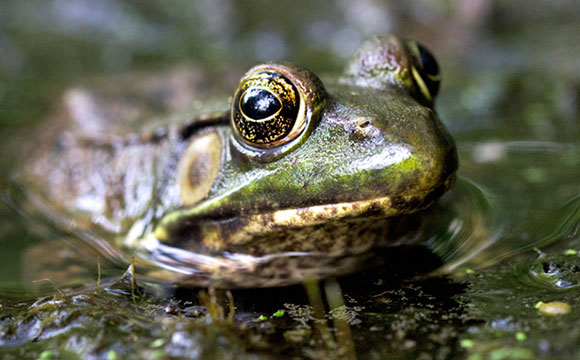
    Estrogen Contamination is Changing the Amphibian Populations
    Estrogen in suburban yards is changing the ratio of male and female green frogs at nearby ponds.

    New research from Yale University reveals that estrogen in suburban yards is changing the ratio of male and female green frogs at nearby ponds.

    Green frogs in the suburbs are seeing a gender revolution. Higher levels of estrogen in areas where there are shrubs, vegetable gardens, and manicured lawns are disrupting frogs’ endocrine systems, according to a new study. That, in turn, is driving up the number of female frogs and lowering the number of male frogs.

    The research appears in the journal Proceedings of the National Academy of Sciences. It is based on tests conducted at 21 ponds in southwestern Connecticut in 2012.

    Previous studies have shown similar effects caused by agricultural pesticides and wastewater effluent; the new study finds amphibian endocrine disruption also exists in suburban locales.

    “In suburban ponds, the proportion of females born was almost twice that of frog populations in forested ponds,” said lead author Max Lambert, a doctoral student at the Yale School of Forestry & Environmental Studies. “The fact that we saw such clear evidence was astonishing.”

    David Skelly, the Frank R. Oastler Professor of Ecology at Yale and director of the Yale Peabody Museum of Natural History, is the senior author of the study.

    The researchers looked at ponds with varying degrees of suburban neighborhood impact — with entirely forested ponds at one end of the spectrum, and ponds that were heavily surrounded by suburbia at the other end. The sites included ponds linked to both septic systems and sewer lines. In many cases, the researchers needed to obtain permission from homeowners to survey their back yards.

    “Our work shows that, for a frog, the suburbs are very similar to farms and sewage treatment plants,” Lambert said. “Our study didn’t look at the possible causes of this, partly because the potential relationship between lawns or ornamental plantings and endocrine disruption was unexpected.”

    Lambert noted that some plants commonly found in lawns, such as clovers, naturally produce phytoestrogens. The simple act of maintaining a lawn, in other words, maybe one source of the contamination.

    There also are possible implications for other species that use suburban ponds, note the researchers. Those species include other amphibians, such as wood frogs, spring peepers, gray tree frogs, and salamanders, as well as birds, turtles, and mammals.

    “Some of our lab’s current work is trying to understand how the suburbs influence sexual development in other species,” Lambert said.

    Additional co-authors of the study are Peabody Museum research assistants Geoffrey Giller and Larry Barber, and Kevin Fitzgerald of the U.S. Geological Survey.

    Reference: “Suburbanization, estrogen contamination, and sex ratio in wild amphibian populations” by Max R. Lambert, Geoffrey S. J. Giller, Larry B. Barber, Kevin C. Fitzgerald and David K. Skelly, 22 January 2015, PNAS.
    DOI: 10.1073/pnas.1501065112

    Never miss a breakthrough: Join the SciTechDaily newsletter.
    Follow us on Google and Google News.

    Amphibians Ecology Environmental Science Estrogen Frogs Yale University
    Share. Facebook Twitter Pinterest LinkedIn Email Reddit

    Related Articles

    Many More Amphibian Species at Risk of Extinction

    Researchers Reveal Human Threats to the Amphibian Tree of Life

    New Research Shows Suburbanization Alters Small Pond Ecosystems

    Study Projects How Climate Change Will Affect the Functions Birds in Ecosystems Worldwide

    Preserved Frogs May Hold Past Clues About Batrachochytrium Dendrobatidis

    Evolution Shapes Ecology of Dammed Connecticut Lakes

    “Map of Life” to Illustrate All Living Things Geographically

    Poisonous Dendrobatidae Frogs are Aposematic Organisms and Critically Endangered

    New Frog Species Discovered Living in New York and New Jersey

    Leave A Reply Cancel Reply

    • Facebook
    • Twitter
    • Pinterest
    • YouTube

    Don't Miss a Discovery

    Subscribe for the Latest in Science & Tech!

    Trending News

    Scientists Just Discovered a Hidden Freshwater World Beneath the Great Salt Lake

    Why Your Daily Shower Could Be Worsening the Water Crisis

    Scientists Discover New “Magic Mushroom” Species That Rewrites Evolutionary History

    Mystery Deepens: Astrophysicists Say Dark Matter May Not Be One Thing

    Your BMI Might Be Wrong: Study Finds Millions Are Misclassified

    A Simple Blood Test Could Predict Dementia Risk 25 Years Early

    3.5-Billion-Year-Old Rocks Rewrite the Story of Plate Tectonics

    Why Aging Lungs Turn Mild Infections Into Life-Threatening Illness

    Follow SciTechDaily
    • Facebook
    • Twitter
    • YouTube
    • Pinterest
    • Newsletter
    • RSS
    SciTech News
    • Biology News
    • Chemistry News
    • Earth News
    • Health News
    • Physics News
    • Science News
    • Space News
    • Technology News
    Recent Posts
    • This Alga Rewrites the Rules of Photosynthesis To Survive in the Dark
    • Are Humans Naturally Violent? Scientists Challenge Long-Held Assumptions
    • Scientists Say This Popular Food Could Help Your Body Get Rid of Microplastics
    • Scientists Build Five-in-One “Super Molecule” for Next-Gen Electronics
    • Physicists Discover Magnetic Mechanism That Challenges a 300-Year-Old Law of Friction
    Copyright © 1998 - 2026 SciTechDaily. All Rights Reserved.
    • Science News
    • About
    • Contact
    • Editorial Board
    • Privacy Policy
    • Terms of Use

    Type above and press Enter to search. Press Esc to cancel.