
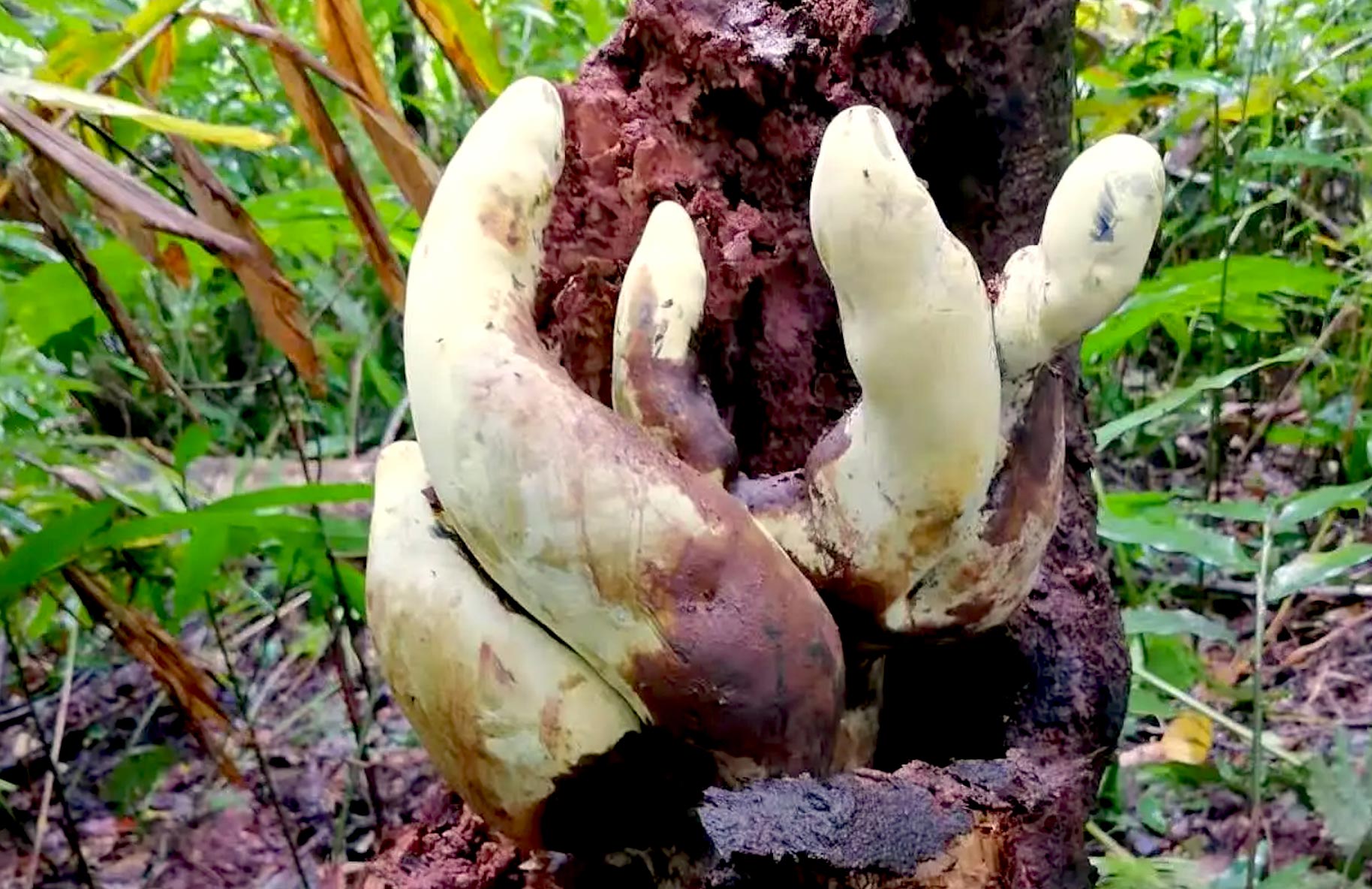
A newly discovered giant fungus belongs to a previously unknown family that may have emerged around 65 million years ago, shortly after the mass extinction that killed the non-avian dinosaurs.
A fungus discovered in China’s Yunnan forests produces whitish, spore-bearing structures up to 50 centimeters (about 20 inches) tall and weighing as much as 2.2 kilograms (4.9 pounds). The newly described species, Dianjunus rex, has the largest known fruiting bodies in the fungal phylum Ascomycota, surpassing previous record holders that stood 20 to 30 centimeters (about 8 to 12 inches) tall.
Ascomycota is the largest group of fungi, with more than 64,000 species. Its members, called ascomycetes, do not grow true mushrooms. Instead, they release spores from tiny, sac-like structures inside or on the surfaces of their fruiting bodies. For D. rex, producing such large reproductive structures could offer an advantage in a crowded forest, although the researchers have not established why it grows so big.
“A fruiting body which towers above surrounding vegetation and debris could have better dispersal of spores by wind in dense forests. However, such a large structure requires substantial energy investment, suggesting that this strategy likely evolved only where the ecological benefits outweighed the costs,” hypothesized Dr. Indunil C Senanayake, the study’s corresponding author and an associate professor at the Germplasm Bank of Wild Species of the Kunming Institute of Botany in China.
DNA reveals a new fungal family
Scientists from the institute encountered the fungus during fieldwork in temperate coniferous forests near Damaidi and Yipinglang and in tropical rainforest near Nanbang. Its upright fruiting bodies, known as stromata, grew on the woody roots of Chinese cork oak, emerging from the rhizosphere, the soil immediately surrounding the roots. Senanayake said, “The discovery illustrates how much fungus biodiversity remains to be discovered in East Asian forests.”
To investigate what they had found, the researchers collected fruiting bodies and deposited voucher specimens in the Kunming Institute of Botany’s collections. They grew spores on laboratory media to study the fungus’s form and structure and sequenced its genome, including its full set of protein-coding genes.
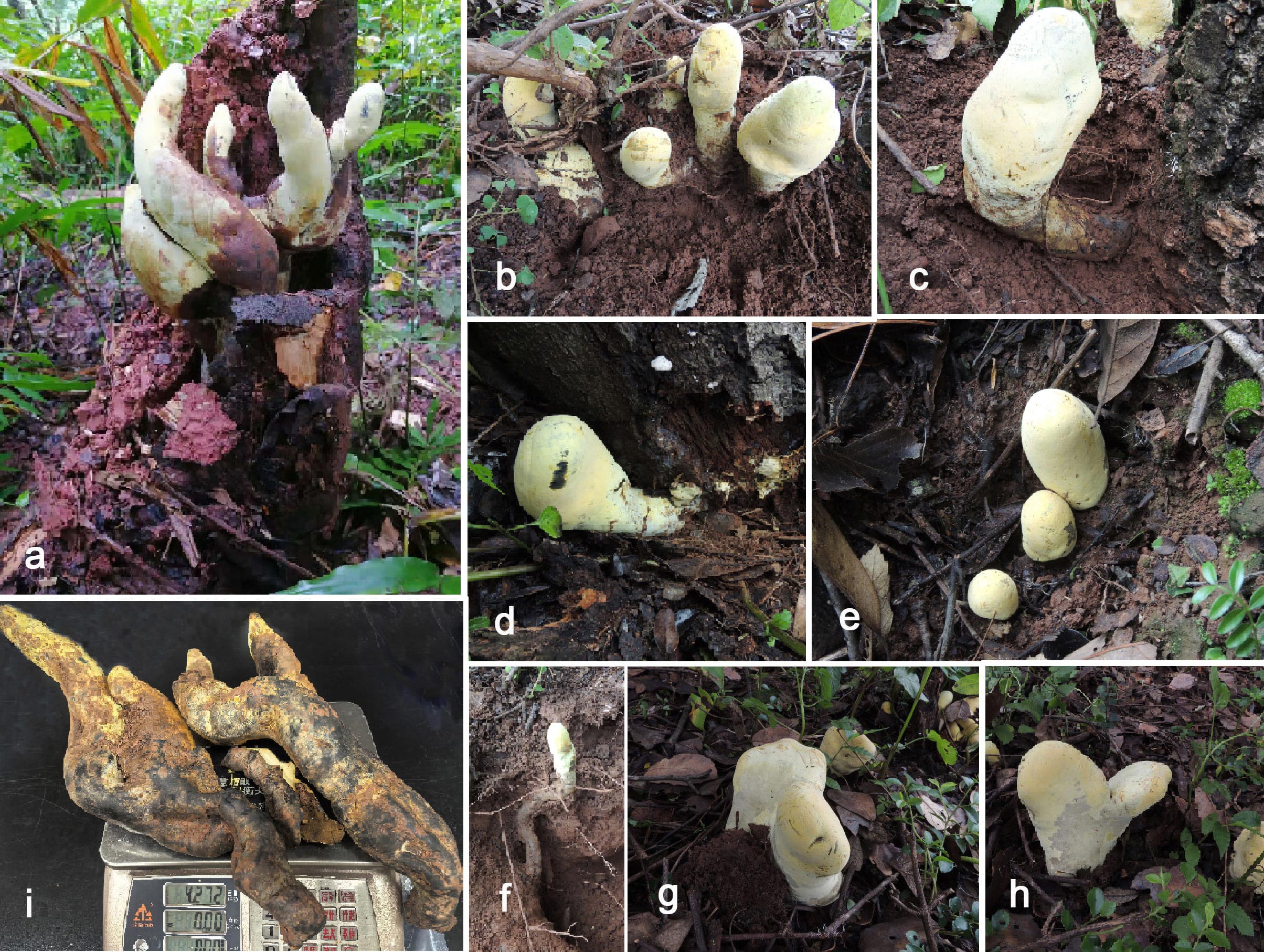
The genetic results, supported by the detailed examination of its morphology, established a new species and genus within the order Xylariales. The findings, published in Frontiers in Fungal Biology, also warranted recognition at a broader level of classification.
“This remarkable species represents a new fungal family, Dianjunaceae, and provides a rare window into the evolution of extreme fungal body forms,” said Senanayake.
The researchers chose the name Dianjunus rex for the fungus’s regal size and the ancient Dian kingdom. Its closest known relative, Graphostroma platystoma, grows on dead hardwood across the Northern Hemisphere and is itself the sole member of another family, Graphostromataceae.
Mass extinction may have favored wood-decomposing fungi
Other fungi in Xylariales are known for producing secondary compounds, chemicals beyond those essential for basic growth, as well as enzymes that break down complex plant molecules. Similar enzymes might help “D-rex” digest dead wood, a possibility that gives context to the researchers’ investigation of its evolutionary origins.
Using a molecular clock analysis, which estimates evolutionary timing from genetic differences, the team compared the new species’ DNA with genomes from hundreds of fungi with known evolutionary ages. The results suggested that the Dianjunaceae family arose around 65 million years ago, roughly one million years after the Cretaceous-Paleogene mass extinction. That event wiped out the non-avian dinosaurs and countless other animals and plants.
“This timing raises an intriguing possibility. After the mass extinction, forests experienced dramatic changes, including the sudden availability of large amounts of dead plant material,” said Senanayake. “For wood-associated decomposing fungi, such environmental disruption may have created new ecological opportunities.”
The researchers expect more fungal discoveries in subtropical China, where conditions favor diversification but finding and documenting species remains difficult.
“This region combines exceptional habitat heterogeneity, climatic stability, and complex biotic interactions that promote fungal diversification. Historically, however, fungal diversity in these ecosystems has been underestimated due to logistical difficulties in field sampling, the seasonal and cryptic nature of fungal fruiting, and a historical emphasis on economically important fungi,” said Senanayake.
Reference: “Unearthing a fungal giant: Dianjunaceae fam. nov., a novel Paleocene lineage of Xylariales harboring Dianjunus rex gen. et sp. nov” by Jing Song, Zhuyue Yan, Jesús Pérez-Moreno, Fengming Zhang, Shimei Yang, Tao Xie, Luofeng Su, Jianwei Liu, Yanliang Wang, Dong Liu, Zhenyan Yang, Chengmo Yang, Wei Liu, Xiaofei Shi, Shanping Wan, Ratchadawan Cheewangkoon, Dongqin Dai, Indunil C. Senanayake and Fuqiang Yu, 8 September 2026, Frontiers in Fungal Biology.
DOI: 10.3389/ffunb.2026.1940464
Never miss a breakthrough: Join the SciTechDaily newsletter.
Follow us on Google and Google News.