
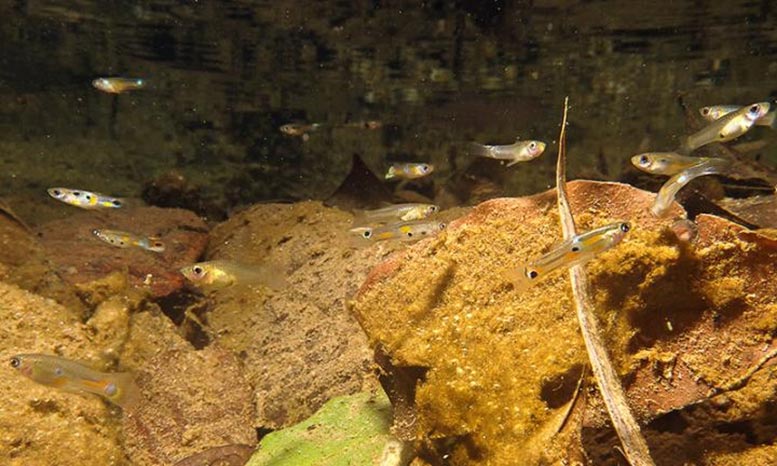
Guppies, a perennial pet store favorite, have helped a UC Riverside scientist unlock a key question about evolution: Do animals evolve in response to the risk of being eaten, or to the environment that they create in the absence of predators? Turns out, it’s the latter.
David Reznick, a professor of biology at UC Riverside, explained that in the wild, guppies can migrate over waterfalls and rapids to places where most predators can’t follow them. Once they arrive in safer terrain, Reznick’s previous research shows they evolve rapidly, becoming genetically distinct from their ancestors.
“We already knew that they evolved quickly, but what we didn’t yet understand was why,” Reznick said. In a new paper published in American Naturalist, Reznick and his co-authors explain the reason the tiny fish evolve so quickly in safer waters.
To answer their questions, the scientists traveled to Trinidad, the guppies’ native habitat, and conducted an experiment. They moved guppies from areas in streams where predators were plentiful to areas where predators were mostly absent. Over the course of four years, they studied how the introduced guppies changed in comparison to the ones from where they originated.
“If guppies evolve because they aren’t at risk of becoming food for other fish, then evolution should be visible right away,” Reznick said. “However, if in the absence of predators they become abundant and deplete the environment of food, then there will be a lag in detectable changes.”
Guppies from all four streams were marked so they could be tracked over the course of four years. The scientists tracked the males, which tend to live about five months. They looked at the fishes’ age and size at maturity, which are key traits affecting population growth.
“The new news is that organisms can shape their own evolution by changing their environment.” — David Reznick
They also tracked how the environment changed as the guppy populations expanded, focusing on the abundance of food such as algae and insects, as well as the presence of other nonpredator fish.
They found a two-to-three-year lag between when guppies were introduced and when males evolved, suggesting the second hypothesis was correct; guppies were first changing their new environments, and then as a result, they turned out to be changing themselves.
“The speed of evolution makes it possible to study how it happens,” Reznick said. “The new news is that organisms can shape their own evolution by changing their environment.”
One of Reznick’s current projects includes applying these concepts to questions about human evolution.
“Unlike guppies and other organisms, human population density seems to increase without apparent limit, which increases our impact on our environment and on ourselves,” he said.
###
Co-authors on this study included Ron Basser, a former doctoral student at UC Riverside and now assistant professor at Williams College; Joe Travis at Florida State University; Corey Handelsman, Cameron Ghalambor, Emily Ruell, and Julian Torres-Dowdall from Colorado State University; Tim Coulson and Tomos Potter of Oxford University, and Paul Bentzen of Dalhousie University in Canada.
Reference: “Eco-Evolutionary Feedbacks Predict the Time Course of Rapid Life-History Evolution” by David N. Reznick, Ronald D. Bassar, Corey A. Handelsman, Cameron K. Ghalambor, Jeff Arendt, Tim Coulson, Tomos Potter, Emily W. Ruell, Julián Torres-Dowdall, Paul Bentzen and Joseph Travis, 9 September 2019, American Naturalist.
DOI: 10.1086/705380
Never miss a breakthrough: Join the SciTechDaily newsletter.
Follow us on Google and Google News.