
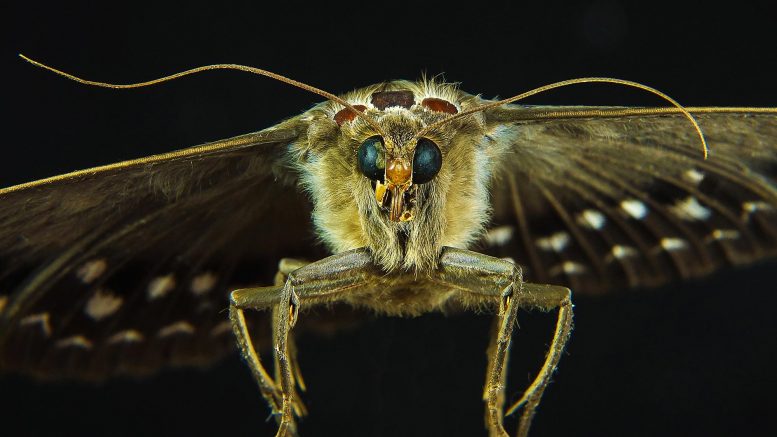
Scientists find that unappetizing moths make less effort to escape attacking bats.
You might think that prey would invariably flee in terror from a predator. But what if an animal was apathetic in the face of danger?
A new study in Frontiers in Ecology and Evolution published December 16, 2019, investigates why some moths are more relaxed fliers in the face of bat attacks. The research reveals that less appetizing moths are more nonchalant when attacked by bats, whereas more palatable moths tend to employ evasive maneuvers.
The work demonstrates the complex risks and rewards of anti-predator strategies where mistakes invariably mean death, and may let scientists predict the evasive behaviors of rare or even extinct species.
Many prey animals have evolved defense mechanisms to evade and deter potential predators. In moths, these include chemical defenses that make them less appetizing, ultrasonic hearing to hear bats coming, and mid-flight evasive maneuvers — such as swoops and dives — that help them to escape.
However, researchers understand relatively little about how these factors are linked and how they vary between different species. Dr. Nicolas Dowdy of the Milwaukee Public Museum and Wake Forest University in the US, noticed unusual behavior in certain species of tiger moths, which seemed to be relatively relaxed when attacked by predatory bats.
Intrigued by this behavior, Dowdy and his colleagues set out to identify the factors that contribute to this apparent nonchalance. They hypothesized that nonchalant moths have evolved chemical defenses that made them unpalatable, meaning they have less motivation to evade bats than their more delicious moth counterparts.
Why not just evade the bats anyway? Well, there are risks and rewards for specific anti-predator strategies. For instance, performing panicked evasive maneuvers might help a moth avoid a bat, but it might also land it in a spider’s web or away from a food source or mate (in addition to being pretty exhausting). Dowdy speculated that unappetizing moths may often take the lazier and potentially safer option by relying on their chemical defenses rather than roll the dice on an emergency flight.
To test his hypothesis, Dowdy and his colleagues collected five different species of tiger moths and then released them in an outdoor “flight arena” at night, where wild bats would frequently swoop in to feed. Using infrared cameras, the team monitored interactions between the bats and moths and recorded how often different species displayed evasive or nonchalant behavior during a bat attack. They also measured how palatable the moths were to the bats by observing if the bats consumed the moths or spat them out.
“Strikingly, we observed that moths with weak or no chemical defenses often dive away to escape bat attacks,” explained Dowdy. “However, moths with more potent chemical defenses are more ‘nonchalant’, performing evasive maneuvers less often.”
This correlation allowed the researchers to predict the evasive or nonchalant behavior of the moths based on their palatability. It may be possible that this relationship between palatability and nonchalance exists elsewhere in the animal kingdom but future studies are needed.
An exciting extension of this work may be reconstructing behaviors of rare or even extinct species. By measuring levels of unappetizing compounds in preserved animal specimens as an estimate of a species’ palatability, it could be possible to deduce whether or not these extinct creatures would have actively evaded predators or been more casual in their defensive behaviors.
At least there’s a silver lining for disgusting moths: being repulsive means that you can rest a little easier in the face of danger.
Reference: “Nonchalant Flight in Tiger Moths (Erebidae: Arctiinae) Is Correlated With Unpalatability” by Nicolas J. Dowdy and William E. Conner, 16 December 2019, Frontiers in Ecology and Evolution.
DOI: 10.3389/fevo.2019.00480
Never miss a breakthrough: Join the SciTechDaily newsletter.
Follow us on Google and Google News.