

A stranger’s face can hold a cow’s attention longer than a familiar handler’s, video tests suggest, offering clues to how cattle recognize the people around them.
When cows watched videos of people, they looked longer when the face on screen matched the voice they heard. The finding suggests that these highly social animals, which live in close contact with humans, can connect a person’s appearance with their voice.
Océane Amichaud of INRAE in Nouzilly, France, and colleagues tested these abilities in 32 Prim’ Holstein cows (Bos taurus taurus). Their study, published in the open-access journal PLOS One, examined both how the animals responded to human faces and whether they could link information from sight and hearing.
Cows distinguish faces and match voices
In the visual tests, the researchers played muted videos of familiar and unfamiliar male faces and measured how long the cows watched them. Unfamiliar faces held the animals’ gaze longer than a familiar handler’s face. That preference for new faces indicated that the cows could distinguish between people they knew and people they did not.
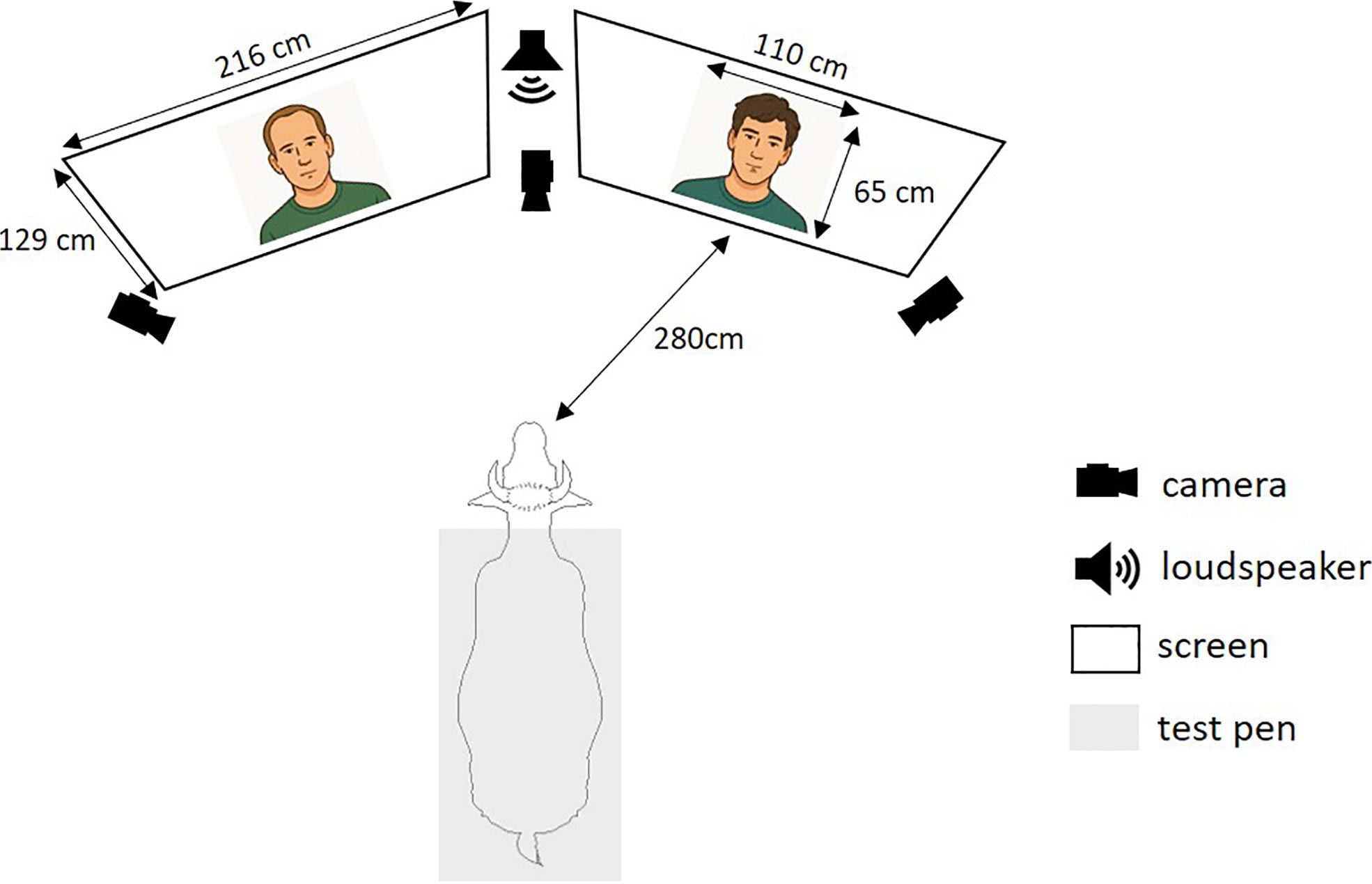
The researchers also tested cross-modal recognition, the ability to connect information received through different senses. They showed videos of familiar and unfamiliar faces while playing a recording of one of the two men speaking. Each man said the same sentence, keeping the words consistent across the recordings.
“In this study, using visual preference and cross-modal tests, we showed that cows are able to process human faces presented in 2D on videos and to associate familiar and unfamiliar faces with the corresponding voices by integrating multiple sensory modalities,” the authors said.
Recognition without detectable emotional change
Heart rate measurements taken while the cows watched the videos did not reveal evidence that familiar or unfamiliar faces and voices affected their emotional responses. Differences in how long the animals looked therefore did not correspond to an emotional change detectable through this measure.
The authors caution that watching a video and hearing a recording are not equivalent to interacting with a person. Although the results suggest that cows can identify people through their faces and voices, further studies could examine how the animals interact with specific individuals. Understanding those relationships could help guide efforts to support their welfare.
Reference: “Cows visually discriminate and cross-modally recognise familiar and unfamiliar human faces in videos” by Océane Amichaud, Julie Lemarchand, Fabien Cornilleau, Plotine Jardat, Vitor H. B. Ferreira, Ludovic Calandreau and Léa Lansade, 20 May 2026, PLOS ONE.
DOI: 10.1371/journal.pone.0329529
This study was funded by the French National Research Institute for Agriculture, Food and the Environment. The funders had no role in study design, data collection and analysis, decision to publish, or preparation of the manuscript.
Never miss a breakthrough: Join the SciTechDaily newsletter.
Follow us on Google and Google News.