
Do parrots actually use names the way humans do? A new study analyzing hundreds of captive parrots reveals surprisingly complex social communication.
Like many animals, parrots produce calls that can sound as though they are communicating with one another, perhaps even addressing a particular bird.
But whether they use names in anything like the human sense is a harder question.
To investigate it, Lauryn Benedict, a biology professor at the University of Northern Colorado, did not travel to tropical field sites to record wild parrots, as researchers have done before. Instead, she studied birds that already imitate human speech, including the names people use.
Captive parrots offer evidence
Benedict worked with Christine Dahlin of the University of Pittsburgh at Johnstown, a collaborator of many years, along with a research team from Austria.
Together, they examined vocal recordings from more than 880 captive parrots. Many of the birds appeared to use names in ways that resembled how people identify individuals. The recordings also showed that parrots can use names in some unexpected ways.
Names organize social life
Proper names help people manage complicated social relationships by making individuals easier to identify. Many wild animals also use sounds that may function somewhat like names, possibly for similar social reasons.
Although animal researchers have been studying these vocalizations, Dahlin said, ”We cannot conclude that they are analogous to human names both because animals’ signals are often so different and because we don’t understand the full intent behind the signals.”
Parrots offered a useful way to study the question because many can imitate human speech. Benedict and the team drew on the ManyParrots project, a research network that studies parrot vocal learning and cognition through surveys and audio recordings.
Name use varies widely
The researchers reviewed survey data from more than 889 parrots. For some of the birds, survey respondents also supplied context that helped the team interpret how names were being used.
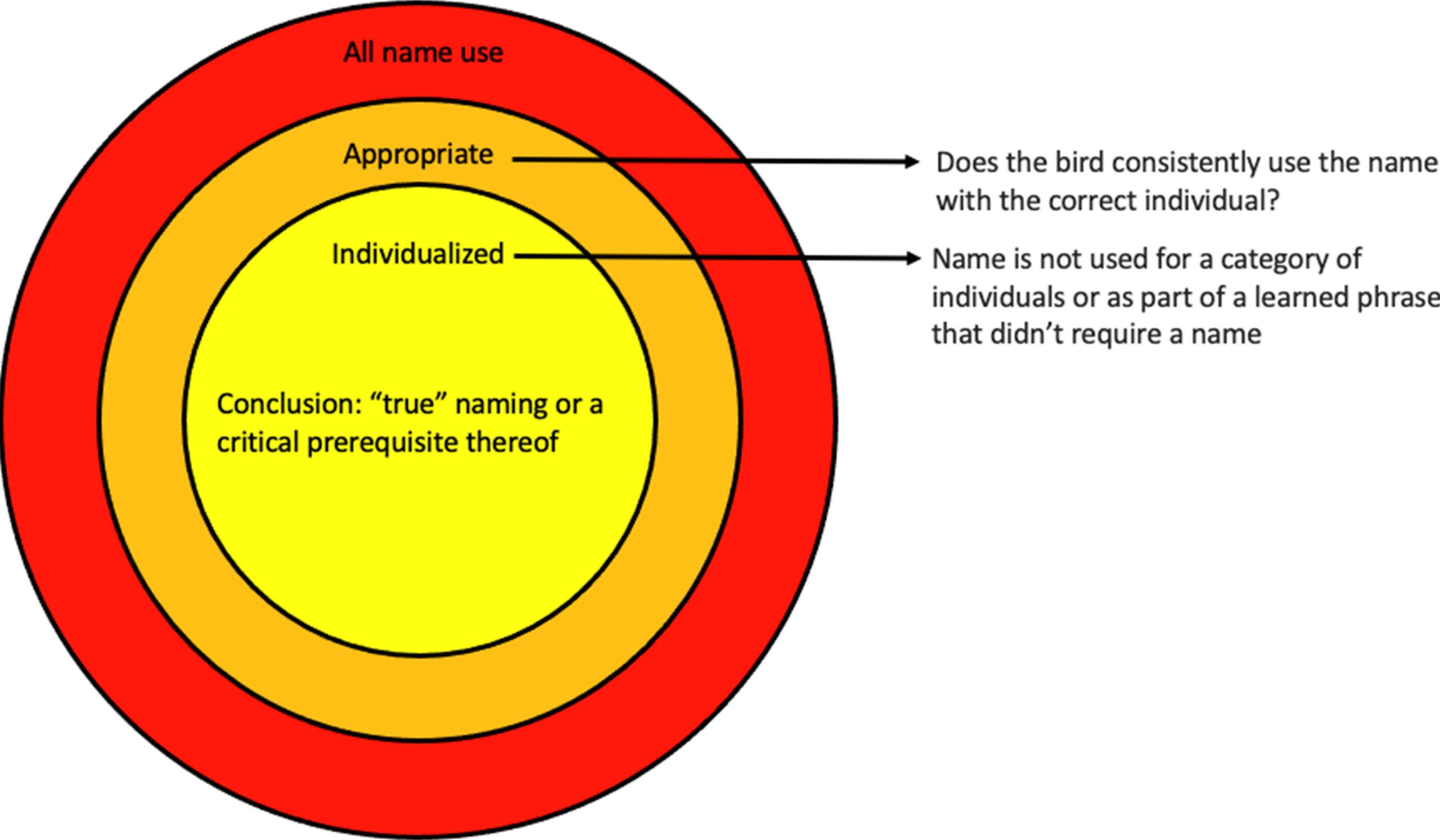
Nearly half of the survey respondents provided examples of parrots saying names. Among 413 audio clips, 88 appeared to show birds using names as labels for people or animals. The team also found strong evidence that some parrots were not just naming a broad category, such as “people,” but referring to one specific individual.
At the same time, many parrots used these labels in ways that people usually would not. Some birds, for example, said their own names simply to attract attention.
Dahlin said the findings suggest that parrots have the vocal and cognitive abilities to use names in multiple ways, including communicating with people and referring to someone who is not present. Still, differences across species and even between individuals of the same species leave many unanswered questions about how, when, and why animals use these abilities to address another creature by name.
Reference: “Name use by companion parrots” by Lauryn Benedict, Viktoria Groiss, Marisa Hoeschele, Eva Reinisch and Christine R. Dahlin, 17 April 2026, PLOS ONE.
DOI: 10.1371/journal.pone.0346830
This work was funded in part by the Vienna Science and Technology Fund (WWTF) project ANIML (LS23-014) to MH. The funders had no role in study design, data collection and analysis, decision to publish, or preparation of the manuscript.
Never miss a breakthrough: Join the SciTechDaily newsletter.
Follow us on Google and Google News.
2 Comments
I have a Timneh Gray parrot. A while after I got him, I read that I should not give him a name with a sibilant sound like “s” or “ch” because they have trouble saying them. But, of course, I had named him “Shadow.” However, his first word was a very clear “Shadow” and he recognizes the names for various objects and people. I am “Daddy” and my wife is “Mommy.” It is pretty easy to see how he responds since parrots have a cock-eyed way of looking at or for things instead of looking at them head-on.
thanks for this