
Close Menu
    Facebook X (Twitter) Instagram
    SciTechDaily
    • Biology
    • Chemistry
    • Earth
    • Health
    • Physics
    • Science
    • Space
    • Technology
    Facebook X (Twitter) Pinterest YouTube RSS
    SciTechDaily
    Home»Biology»Rare Deep Sea Bigfin Squid Sighted in Australian Waters for First Time
    Biology

    Rare Deep Sea Bigfin Squid Sighted in Australian Waters for First Time

    By PLOSNovember 12, 2020No Comments2 Mins Read
    Facebook Twitter Pinterest Telegram LinkedIn WhatsApp Email Reddit
    Share
    Facebook Twitter LinkedIn Pinterest Telegram Email Reddit
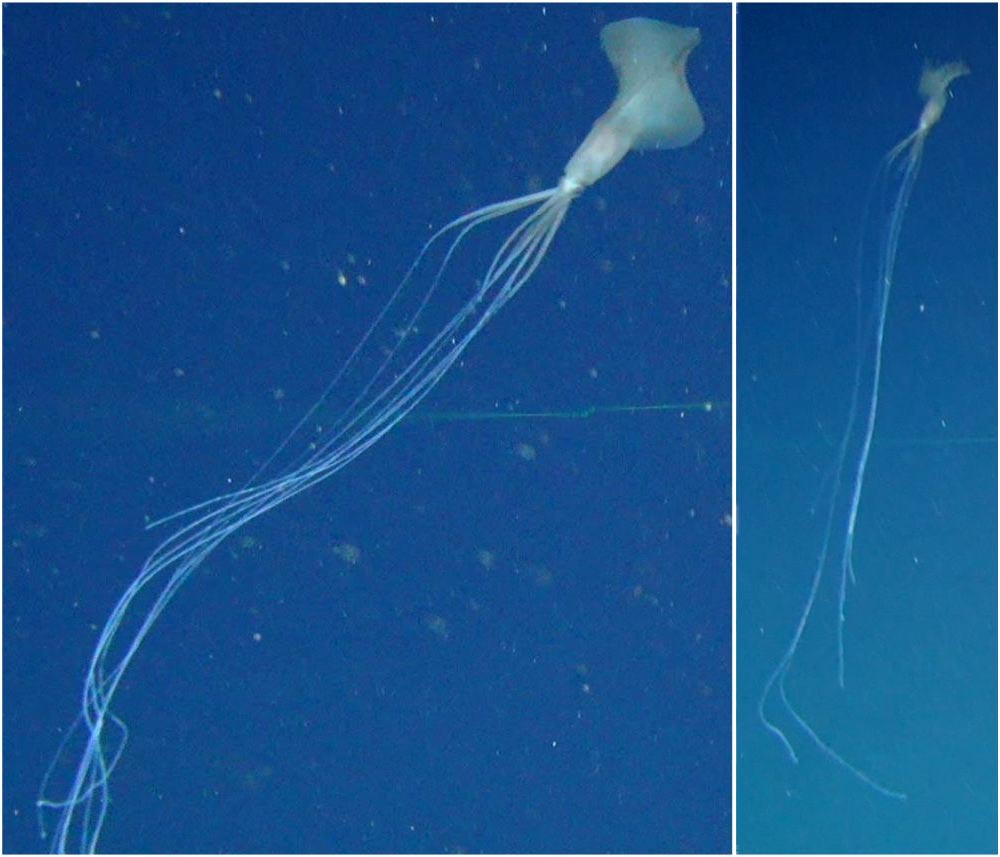
    Rare Deep Sea Bigfin Squid
    Magnapinna squid. Credit: Osterhage et al. (PLOS ONE, 2020) CC BY

    One of the most remarkable groups of deep-sea squids is the Magnapinnidae, known for their large fins and strikingly long arm and tentacle filaments. Little is known of their biology and ecology as most specimens are damaged and juvenile, and in-situ sightings are sparse, numbering around a dozen globally.

    As part of a recent large-scale research program in the Great Australian Bight, Remotely Operated Vehicles and a towed camera system were deployed in depths of 946–3258 m (3,104-10,689 ft) resulting in five Magnapinna sp. sightings.

    These represent the first records of Bigfin Squid in Australian waters, and more than double the known records from the southern hemisphere, bolstering a hypothesis of cosmopolitan distribution. As most previous observations have been of single Magnapinna squid these multiple sightings have been quite revealing, being found in close spatial and temporal proximity of each other. Morphological differences indicate each sighting is of an individual rather than multiple sightings of the same squid.

    In terms of morphology, previous in-situ measurements have been roughly based on nearby objects of known size, but this study used paired lasers visible on the body of a Magnapinna squid, providing a more accurate scaling of size.

    Squid of a juvenile size were also recorded and are confirmed to possess the long distal filaments which have thus far been mostly missing from specimens due to damage.

    The authors have described fine-scale habitat, in-situ coloration, and behavioral components including a horizontal example of the ‘elbow’ pose, and coiling of distal filaments: a behavior not previously seen in squid. These sightings add to our knowledge of this elusive and intriguing genus, and reinforce the value of imagery as a tool in deep-sea squid research.

    Reference: “Multiple observations of Bigfin Squid (Magnapinna sp.) in the Great Australian Bight reveal distribution patterns, morphological characteristics, and rarely seen behaviour” by Deborah Osterhage, Hugh MacIntosh, Franziska Althaus and Andrew Ross, 11 November 2020, PLOS ONE.
    DOI: 10.1371/journal.pone.0241066

    Never miss a breakthrough: Join the SciTechDaily newsletter.
    Follow us on Google and Google News.

    Biodiversity Marine Biology PLOS Zoology
    Share. Facebook Twitter Pinterest LinkedIn Email Reddit

    Related Articles

    Researchers Just Found a New Species of Glowing Shark

    The “Popcorn” Parasite: Scientists Discover 14 Bizarre New Marine Species

    Alien Species Predicted to Increase by 36% Worldwide by 2050

    New Species Found in the Hottest Place on Earth

    Making a List of All Creatures, Great and Small: For the First Time, an Agreed List of All the World’s Species

    Presence of Cryptic and Elusive Tiny Creatures Betrayed by Facebook and Instagram

    First Sighting of the Spade-Toothed Whale

    Leopard Seals Suction Feed on Krill Like Whales

    A Fifth of All Invertebrates on Earth Threatened by Extinction

    Leave A Reply Cancel Reply

    • Facebook
    • Twitter
    • Pinterest
    • YouTube

    Don't Miss a Discovery

    Subscribe for the Latest in Science & Tech!

    Trending News

    Don’t Miss: A Brilliant Venus and Glowing Harvest Moon Light Up the Sky

    New Twist on the Einstein Problem Reveals Unexpected Physics

    JWST Captures Stunning Evidence of How Supermassive Black Holes Feed

    Early Exercise May Permanently Change How Much Energy the Body Uses To Move

    New Molecule Wipes Out Aggressive Lymphoma Tumors in Mice in Just 11 Days

    The Human Family Tree May Need a Major Rewrite

    Scientists Find a Surprising Cancer-Fighting Effect in Dark Sweet Cherries

    New AI Detects Hidden Warning Signs of Solar Eruptions Hours Before They Emerge

    Follow SciTechDaily
    • Facebook
    • Twitter
    • YouTube
    • Pinterest
    • Newsletter
    • RSS
    SciTech News
    • Biology News
    • Chemistry News
    • Earth News
    • Health News
    • Physics News
    • Science News
    • Space News
    • Technology News
    Recent Posts
    • This Utah Mountain Is Hiding Enough Ice To Fill 600 Olympic Pools
    • Vagus Nerve Stimulation Could Unlock the Brain’s Hidden Learning Potential
    • Your Mother’s Age May Leave a Biological Mark That Lasts for Generations
    • Women Who Ate More Antioxidants Had Strikingly Lower Rates of Cervical Cancer
    • A Hidden Hormone Disorder May Be Driving Millions of High Blood Pressure Cases
    Copyright © 1998 - 2026 SciTechDaily. All Rights Reserved.
    • Science News
    • About
    • Contact
    • Editorial Board
    • Privacy Policy
    • Terms of Use

    Type above and press Enter to search. Press Esc to cancel.