
Human Cells Help Researchers Understand Squid Camouflage
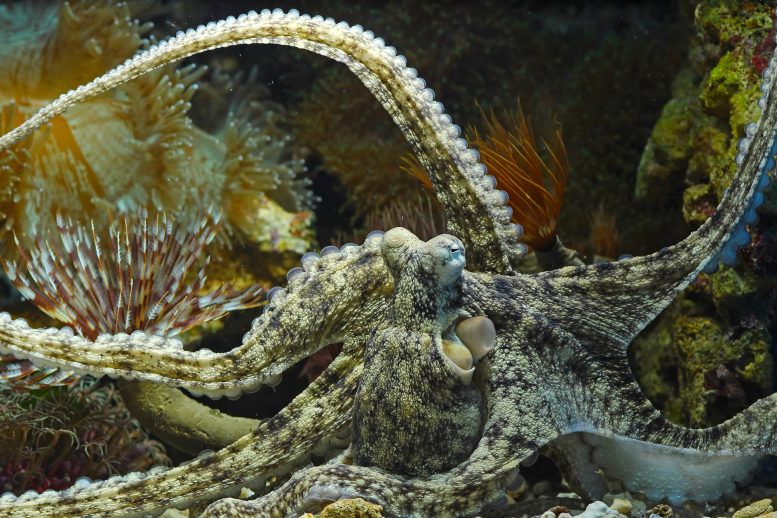
Squids and octopuses are masters of camouflage, blending into their environment to evade predators or surprise prey. Some aspects of how these cephalopods become reversibly transparent are still “unclear,” largely because researchers can’t culture cephalopod skin cells in the lab. Today, however, researchers report that they have replicated the tunable transparency of some squid skin cells in mammalian cells, which can be cultured. The work could not only shed light on basic squid biology, but also lead to better ways to image many cell types.
The researchers will present their results at the spring meeting of the American Chemical Society (ACS). ACS Spring 2023 is a hybrid meeting being held virtually and in-person March 26–30, and features more than 10,000 presentations on a wide range of science topics.
For many years, Alon Gorodetsky, Ph.D., and his research group have been working on materials inspired by squid. In past work, they developed “invisibility stickers,” which consisted of bacterially produced squid reflectin proteins that were adhered onto sticky tape. “So then, we had this crazy idea to see whether we could capture some aspect of the ability of squid skin tissues to change transparency within human cell cultures,” says Gorodetsky, who is the principal investigator on the project.
Exploring Leucophores and Light Scattering
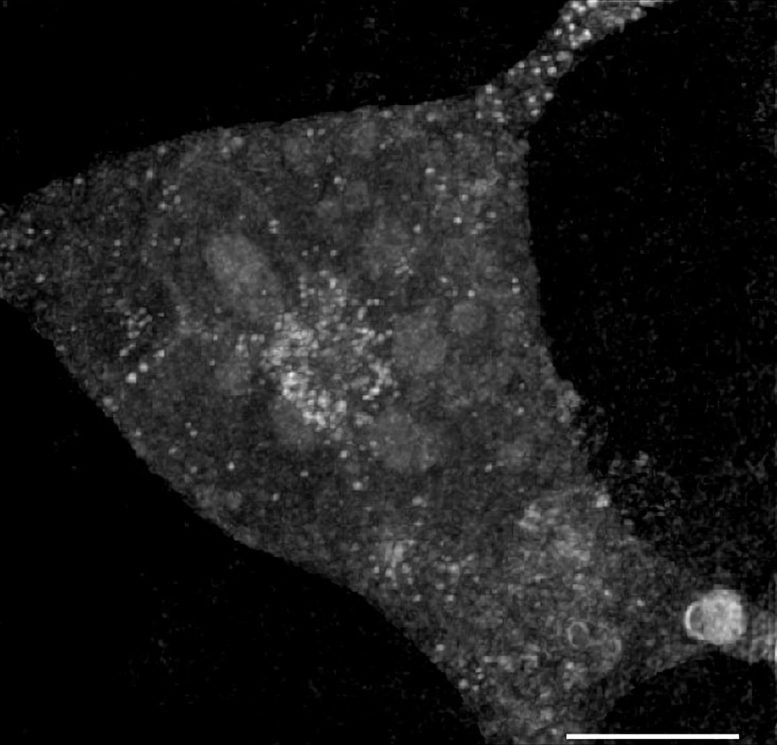
The team at the University of California, Irvine focused their efforts on cephalopod cells called leucophores, which have particulate-like nanostructures composed of reflectin proteins that scatter light. Typically, reflectins clump together and form the nanoparticles, so light isn’t absorbed or directly transmitted; instead, the light scatters or bounces off of them, making the leucophores appear bright white.
“We wanted to engineer mammalian cells to stably, instead of temporarily, form reflectin nanostructures for which we could better control the scattering of light,” says Gorodetsky. That’s because if cells allow light through with little scattering, they’ll seem more transparent. Alternatively, by scattering a lot more light, cells will become opaque and more apparent. “Then, at a cellular level, or even the culture level, we thought that we could predictably alter the cells’ transparency relative to the surroundings or background,” he says.
To change how light interacts with cultured cells, Georgii Bogdanov, a graduate student in Gorodetsky’s lab who is presenting the results, introduced squid-derived genes that encoded for reflectin into human cells, which then used the DNA to produce the protein. “A key advance in our experiments was getting the cells to stably produce reflectin and form light-scattering nanostructures with relatively high refractive indices, which also allowed us to better image the cells in three dimensions,” says Bogdanov.
In experiments, the team added salt to the cells’ culture media and observed the reflectin proteins clumping together into nanostructures. By systematically increasing the salt concentration, Bogdanov got detailed, time-lapse 3D images of the nanostructures’ properties. As the nanoparticles became larger, the amount of light that bounced off the cells increased, consequently tuning their opacity.
Then, the COVID-19 pandemic hit, leaving the researchers to wonder what they could do to advance their investigation without being physically in the lab. So, Bogdanov spent his time at home developing computational models that could predict a cell’s expected light scattering and transparency before an experiment was even run. “It’s a beautiful loop between theory and experiments, where you feed in design parameters for the reflectin nanostructures, get out specific predicted optical properties and then engineer the cells more efficiently — for whatever light-scattering properties you might be interested in,” explains Gorodetsky.
Insights into Squid Biology and Imaging Applications
On a basic level, Gorodetsky suggests that these results will help scientists better understand squid skin cells, which haven’t been successfully cultured in a laboratory setting. For example, previous researchers postulated that reflectin nanoparticles disassemble and reassemble to change the transparency of tunable squid leucophores. And now Gorodetsky’s team has shown that similar rearrangements occurred in their stable engineered mammalian cells with simple changes in salt concentration, a mechanism that appears analogous to what has been observed in the tunable squid cells.
The researchers are now optimizing their technique to design better cellular imaging strategies based on the cells’ intrinsic optical properties. Gorodetsky envisions that the reflectin proteins could act as genetically encoded tags that would not bleach inside human cells. “Reflectin as a molecular probe provides a lot of possibilities to track structures in cells with advanced microscopy techniques,” adds Bogdanov. For example, the scientists propose that imaging approaches based on their work could also have implications for better understanding cell growth and development.
Meeting: ACS Spring 2023
Title
Dynamic optical systems inspired by cephalopods
Abstract
Cephalopods (e.g., squids, octopuses, and cuttlefish) have captivated the imagination of both the general public and scientists alike due to their sophisticated nervous systems, complex behavioral patterns, and visually stunning coloration changes. By drawing inspiration from the structures and functionalities of tunable cephalopod skin cells, we have designed and engineered human cells that contain reconfigurable protein-based photonic architectures and, as a result, possess tunable transparency-changing and light-scattering capabilities (1). In turn, we have visualized the refractive index distributions of analogous engineered cells with three-dimensional label-free holotomographic microscopy techniques, and as a consequence, we have developed a detailed understanding of the relationship between their global optical characteristics and subcellular ultrastructures (2). We have moreover extended these efforts to the predictive engineering of the refractive indices and light-scattering properties of multiple self-assembled protein-based platforms, both in vitro and in vivo (2,3). Finally, we have developed improved chemical and genetic strategies for manipulating the sizes, numbers, and refractive indices of our subcellular structures (4). Our combined findings may facilitate an improved understanding of cephalopod camouflage mechanisms and lead to the development of unique tools for applications in biophotonics and bioengineering.
The researchers acknowledge funding from the Defense Advanced Research Projects Agency and the U.S. Air Force Office of Scientific Research.
Never miss a breakthrough: Join the SciTechDaily newsletter.
Follow us on Google and Google News.
1 Comment
That’s not a squid