

A search through more than 60,000 bone fragments uncovered the first confirmed Denisovan radius, a forearm bone offering rare clues to how these ancient human relatives were built.
A forearm fragment from a cave in southwest China combines features resembling those of Neanderthals and modern humans, yet it belonged to neither. Proteins preserved in the bone identify its owner as Denisovan, part of an ancient human group recognized through genetic evidence.
The fragment is the first, and so far only, confirmed Denisovan radius, one of the two long bones in the forearm. Denisovans are thought to have lived across much of Asia, but their fossil record is sparse, particularly for bones below the skull. That scarcity has left researchers with little evidence of the physical traits that helped them adapt to different environments.
The radius is among five remains from Bianfu Cave in Yunnan Province that a new study identified as Denisovan. Dating to the late Middle Pleistocene, the fossils fill a longstanding gap in the group’s known distribution in southwest China. Professor Qiaomei Fu of the Institute of Vertebrate Paleontology and Paleoanthropology (IVPP) of the Chinese Academy of Sciences (CAS) led the research in collaboration with multiple institutions. The findings were published in Nature on September 9.
Neanderthal and modern human traits combined
Cataloged as BFD771, the radius fragment preserves the end nearest the elbow. Its large dimensions at that end resemble Neanderthal radii, as does the likely inward orientation of its radial tuberosity, the bony projection where the biceps muscle attaches. Its overall external shape, however, is closer to that of modern humans. So is the geometry of a cross section through the middle of its neck, the narrowed region near the elbow end. The researchers interpret this combination as evidence of distinctive mechanical demands and behavioral adaptations in Denisovans, differing from those inferred for Neanderthals and modern humans.
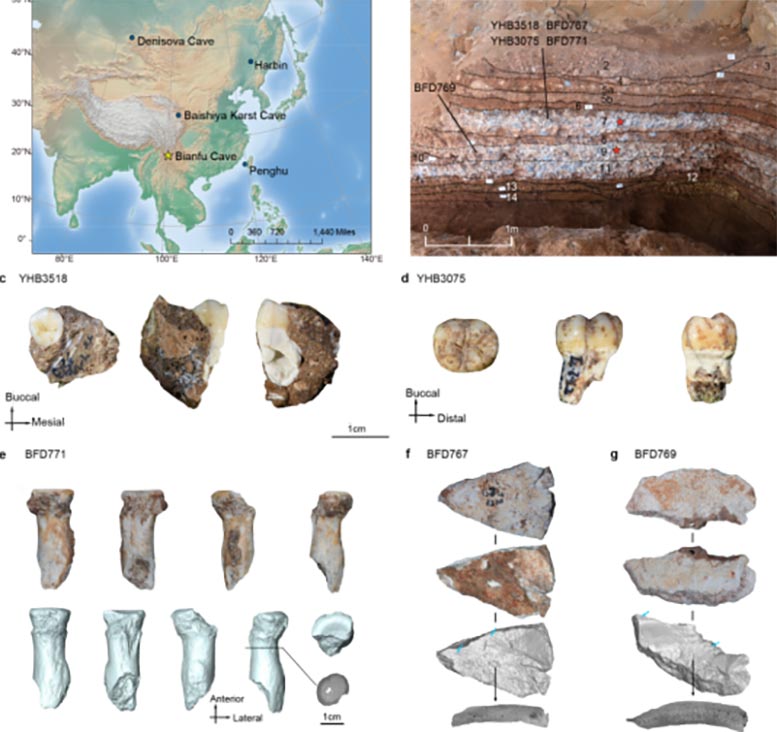
Two skull fragments, BFD767 and BFD769, provided another anatomical comparison. Both are pieces of parietal bones, which form part of the top and sides of the skull. Their skull vault thickness patterns most closely resemble those of Homo heidelbergensis and late Middle Pleistocene archaic Homo from East Asia.
Bone shape narrows the search
Finding these bones required narrowing a collection of more than 60,000 fragments. Researchers increasingly use Zooarchaeology by Mass Spectrometry, or ZooMS, to screen large fossil collections by examining protein signatures. The technique requires minimally invasive sampling and is simple, fast, and relatively inexpensive. Even so, hominin fossil recovery rates at sites such as Denisova Cave and Baishiya Karst Cave have been just 0.1%. Applying ZooMS to every fragment from Bianfu Cave would have been costly and inefficient.
The team instead developed a “morphological pre-screening + ZooMS identification” strategy, first examining bone shapes to select 22 potential hominin remains. ZooMS then confirmed that the two parietal fragments and the radius fragment belonged to hominins, the group that includes humans and our extinct close relatives. The combined approach substantially improved screening efficiency and provides a repeatable method for searching other Paleolithic sites with abundant bone fragments.
BFD767 and BFD771 came from Layer 7, dated to approximately 148,000 to 134,000 years ago. That layer also contained four hominin teeth, two of which the researchers included in the study: a lower fourth premolar, YHB3518, and a lower second molar, YHB3075. The other skull fragment, BFD769, came from the older Layer 9, dated to approximately 167,000 to 150,000 years ago.
Proteins identify five Denisovan remains
Identifying the bones as hominin remains did not reveal which ancient human group they belonged to. To find out, researchers analyzed proteins preserved in three bones and two teeth, recovering 6 to 16 proteins from each specimen. Protein fragments in the tooth enamel also indicated that both teeth belonged to males.
All five fossils carried the Denisovan-specific protein variant COL1A2 R996K. Additional variants in the teeth supported this identification and helped distinguish the fossils from other ancient human groups, including Homo erectus.
The researchers also constructed evolutionary trees using the recovered protein sequences. All five specimens clustered with the Denisovan specimen Denisova 3, with 100% posterior probability, providing strong support for their identification.
These findings make Bianfu Cave the richest known source of Denisovan fossils outside Denisova Cave. Dating to a glacial period known as Marine Isotope Stage 6, the remains suggest that the Yunnan-Guizhou Plateau’s relatively warm climate and abundant food resources may have provided a favorable habitat for Denisovans.
Reference: “Ancient proteins identify various Denisovan remains from Southwest China” by Huiyun Rao, Song Xing, Qijun Ruan, Fan Bai, Yuhao Zhao, Zhongyou Wu, Siyuan Tang, E. Andrew Bennett, Xiaotian Feng, Sungui Lin, Qingfeng Shao, Xiong Yang, Zitao Li, Kai Zhou, Feng Liu and Qiaomei Fu, 9 September 2026, Nature.
DOI: 10.1038/s41586-026-10976-9
This work was supported by the National Key R&D Program of China (2023YFF0905700), the Archaeological Talent Promotion Program of China (2024-278), the National Natural Science Foundation of China (L2424324), the New Cornerstone Science Foundation and the Open Research Fund of TPESER (TPESER202210).
Never miss a breakthrough: Join the SciTechDaily newsletter.
Follow us on Google and Google News.