
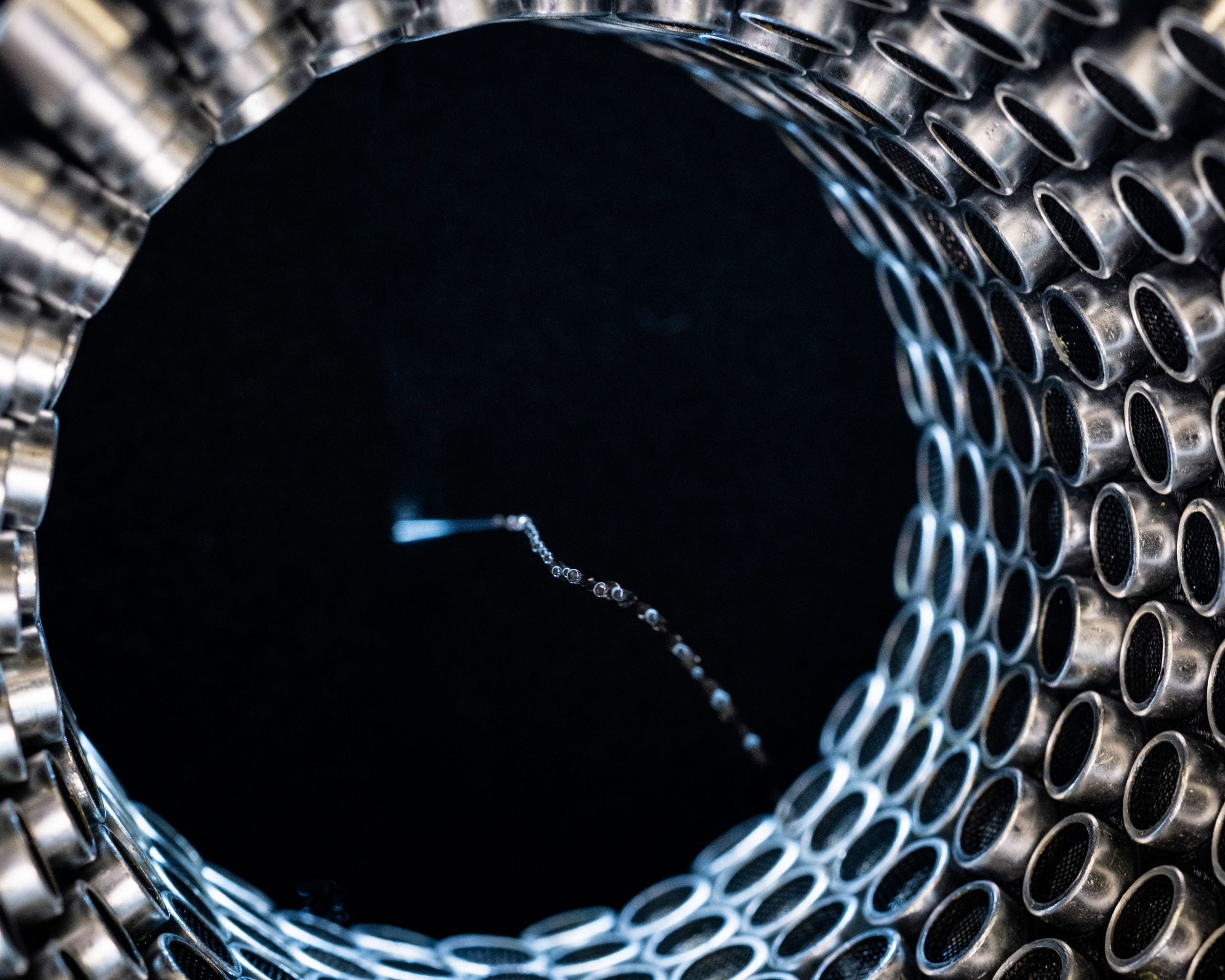
Scientists have developed an invisible tube made entirely of ultrasonic waves that can guide liquids through mid-air without physical contact.
Researchers at the University of Helsinki have created a pipe with no physical walls, using ultrasound to guide a stream of liquid horizontally through open air. The technology could provide a new way to transport corrosive, sticky, or contamination-sensitive substances without exposing them to the surfaces of conventional pipes.
“Of all the experimental setups I have seen, I would say this is the closest thing to magic,” says Ari Salmi, Professor of Electronics at the University of Helsinki, who led the development of the device.
How Ultrasound Creates an Invisible Pipe
The system uses 256 miniature speakers arranged in a cylinder around the flowing liquid, approximately five centimeters (2 inches) away. They produce ultrasonic waves at a frequency of about 40 kilohertz, beyond the range of human hearing. By carefully coordinating these waves, the researchers create an acoustic field that confines the liquid to a narrow path without any solid walls.
Unlike conventional piping, the ultrasonic channel can change direction without requiring physical adjustments. Researchers can electronically reshape the path, redirect the liquid toward another destination, or control its release with single-drop precision. “By changing how the speakers are controlled, we can reshape and turn the tube as needed,” explains postdoctoral researcher Dmitry Nikolaev, who led the project team.
https://youtu.be/qmslDZWmiaE
Video material of the ultrasound tube transmitting liquids, powder, mist and electricity. Taken from the article Contactless continuous guidance of matter in its main states using curved elongated Bessel-like acoustic fields. Credit: Dmitry Nikolaev
The approach can also be adapted for different materials. “Transporting a solid substance, for example, requires a different field configuration than transporting a liquid or a gas.” Beyond moving matter, the ultrasonic tube can guide an electrical discharge along a controlled route.
From a Simple Question to a Working Device
Salmi first conceived the idea four years ago, following earlier research into using ultrasound to clean the inside of pipes. “We had been developing a device that cleaned the inner surfaces of pipes with ultrasound. At a lunch with a colleague, we discussed that it would be handy if a pipe had no surface for dirt to stick to.”
The discussion stayed with him. During an evening walk with his dog, he realized that ultrasound might be used to form the walls of a pipe rather than simply clean them. Turning the concept into a functioning device required extensive experimentation to determine how the speakers should operate together. The University of Helsinki researchers worked with collaborators at the Public University of Navarre and the University of Michigan to develop the system.
A Small Prototype With Potential for Expansion
The completed prototype produces an ultrasonic tube just eight centimeters (3.1 inches) long, shorter than the diameter of the surrounding device. Nikolaev says multiple modules could be connected to extend the channel to greater lengths. Each eight-centimeter section consumes approximately 50 watts of electricity, comparable to a traditional incandescent light bulb.
Although the device operates beyond human hearing, its ultrasonic field is extremely intense, and dogs may find the sound unpleasant. “At the core of the device, the intensity of the ultrasound is comparable to a continuous roar of gunfire right next to your ear,” Nikolaev says. “Even right here next to it, the sound could be compared to a jet engine if you were standing right beside it. But it is too high-pitched for the human ear.”
Reference: “Contactless continuous guidance of matter in its main states using curved elongated Bessel-like acoustic fields” by Dmitrii Nikolaev, Denys Iablonskyi, Alexander Martinez-Marchese, Marika Sirkka, Mikel Aldea, Chinedum Okwudire, Edward Hæggström, Asier Marzo and Ari Salmi, 23 October 2026, Proceedings of the National Academy of Sciences.
DOI: 10.1073/pnas.2614959123
Never miss a breakthrough: Join the SciTechDaily newsletter.
Follow us on Google and Google News.