

Using advanced laser spectroscopy on extremely rare radioactive material, researchers have uncovered new insights into the structure of heavy atomic nuclei.
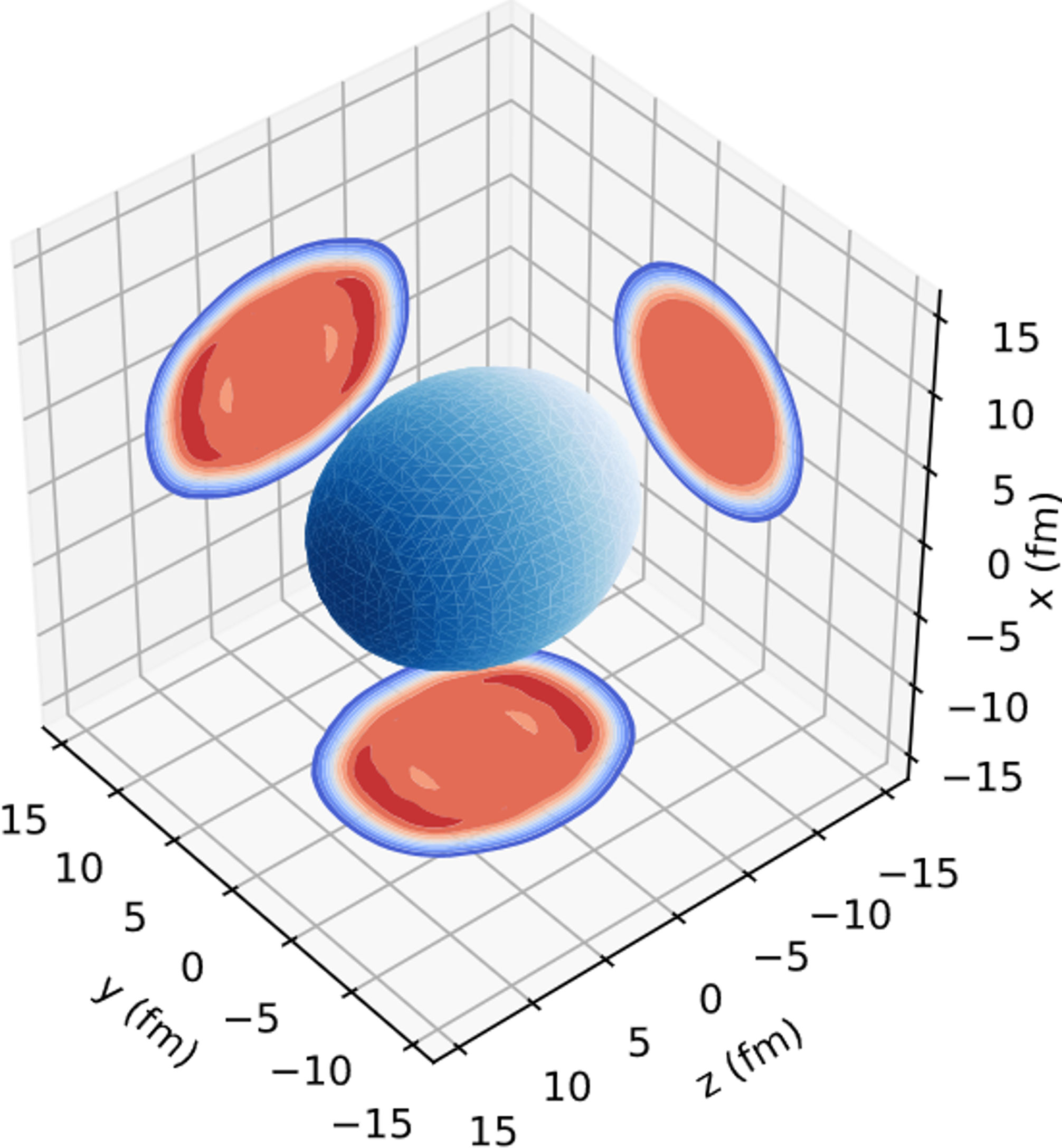
The nucleus of fermium-255 is far from spherical. Scientists have now determined its shape for the first time, finding that it is strongly elongated, much like a rugby ball. The high-precision measurements, published in Physical Review Letters, also correct earlier nuclear data and provide new evidence supporting theoretical models of the heaviest elements.
Fermium-255 contains 100 protons and 155 neutrons. In such heavy nuclei, the electrical repulsion between positively charged protons creates conditions that can lead to spontaneous fission, in which a nucleus splits into smaller fragments. Nuclear shape influences this process, making it a critical factor in predicting whether even heavier, potentially longer-lived elements can exist.
How Laser Light Reveals the Shape of a Nucleus
Rather than observing the nucleus directly, researchers studied its interactions with the electrons surrounding it. Electrons close to the nucleus are sensitive to its size, shape, and magnetic properties. These interactions produce extremely small differences in atomic energy levels that can be detected through precise laser measurements.
This phenomenon, known as hyperfine interaction, arises from the electromagnetic properties of the nucleus. A deformed nucleus interacts with the electric field of nearby electrons, while nuclear magnetism produces additional effects. Because fermium-255 has an odd number of neutrons, its nucleus also possesses a magnetic moment that contributes to the splitting of electronic energy levels.
Scientists at Johannes Gutenberg University Mainz (JGU) first observed atomic energy levels in fermium more than 20 years ago. However, the technology available then could not resolve the fine details needed to determine its nuclear structure accurately. Some of the resulting nuclear data remained incomplete or inconsistent.
Producing Fermium From an Exceptionally Rare Starting Material
Fermium must be manufactured artificially, and obtaining enough atoms for an experiment requires an unusually complex production process. The researchers began with months of neutron irradiation of transuranium material at the High Flux Isotope Reactor at Oak Ridge National Laboratory (USA), producing einsteinium-254.
After initial experiments in the United States, the material traveled to Mainz (Germany) for processing and then to the Institute Laue-Langevin in France for additional neutron irradiation. This produced einsteinium-255, which decays into fermium-255. The material was subsequently returned to Mainz for spectroscopy experiments.
Einsteinium-255 has a half-life of approximately 40 days, allowing it to supply fermium-255 over several weeks. Through repeated chemical separations, scientists obtained individual samples containing tens of millions to about one billion fermium atoms. At JGU’s RISIKO separator, the samples were heated to approximately 1,000 degrees Celsius (1,832 degrees Fahrenheit) to release atoms for laser analysis. Specialized Ti laser systems excited and ionized the atoms, enabling researchers to resolve the hyperfine structure of two optical transitions despite the extremely small quantities available.
New Measurements Challenge Earlier Nuclear Data
Researchers combined the experimental spectra with advanced atomic calculations performed at Jagiellonian University in Kraków, Poland, and the Helmholtz Institute Mainz (HIM). The analysis confirmed that the fermium-255 nucleus has a strongly prolate shape, meaning it is stretched along one axis. It also produced a magnetic dipole moment that differs from previously tabulated values, correcting earlier results that were inconsistent with physical expectations.
The measurements agree closely with modern nuclear theories developed by research groups in France and Germany. By providing more reliable information about nuclear deformation and magnetism, the findings strengthen models of nuclear fission and could improve predictions of the stability of superheavy elements that have yet to be discovered.
Reference: “High-Resolution Laser Spectroscopy on the Hyperfine Structure of Fm255 (Z=100)” by Mitzi Urquiza-González, Matou Stemmler, Thomas E. Albrecht, Benjamin Bally, Michael Bender, Sebastian Berndt, Michael Block, Alexandre Brizard, Joseph S. Andrews, Jacek Bieroń, Premaditya Chhetri, Holger Dorrer, Christoph E. Düllmann, Julie G. Ezold, Stephane Goriely, Manuel J. Gutiérrez, Dag Hanstorp, Raphael Hasse, Reinhard Heinke, Korbinian Hens, Stephane Hilaire, Magdalena Kaja, Tom Kieck, Nina Kneip, Ulli Köster, Andrea T. Loria Basto, Christoph Mokry, Danny Münzberg, Kristian Myhre, Thorben Niemeyer, Sophie Péru, Sebastian Raeder, Dennis Renisch, Jörg Runke, Samantha K. Schrell, Dominik Studer, Kenneth van Beek, Jessica Warbinek and Klaus Wendt, 15 May 2026, Physical Review Letters.
DOI: 10.1103/2813-b49x
Never miss a breakthrough: Join the SciTechDaily newsletter.
Follow us on Google and Google News.