
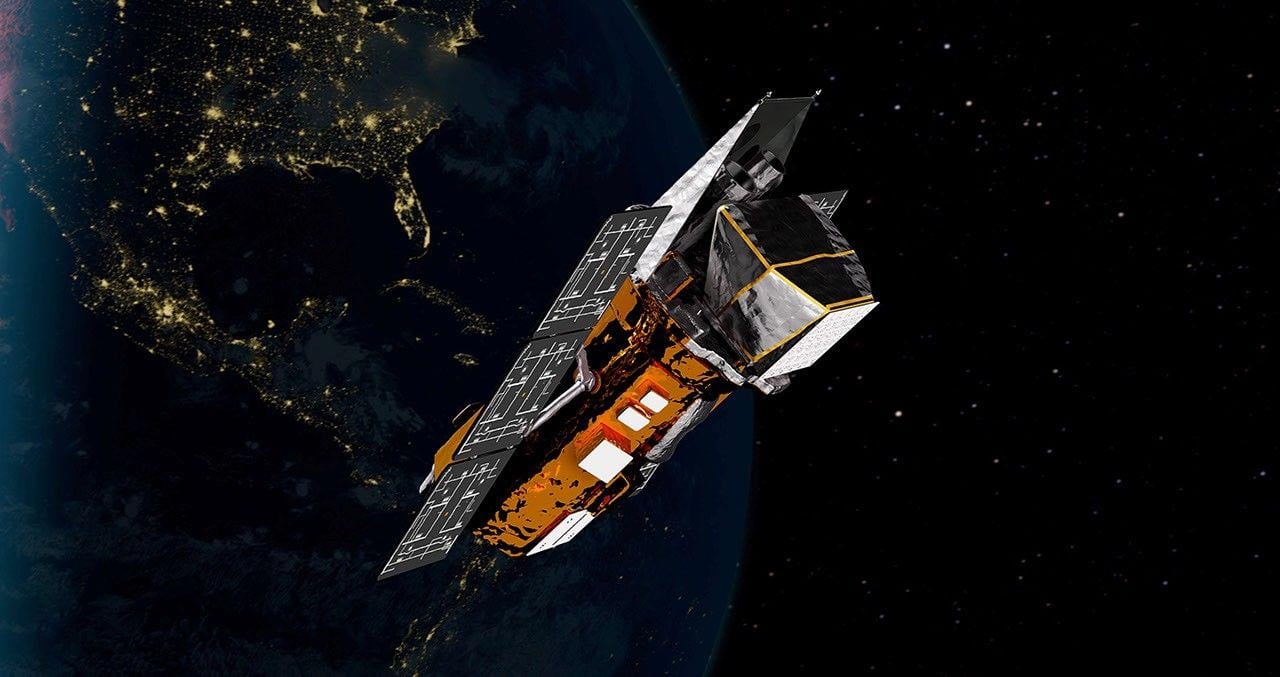
NASA’s Neil Gehrels Swift Observatory has returned to Earth after spending nearly 22 years in space, bringing an extraordinary mission of cosmic discovery to an end. The spacecraft reentered Earth’s atmosphere on Wednesday, more than two decades after launching in 2004.
Swift was a pioneering space observatory equipped with three telescopes capable of detecting different wavelengths of light. It was the first observatory of its kind, built to investigate some of the most powerful explosions in the universe.
NASA’s Swift Observatory Reenters Earth’s Atmosphere
The U.S. Space Force confirmed that Swift entered the atmosphere at 7:39 a.m. EST on November 4, above North Sumatra, Indonesia. The reported location was approximately 3.4 degrees north latitude and 98.6 degrees east longitude.
NASA anticipated that most of the spacecraft would burn up as it plunged through the atmosphere, although some pieces may have survived the descent.
A Two-Year Mission That Lasted Nearly 22 Years
When Swift launched in 2004, its primary goal was to study gamma-ray bursts, extraordinarily energetic explosions that rank among the most powerful events in the cosmos. The observatory was initially expected to operate for just two years, but it continued collecting valuable scientific data for more than two decades.
Over its remarkable lifetime, Swift became an exceptionally versatile tool for astronomers. Its instruments could observe several types of light, allowing researchers to investigate a wide range of cosmic phenomena. The spacecraft could also quickly turn toward sudden, short-lived bursts of energy and notify other observatories, giving scientists an opportunity to study events that might otherwise disappear before they could be examined.
These capabilities helped transform our understanding of the universe. Swift contributed to discoveries involving active galaxies powered by supermassive black holes, stars producing powerful X-ray flares, and the spectacular explosions of dying stars known as supernovas. Its observations also extended much closer to home, providing valuable information about comets and asteroids traveling through our own solar system.
What began as a two-year mission ultimately became nearly 22 years of exploring the universe, leaving behind a remarkable scientific legacy.
Never miss a breakthrough: Join the SciTechDaily newsletter.
Follow us on Google and Google News.