

Astronomers, using data from NASA’s Swift Observatory, have identified an extraordinary recurring signal from two massive black holes in a galaxy a billion light-years away.
Known as AT 2021hdr, this event showcases a pair of orbiting black holes disturbing a gas cloud, creating periodic light oscillations detectable across multiple wavelengths. This system, located in the constellation Cygnus, provides an unprecedented look at how supermassive black holes interact with their environments.
Black Holes Disrupt Gas Cloud in Distant Galaxy
Scientists using NASA’s Neil Gehrels Swift Observatory have, for the first time, detected signals from two massive black holes disrupting a gas cloud at the center of a distant galaxy.
“It’s a very weird event, called AT 2021hdr, that keeps recurring every few months,” explained Lorena Hernández-García, an astrophysicist at the Millennium Institute of Astrophysics, the Millennium Nucleus on Transversal Research and Technology to Explore Supermassive Black Holes, and University of Valparaíso in Chile. “We think that a gas cloud engulfed the black holes. As they orbit each other, the black holes interact with the cloud, perturbing and consuming its gas. This produces an oscillating pattern in the light from the system.”
Hernández-García led a study on AT 2021hdr, which was published on November 13 in the journal Astronomy and Astrophysics.

The Dual Black Holes of Cygnus
The dual black holes are in the center of a galaxy called 2MASX J21240027+3409114, located 1 billion light-years away in the northern constellation Cygnus. The pair are about 16 billion miles (26 billion kilometers) apart, close enough that light only takes a day to travel between them. Together they contain 40 million times the Sun’s mass.
Scientists estimate the black holes complete an orbit every 130 days and will collide and merge in approximately 70,000 years.
Watch as a gas cloud encounters two supermassive black holes. The complex interplay of gravitational and frictional forces causes the cloud to condense and heat. Some of the gas is ejected from the system with each orbit of the black holes. Credit: F. Goicovic et al. 2016
Event Detection and Initial Observations
AT 2021hdr was first spotted in March 2021 by the Caltech-led ZTF (Zwicky Transient Facility) at the Palomar Observatory in California. It was flagged as a potentially interesting source by ALeRCE (Automatic Learning for the Rapid Classification of Events). This multidisciplinary team combines artificial intelligence tools with human expertise to report events in the night sky to the astronomical community using the mountains of data collected by survey programs like ZTF.
“Although this flare was originally thought to be a supernova, outbursts in 2022 made us think of other explanations,” said co-author Alejandra Muñoz-Arancibia, an ALeRCE team member and astrophysicist at the Millennium Institute of Astrophysics and the Center for Mathematical Modeling at the University of Chile. “Each subsequent event has helped us refine our model of what’s going on in the system.”
Since the first flare, ZTF has detected outbursts from AT 2021hdr every 60 to 90 days.
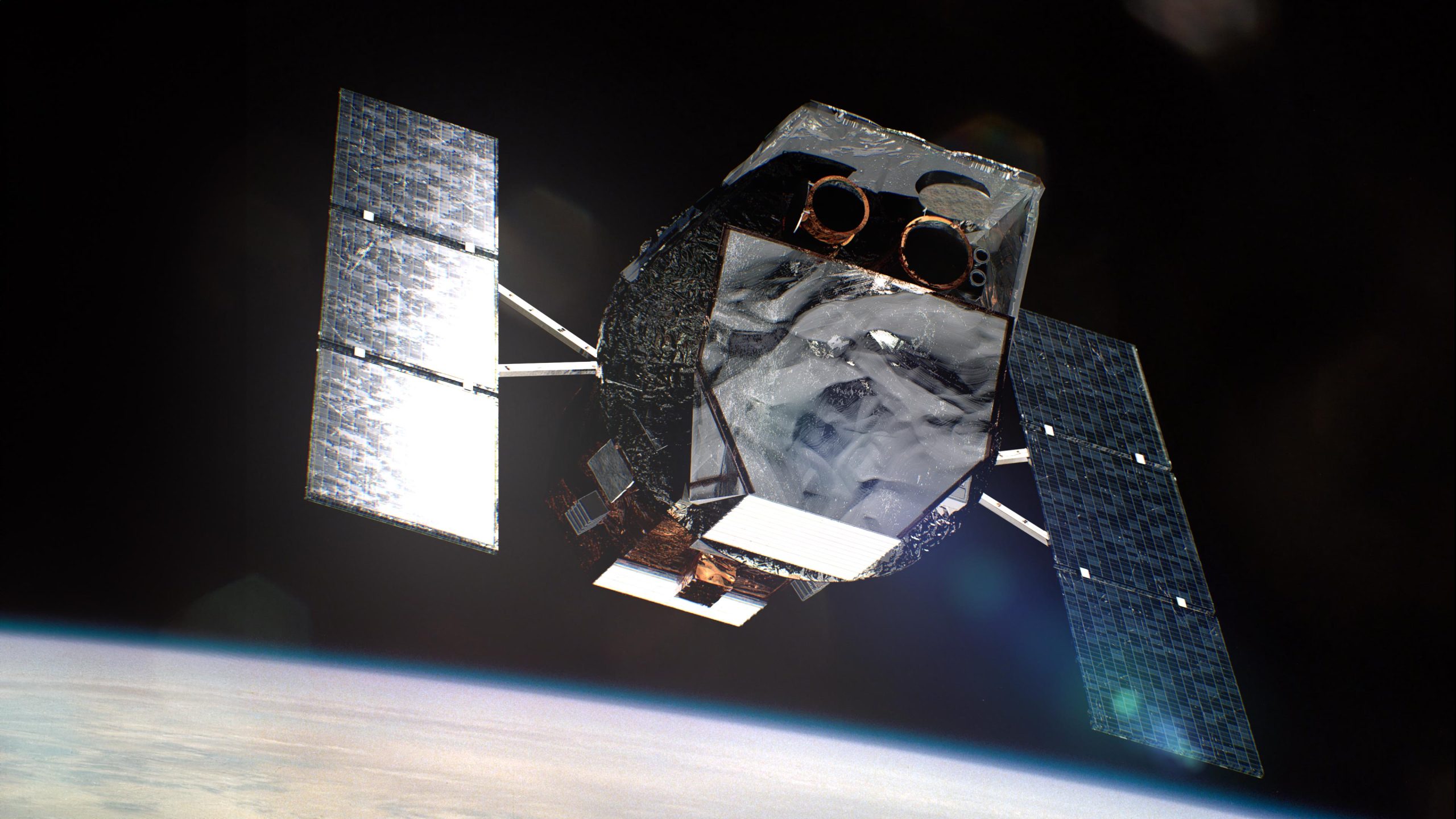
Hernández-García and her team have been observing the source with Swift since November 2022. Swift helped them determine that the binary produces oscillations in ultraviolet and X-ray light on the same time scales as ZTF sees them in the visible range.
Refining the Tidal Disruption Model
The researchers conducted a Goldilocks-type elimination of different models to explain what they saw in the data.
Initially, they thought the signal could be the byproduct of normal activity in the galactic center. Then they considered whether a tidal disruption event — the destruction of a star that wandered too close to one of the black holes — could be the cause.
Finally, they settled on another possibility, the tidal disruption of a gas cloud, one that was bigger than the binary itself. When the cloud encountered the black holes, gravity ripped it apart, forming filaments around the pair, and friction started to heat it. The gas got particularly dense and hot close to the black holes. As the binary orbits, the complex interplay of forces ejects some of the gas from the system on each rotation. These interactions produce the fluctuating light Swift and ZTF observe.
Future Studies and Cosmic Insights
Hernández-García and her team plan to continue observations of AT 2021hdr to better understand the system and improve their models. They’re also interested in studying its home galaxy, which is currently merging with another one nearby — an event first reported in their paper.
“As Swift approaches its 20th anniversary, it’s incredible to see all the new science it’s still helping the community accomplish,” said S. Bradley Cenko, Swift’s principal investigator at NASA’s Goddard Space Flight Center in Greenbelt, Maryland. “There’s still so much it has left to teach us about our ever-changing cosmos.”
NASA’s missions are part of a growing, worldwide network watching for changes in the sky to solve mysteries of how the universe works.
Reference: “AT 2021hdr: A candidate tidal disruption of a gas cloud by a binary super massive black hole system” by L. Hernández-García, A.M. Muñoz-Arancibia, P. Lira, G. Bruni, J. Cuadra, P. Arévalo, P. Sánchez-Sáez, S. Bernal, F.E. Bauer, M. Catelan, F. Panessa, M. Pávez-Herrera, C. Ricci, I. Reyes-Jainaga, B. Ailawadhi, V. Chavushyan, R. Dastidar, A. Deconto-Machado, F. Förster, A. Gangopadhyay, A. García-Pérez, I. Márquez, J. Masegosa, K. Misra, V. M Patiño-Alvarez, M. Puig-Subirà, J. Rodi and M. Singh, 13 November 2024, Astronomy & Astrophysics.
DOI: 10.1051/0004-6361/202451305
Goddard manages the Swift mission in collaboration with Penn State, the Los Alamos National Laboratory in New Mexico, and Northrop Grumman Space Systems in Dulles, Virginia. Other partners include the University of Leicester and Mullard Space Science Laboratory in the United Kingdom, Brera Observatory in Italy, and the Italian Space Agency.
Never miss a breakthrough: Join the SciTechDaily newsletter.
Follow us on Google and Google News.
3 Comments
In my opinion, you should think outside the box completely! And start a new and revolutionary direction, which I have no doubt will bring For huge discoveries to the point of a revolution of hundreds of years…
Um, why!? The current science works well, see the article.
Imagine black holes are just fart of some 8th dimensional entity.