
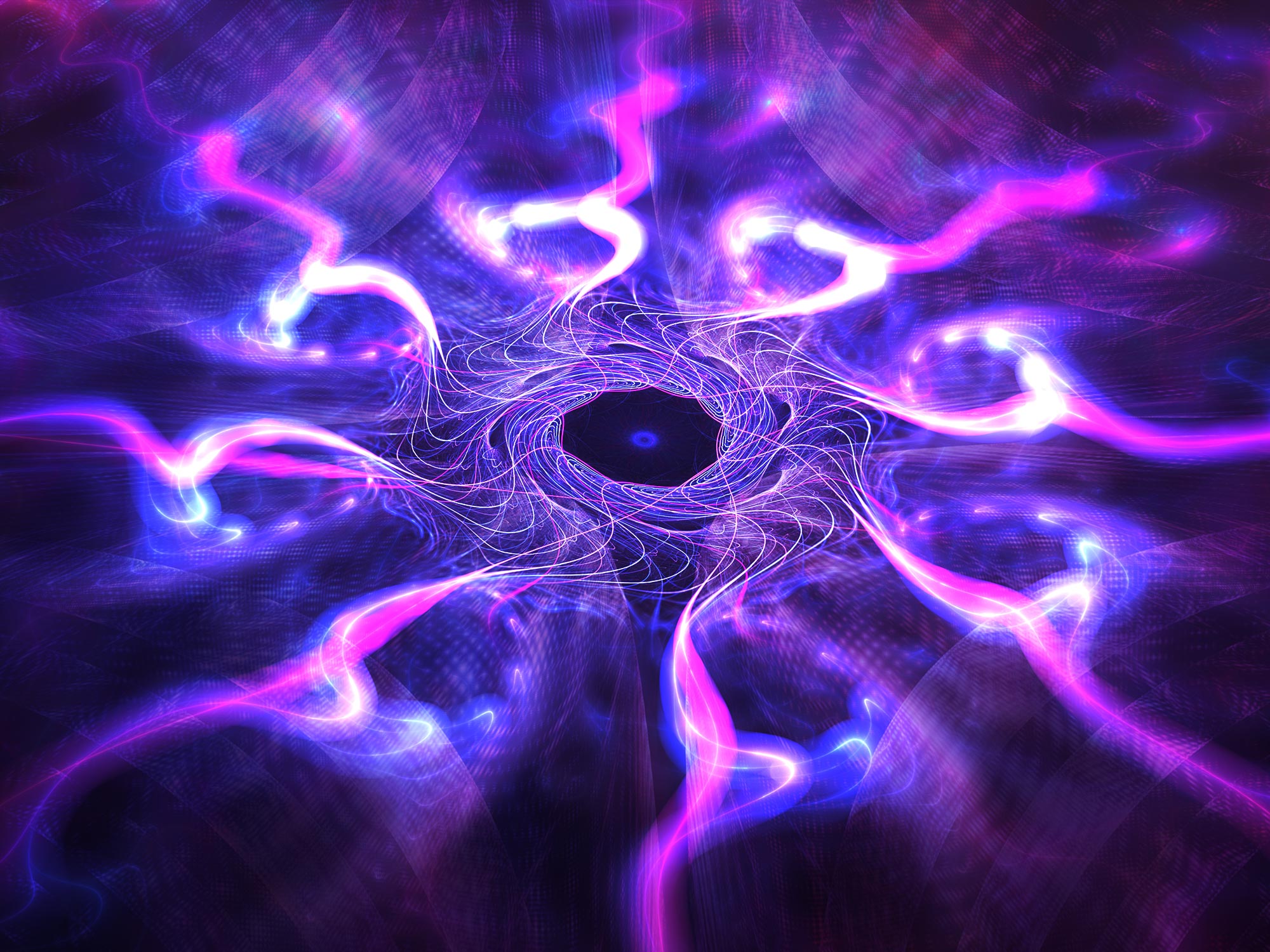
With each laser pulse, a room-temperature supersolid selects a new arrangement, revealing how crystal-like order can emerge without being locked to one position.
Studying unusual quantum states often requires expensive equipment that cools samples almost to absolute zero. Researchers have now observed a supersolid at room temperature, using a system that strongly links light and matter. This unusual state combines the repeating pattern of a crystal with the frictionless flow of a superfluid.
A superfluid has no viscosity, the internal resistance that opposes flow in an ordinary fluid, so it can pass through extremely narrow channels without resistance. If you moved an oar through one, you would feel almost no drag until you exceeded a critical speed, when swirling quantum vortices would appear. A supersolid retains this fluid behavior while developing crystal-like order.
The TopoLight consortium’s study, published in Science Advances, involved researchers from the Faculty of Physics at the University of Warsaw, the Military University of Technology in Poland, IBM Research Zurich, and the French National Centre for Scientific Research (CNRS).
A supersolid made from light and matter
The team built its system around an optical microcavity, a tiny structure that confines light. It contained a specially designed liquid crystal and a coating of organic semiconductor, a combination that allowed light and matter to interact strongly at room temperature. The most important measurements took place at IBM Research Zurich, where researchers deposited thin semiconductor films onto photonic structures fabricated at the Military University of Technology.
“We have studied the organic semiconductor MeLPPP (methyl-substituted ladder-type poly(paraphenylene) for many years and previously observed Bose-Einstein condensation in this material,” says Thilo Stöferle from IBM Research. “This was the first time we combined it with a liquid-crystal microcavity.”
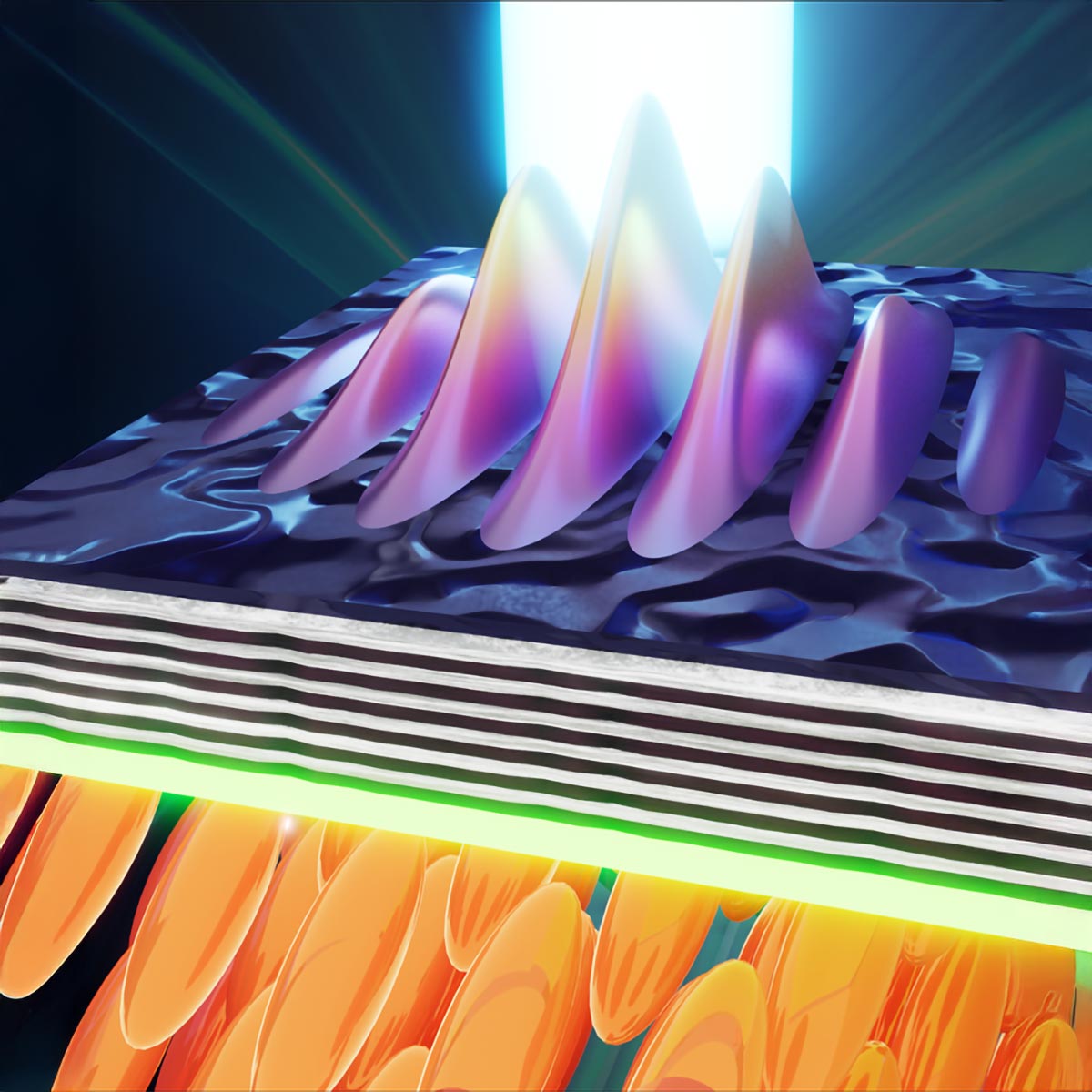
Inside the cavity, light and electronic excitations in the material become strongly coupled, behaving as hybrid entities called exciton polaritons. These quasiparticles last only a few picoseconds, with each picosecond equal to one trillionth of a second. Even that brief lifetime is enough for them to form a Bose-Einstein condensate, in which many particles share a quantum state and behave as a coordinated whole. Such a condensate can act as a quantum superfluid.
Building the sample also started a countdown. The organic semiconductor gradually reacted with the liquid crystal, leaving the researchers only a few hours after assembly to complete all their measurements.
“We had to plan the entire sequence of experiments in advance,” recalls Dr. Marcin Muszyński, the paper’s first author, now a postdoctoral researcher at The City College of New York. “Repeating a measurement meant fabricating an entirely new sample.”
Crystal-like order appears in shifting stripes
The transition to a supersolid showed up as regularly spaced bright fringes in the emitted light. These stripes revealed that the condensate’s density had spontaneously developed a repeating pattern, a hallmark of crystal-like order.
The stripes appeared in a different position with every laser pulse used to excite the sample. Each time, the system selected one of several equally possible arrangements, rather than reproducing a pattern fixed in place.
“This is a textbook example of spontaneous symmetry breaking,” explains Professor Guillaume Malpuech from Institut Pascal (CNRS). “Theory predicted that the supersolid could choose among several equivalent states, and that is exactly what we observed.”
The emitted light also displayed a persistent spin helix, a repeating pattern in its polarization, which describes the orientation of the light’s oscillations. The condensate therefore showed two distinct forms of order at once, one in light intensity and another in polarization.
Supersolid experiments move beyond extreme cold
Physicists predicted supersolids as early as the 1960s, but experimental observations took more than half a century to arrive. In 2017, researchers observed supersolidity in ultracold atomic Bose-Einstein condensates. The new work shows that similar quantum phenomena can be explored in photonic systems operating at room temperature.
“Our liquid-crystal microcavities can operate even at temperatures approaching 60°C,” says Professor Wiktor Piecek from the Military University of Technology, whose group developed the liquid-crystal structures. That is about 140°F.
The microcavities also provide the first electrically tunable platform for investigating supersolid exciton-polariton condensates. Applying an external voltage lets researchers dynamically change their optical properties, providing a flexible way to explore quantum phases of light and matter.
That control could help researchers develop practical quantum devices based on light. Potential applications include ultrafast photonic devices, neuromorphic computing accelerators that take inspiration from the brain, and highly sensitive optical sensors that exploit the supersolid phase’s exceptional sensitivity to polarization.
Reference: “Observation of a supersolid phase in a spin-orbit coupled exciton-polariton Bose-Einstein condensate” by Marcin Muszyński, Pavel Kokhanchik, Rafał Mirek, Darius Urbonas, Pietro Tassan, Piotr Kapuściński, Przemysław Oliwa, Ioannis Georgakilas, Thilo Stöferle, Rainer F. Mahrt, Michael Forster, Ullrich Scherf, Dmitriy Dovzhenko, Rafał Mazur, Przemysław Morawiak, Wiktor Piecek, Przemysław Kula, Barbara Piętka, Dmitry Solnyshkov, Guillaume Malpuech and Jacek Szczytko, 16 October 2026, Science Advances.
DOI: 10.1126/sciadv.aee4875
Never miss a breakthrough: Join the SciTechDaily newsletter.
Follow us on Google and Google News.