

A new detector can measure hundreds of photons with less than a single photon’s uncertainty, offering scientists a sharper way to investigate quantum light and advance future technologies.
Scientists developing powerful quantum computers and highly sensitive cameras need ways to count individual particles of light, even when thousands arrive together. Researchers at Paderborn University in Germany have developed a detection system capable of counting from zero to more than 9,000 photons, opening new possibilities for studying quantum light and making precise optical measurements.
“Precisely counting photons becomes more challenging as their numbers increase,” said Timon Schapeler from Paderborn University. “Our approach extends photon counting to larger numbers of photons, bridging the gap between single-photon measurements and high-sensitivity optical power meters.”
Why conventional detectors struggle to count photons
Conventional detectors struggle with this task. Devices such as avalanche photodiodes typically register whether light is present without revealing how many photons arrived. Detectors designed for larger amounts of light face another problem because electrical noise makes individual photons difficult to distinguish. To overcome these limitations, the researchers combined superconducting nanowire single-photon detectors (SNSPDs), known for their efficiency, precise timing, and low noise, with a technique called multiplexing.
“We wanted to know how high we can push the number of photons that can be counted with SNSPDs,” said Schapeler. “This led to a detector system that uses multiplexing and the intrinsic photon-number resolution of SNSPDs. Although these technologies have been individually studied, there has not previously been a demonstration of using both approaches together at this scale, which is an order of magnitude larger than previous multiplexed single-photon counting systems.”
Splitting light into 1,024 measurements
Previous research had shown that SNSPDs could distinguish limited numbers of photons using precise timing measurements. To expand that capability, the team divided a single light pulse into 128 smaller pulses separated in time, then distributed them across eight detectors to create 1,024 detection bins. This arrangement spreads the incoming photons across smaller measurements while retaining information about how many photons each bin receives.
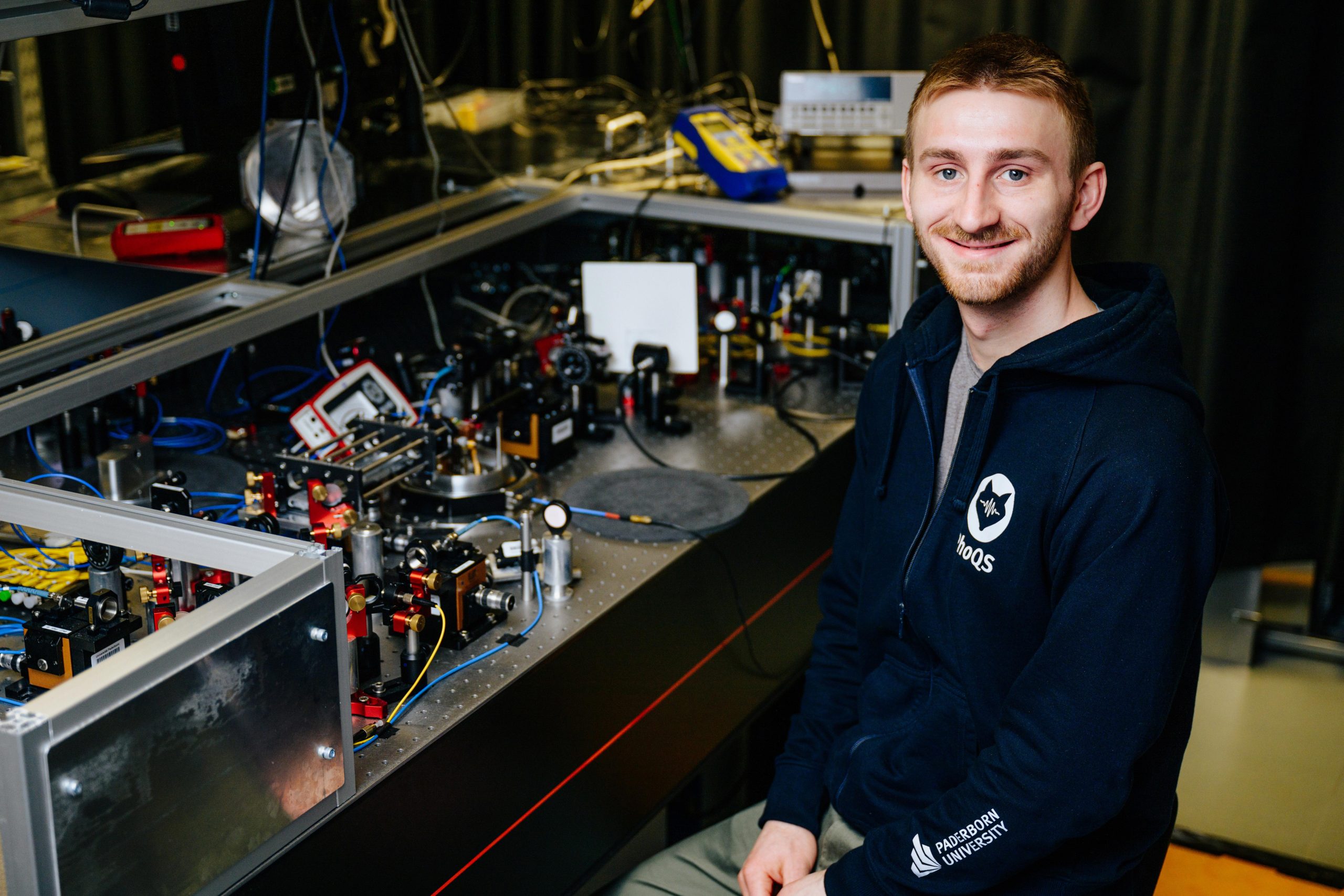
“Our approach uses low-loss optical components to distribute light evenly across 1,024 detection bins while preserving photon-number information in each bin,” said Tim Bartley from Paderborn University. “This enables precise measurements, while multiplexing expands the range of photon numbers the system can measure.”
Counting hundreds of photons with precision
The researchers also used a detector model previously developed with Mariia Sidorova from PTB in Germany to characterize each detection bin and improve measurement accuracy. Testing laser pulses averaging between 1 and 15,000 photons, they demonstrated precise counts of up to 276 photons with uncertainty below a single photon. Achieving comparable precision with a conventional multiplexed system would require approximately 37,000 detector elements, compared with their 1,024 detection bins.
The findings, published in Optica, Optica Publishing Group’s journal for high-impact research, could help scientists develop larger quantum systems that use light to process information.
“Large-scale measurement of individual photons is a cornerstone of photonic quantum computing and single-photon-level imaging,” said Bartley. “With this new macroscopic photon-counting technology, we can learn a lot about how photonic quantum computers and single-photon-sensitive cameras can be scaled.”
Although the system has only been tested with laser pulses, the researchers plan to apply it to bright quantum states of light to investigate quantum effects at larger scales. Continued improvements in SNSPD technology could also support more precise and highly sensitive measurements across a range of sensing applications.
Reference: “Macroscopic photon counting beating the Poisson noise limit” by 19 November 2026, Optica.
DOI: 10.1364/OPTICA.604389
Never miss a breakthrough: Join the SciTechDaily newsletter.
Follow us on Google and Google News.