
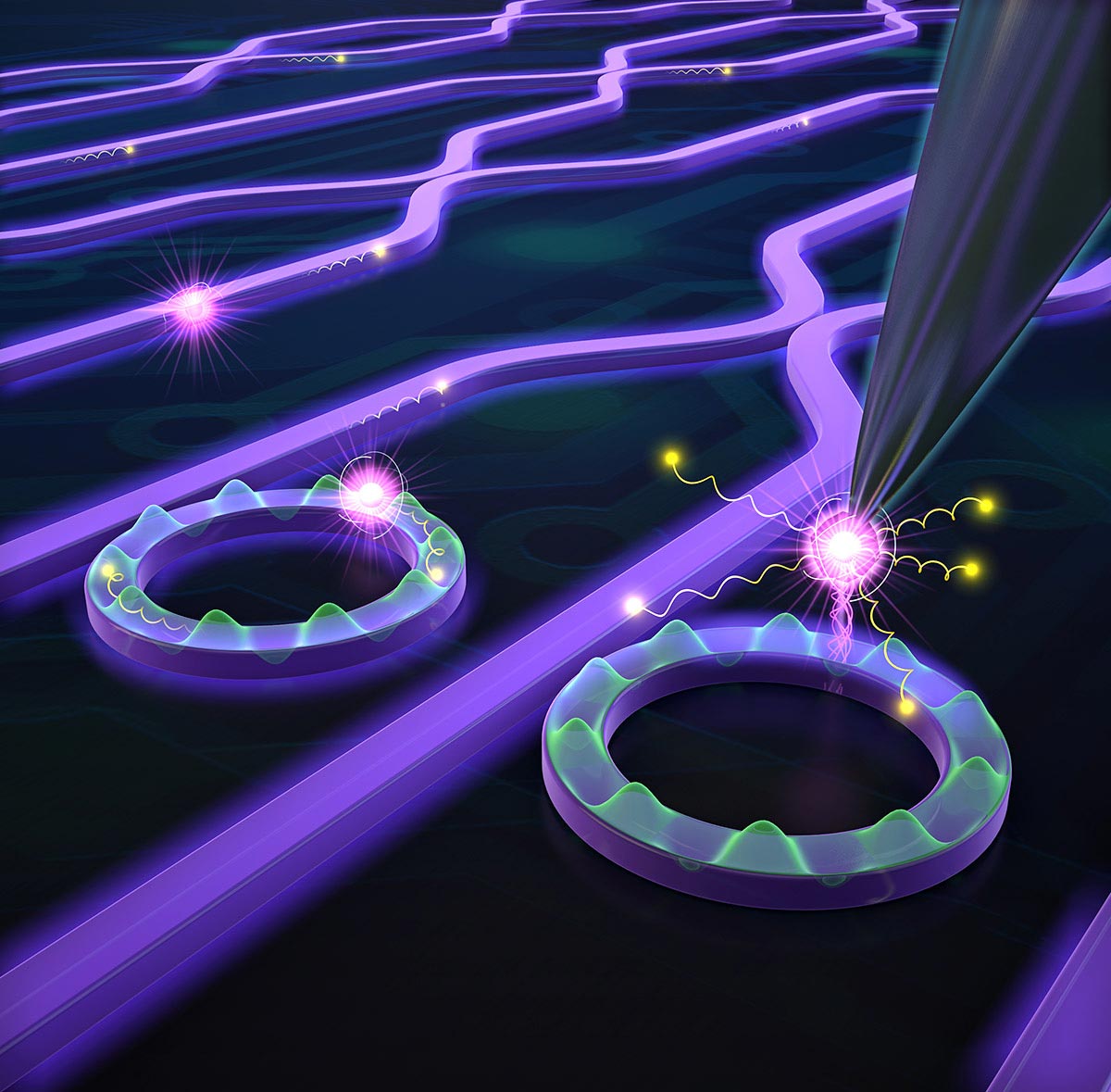
Steven Burrows/Sun Group
JILA breakthrough in integrating artificial atoms with photonic circuits advances quantum computing efficiency and scalability.
In quantum information science, many particles can act as “bits,” from individual atoms to photons. At JILA, researchers utilize these bits as “qubits,” storing and processing quantum 1s or 0s through a unique system.
While many JILA Fellows focus on qubits found in nature, such as atoms and ions, JILA Associate Fellow and University of Colorado Boulder Assistant Professor of Physics Shuo Sun is taking a different approach by using “artificial atoms,” or semiconducting nanocrystals with unique electronic properties. By exploiting the atomic dynamics inside fabricated diamond crystals, physicists like Sun can produce a new type of qubit, known as a “solid-state qubit,” or an artificial atom.
Photonic Circuits and Integration Challenges
Because these artificial atoms do not move, one way to let them talk to each other is to place them inside a photonic circuit. The photons traveling inside the photonic circuit can connect different artificial atoms. Like hot air moving through an air duct to warm a cold room, photons move through the quantum circuit to induce interactions between the artificial atoms. “Having an interface between artificial atoms and photons allows you to achieve precise control of the interactions between two artificial atoms,” explained Sun.
Historically, there have been problems with integrating artificial atoms with photonic circuits. This is because creating the artificial atoms (where atoms are knocked out of a diamond crystal) is a very random process, leading to random placement of the artificial atoms, random number of artificial atoms at each location, and random color each artificial atom emits.
Adding to the issue is the incompatibility between the material that hosts the artificial atoms and the material that hosts the photonic circuit. Despite years of research, scientists have yet to find a suitable material that can be a good host of both, making the integration more difficult.
In a new Nano Letters paper, Sun, his research team, and collaborators from Stanford University proposed a new method that would pave the way to solving these two challenges, enabling a more complicated integrated quantum photonic circuit.
This new technique suggests bigger implications for the future of quantum information science, including a way to scale up the circuits. “We now have a way to integrate multiple artificial atoms on one photonic chip,” explained first author and JILA graduate student Kin Fung Ngan.
Combining Diamonds With Other Materials
Historically, diamond has been a popular choice for hosting artificial atoms, as it’s incredibly pure with a large bandgap, allowing physicists more control over the excitation of the atom inside the crystal.
“Our qubits are embedded into the diamond,” explained Ngan. “The benefit here is that we don’t need any additional apparatus to hold them in space.”
However, the downside of using a diamond as a qubit host is that it’s incredibly hard to carve, making it difficult to define photonic circuits on them. It is also difficult to get a large diamond piece, unlike other photonic materials such as silicon nitride, where eight-inch wafers are readily available.
To make a large quantum photonic circuit, the diamond-based artificial atoms must be placed inside a photonic circuit based on a different material, such as silicon nitride. Sun, Ngan, and JILA graduate student Yuan Zhan had to find ways to integrate the two different components residing in different materials. “If the integration was not achieved properly, you may have a weaker coupling between the atom and the photon or a loss of photons during transmission. These effects will generate errors when we use photons to mediate interactions between two artificial atoms,” elaborated Sun.
While previous studies tried to combine the two materials using external junctions, the researchers took a different approach by embedding a nanosized chunk of diamond containing the artificial atom directly inside the silicon nitride circuit. Using an ultraprecise placement method for arranging the nanodiamonds on the chip, the researchers added nanodiamonds containing an artificial atom to the chip, coated the entire chip with a silicon nitride layer, and then fabricated photonic circuits centered around each atom. This process ensures the maximum coupling between the artificial atom and the photonic circuit.
Testing the New Experimental Setup
After embedding the artificial atoms into the silicon nitride circuit, the researchers tested the coupling efficiency by exciting the artificial atoms and measuring the light collected by the photonic circuit. Their tests showed that the light shone brighter when the atom was placed inside an optical cavity, revealing the ability to efficiently couple light from the artificial atom to the photonic circuit.
Besides contributing to better compatibility, the ultraprecise placement technique allowed researchers to align several artificial atoms in a row on the same circuit, showing the flexibility of their process and its capability to host multiple qubits at once. Currently, Ngan, Zhan, and other JILA researchers are working on techniques to make these artificial atoms interact with each other with the help of photons and to entangle two artificial atoms with the help of photons.
A Duality in Design
While this current quantum photonic circuit leverages photons as mediators for interactions between the artificial atoms (or qubits), the photons themselves can also act as separate qubits within the system.
“The circuit can indeed work for two purposes,” Sun elaborated. “By embedding artificial atoms inside a photonic quantum circuit, we can use the artificial atoms as sources and memories of single photons, potentially reducing the resource required to build a photonic quantum processor.”
The combination of the material compatibility and the duality of the qubits in the system suggests that Sun’s circuit design could have big implications for the future of quantum information, offering an effective way to scale up the integrated quantum photonic systems.
Reference: “Quantum Photonic Circuits Integrated with Color Centers in Designer Nanodiamonds” by Kinfung Ngan, Yuan Zhan, Constantin Dory, Jelena Vučković and Shuo Sun, 2 October 2023, Nano Letters.
DOI: 10.1021/acs.nanolett.3c02645
Never miss a breakthrough: Join the SciTechDaily newsletter.
Follow us on Google and Google News.