

Close Menu
    Facebook X (Twitter) Instagram
    SciTechDaily
    • Biology
    • Chemistry
    • Earth
    • Health
    • Physics
    • Science
    • Space
    • Technology
    Facebook X (Twitter) Pinterest YouTube RSS
    SciTechDaily
    Home»Health»Key Protein Linked to Immune System Disorders
    Health

    Key Protein Linked to Immune System Disorders

    By Hokkaido UniversityMarch 11, 2024No Comments4 Mins Read
    Facebook Twitter Pinterest Telegram LinkedIn WhatsApp Email Reddit
    Share
    Facebook Twitter LinkedIn Pinterest Telegram Email Reddit
    Antibodies Attacking Neuron Concept Art
    A new study reveals the role of STAP-1 in T cell activation and immune response, showing its mediation in cell signaling and its potential link to immune disorders like multiple sclerosis and asthma. This understanding paves the way for therapeutic advancements targeting STAP-1. Credit: SciTechDaily.com

    New research highlights a potential therapeutic target for immune-related disorders, such as multiple sclerosis and asthma.

    A new study has shed light on the importance of the protein STAP-1 in activating certain immune cells. Understanding the role of STAP-1 in these cells could give researchers a better glimpse into immune-related disorders and ways to treat them.

    The researchers found that STAP-1 plays an important role in the activation of T cells, which are white blood cells that play a critical role in defending the body against infections and maintaining overall health. T cells are adept at recognizing foreign molecules that trigger an immune response (antigens) and mounting targeted responses to eliminate pathogens, such as bacteria and viruses.

    The study, published in The Journal of Immunology, investigated how STAP-1 influences immune response. The researchers showed that it acts as an intermediary, facilitating communication between different proteins within the cells and enabling the transmission of signals from one molecule to another.

    “Our findings provide valuable insights into the molecular mechanisms underlying T cell activation and the development of immune disorders,” says Tadashi Matsuda, a Hokkaido University professor who led the study. “We found that STAP-1 plays an important role in regulating immune responses, particularly in the activation and functioning of T cells.”
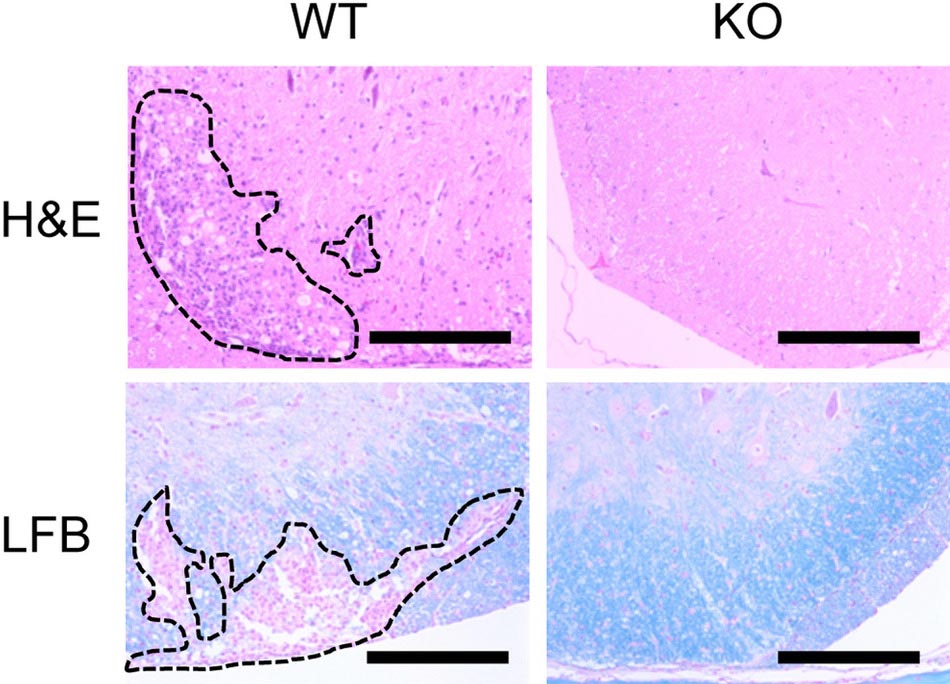
    STAP-1 in Autoimmune Disorders
    The inflammatory reaction in spinal cords of STAP-1 knockout (KO) mice was less severe than that of wild type (WT) mice (top panels). In parallel, spinal cords of STAP-1 KO mice exhibited less demyelination—loss of the myelin sheath that surrounds nerves—when compared with those of WT mice (bottom panels). Credit: Kota Kagohashi, et al. The Journal of Immunology. February 5, 2024

    T cells need two signals to become activated and initiate an immune response. The first signal involves the recognition of antigens presented by other cells, known as antigen-presenting cells. The antigens are recognized by the T cell receptor, a protein complex found on the surface of T cells. The second signal consists of co-stimulatory signals provided by molecules on the antigen-presenting cells.

    The researchers found that STAP-1 helps T cells communicate and respond to signals, particularly those triggered by the T cell receptor. T cells lacking STAP-1 had trouble receiving and transmitting signals properly, reducing the production of certain immune molecules called cytokines. Cytokines can cause inflammation or autoimmune diseases, in which the immune system mistakenly attacks healthy tissues and organs.

    The team also found that STAP-1 interacts with other proteins involved in T cell signaling, forming a complex network that helps regulate T cell activity. They observed that cells lacking STAP-1 had less inflammation in models of diseases like multiple sclerosis and asthma, suggesting that STAP-1 may be involved in the development of these conditions.

    These findings represent a significant step toward understanding immune system regulation. Future research can build on this work by exploring the potential of STAP-1 as a therapeutic target for treating immune-related disorders.

    Reference: “Role of Signal-Transducing Adaptor Protein-1 for T Cell Activation and Pathogenesis of Autoimmune Demyelination and Airway Inflammation” by Kota Kagohashi, Yuto Sasaki, Kiyotaka Ozawa, Takuya Tsuchiya, Shoya Kawahara, Kodai Saitoh, Michiko Ichii, Jun Toda, Yasuyo Harada, Masato Kubo, Yuichi Kitai, Ryuta Muromoto, Kenji Oritani, Jun-ichi Kashiwakura and Tadashi Matsuda, 5 February 2024, The Journal of Immunology.
    DOI: 10.4049/jimmunol.2300202

    This study was supported by Pharma Science Open Unit, Global Facility Center, Hokkaido University, which is funded by the Ministry of Education, Culture, Sports, Science and Technology Japan (MEXT) under the Support Program for Implementation of New Equipment Sharing System.

    Never miss a breakthrough: Join the SciTechDaily newsletter.
    Follow us on Google and Google News.

    Hokkaido University Immunology
    Share. Facebook Twitter Pinterest LinkedIn Email Reddit

    Related Articles

    Revealed: How the COVID-19 Virus Evades Our Immune System

    Scientists Discover a Novel Defense Mechanism Against the COVID-19 Coronavirus

    Researchers Use MRI Brain Scans to Reveal MS Risk in Children

    Researchers Find Antibody That ‘Neutralizes’ Zika Virus

    Nanoparticulate Carbon Black Found in the Lungs of Smokers

    Researchers One Step Closer to Developing Better Vaccines

    New Two-Step Strategy for Weakening Cancer

    Biomarker Discovery May Lead to New Treatments for People With ALS

    Latency Develops Soon After Infection and Slows When Antiretroviral Therapy is Given

    Leave A Reply Cancel Reply

    • Facebook
    • Twitter
    • Pinterest
    • YouTube

    Don't Miss a Discovery

    Subscribe for the Latest in Science & Tech!

    Trending News

    Just 10 Minutes a Day: Scientists Say This Ancient Chinese Practice Shows Powerful Blood Pressure Benefits

    Scientists Say This Popular Food Could Help Your Body Get Rid of Microplastics

    For the First Time, ChatGPT Has Solved an Unproven Math Problem in Geometry

    This Popular Supplement May Actually Slow Biological Aging, Scientists Reveal

    Can a Common Vitamin Fight the Most Aggressive Brain Cancer?

    Scientists Discover How to Stop Vision Loss Before It Starts

    The Mediterranean Isn’t Safe: Scientists Warn of Inevitable Tsunami

    Scientists Say Washing Dishes With a Sponge Has a Concerning Side Effect

    Follow SciTechDaily
    • Facebook
    • Twitter
    • YouTube
    • Pinterest
    • Newsletter
    • RSS
    SciTech News
    • Biology News
    • Chemistry News
    • Earth News
    • Health News
    • Physics News
    • Science News
    • Space News
    • Technology News
    Recent Posts
    • A 30-Year-Old Flu Shot Still Works Today With One Big Problem
    • Widely Available Drug Found To Ease One of Long COVID’s Most Stubborn Symptoms
    • New Study Finds Internalized Stress May Accelerate Cognitive Decline
    • Stopping Weight-Loss Drugs Like Ozempic Can Quickly Erase Heart Benefits
    • A 500-Million-Year-Old Surprise Is Forcing Scientists to Rethink Spider Evolution
    Copyright © 1998 - 2026 SciTechDaily. All Rights Reserved.
    • Science News
    • About
    • Contact
    • Editorial Board
    • Privacy Policy
    • Terms of Use

    Type above and press Enter to search. Press Esc to cancel.