
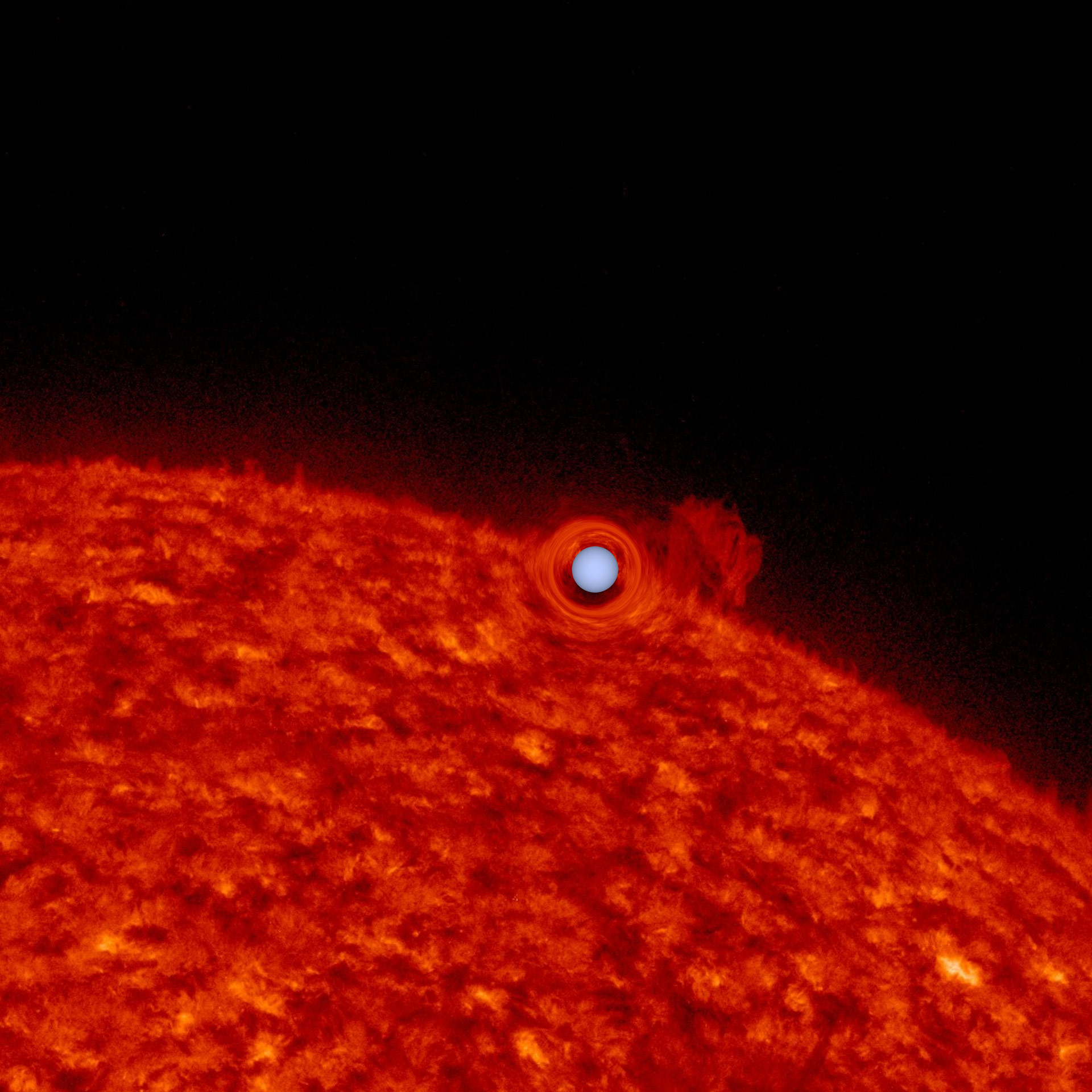
Using data from the Kepler spacecraft, researchers from the University of Washington confirm the first “self-lensing” binary star system.
What looked at first like a sort of upside-down planet has instead revealed a new method for studying binary star systems, discovered by a University of Washington student astronomer.
Working with UW astronomer Eric Agol, doctoral student Ethan Kruse has confirmed the first “self-lensing” binary star system — one in which the mass of the closer star can be measured by how powerfully it magnifies light from its more distant companion star. Though our sun stands alone, about 40 percent of similar stars are in binary (two-star) or multi-star systems, orbiting their companions in a gravitational dance.
Kruse’s discovery confirms an astronomer’s prediction in 1973, based on stellar evolution models of the time, that such a system should be possible. A paper by Kruse and Agol was published in the April 18 edition of Science.
Like so many interesting discoveries, this one happened largely by accident.
Astronomers detect planets too far away for direct observation by the dimming in light when a world passes in front of, or transits, its host star. Kruse was looking for transits others might have missed in data from the planet-hunting Kepler Space Telescope when he saw something in the binary star system KOI-3278 that didn’t make sense.
“I found what essentially looked like an upside-down planet,” Kruse said. “What you normally expect is this dip in brightness, but what you see in this system is basically the exact opposite — it looks like an anti-transit.”
The two stars of KOI-3278, about 2,600 light-years (a light-year is 5.88 trillion miles) away in the Lyra constellation, take turns being nearer to Earth as they orbit each other every 88.18 days. They are about 43 million miles apart, roughly the distance the planet Mercury is from the sun. The white dwarf, a cooling star thought to be in the final stage of life, is about Earth’s size but 200,000 times more massive.
That increase in light, rather than the dip Kruse thought he’d see, was the white dwarf bending and magnifying light from its more distant neighbor through gravitational lensing, like a magnifying glass.
“The basic idea is fairly simple,” Agol said. “Gravity warps space and time and as light travels toward us it actually gets bent, changes direction. So, any gravitational object — anything with mass — acts as a magnifying glass,” though a weak one. “You really need large distances for it to be effective.”
“The cool thing, in this case, is that the lensing effect is so strong, we are able to use that to measure the mass of the closer, white dwarf star. And instead of getting a dip now you get a brightening through the gravitational magnification.”
This finding improves on research in 2013 by the California Institute of Technology, which detected a similar self-lensing effect minus the brightening of the light because the two stars being studied were much closer together.
“The effect in this system is much stronger,” said Agol. “The larger the distance, the more the effect.”
Gravitational lensing is a common tool in astronomy. It has been used to detect planets around distant stars within the Milky Way galaxy, and was among the first methods used to confirm Albert Einstein’s general theory of relativity. Lensing within the Milky Way galaxy, such as this, is called microlensing.
But until now, the process had only been used in the fleeting instances of a nearby and distant star, not otherwise associated in any way, aligning just right, before going their separate ways again.
“The chance is really improbable,” said Agol. “As those two stars go through the galaxy they’ll never come back again, so you see that microlensing effect once and it never repeats. In this case, though, because the stars are orbiting each other, it repeats every 88 days.”
White dwarfs are important to astronomy, and are used as indicators of age in the galaxy, the astronomers said. Basically embers of burned-out stars, white dwarfs cool off at a specific rate over time. With this lensing, astronomers can learn with much greater precision what its mass and temperature are, and follow-up observations may yield its size.
By expanding their understanding of white dwarfs, astronomers take a step closer to learning about the age of the galaxy.
“This is a very significant achievement for a graduate student,” Agol said.
The two have sought time to use the Hubble Space Telescope to study KOI-3278 in more detail, and to see if there are other such star systems waiting to be discovered in the Kepler data.
“If everyone’s missed this one, then there could be many more that everyone’s missed as well,” said Kruse.
The research was funded by grants from the National Science Foundation (#AST 0645416) and NASA (#12-OSS12-0011).
Reference: “KOI-3278: A Self-Lensing Binary Star System” by Ethan Kruse and Eric Agol, 18 April 2014, Science.
DOI: 10.1126/science.1251999
arXiv: 1404.4379
Never miss a breakthrough: Join the SciTechDaily newsletter.
Follow us on Google and Google News.