
Close Menu
    Facebook X (Twitter) Instagram
    SciTechDaily
    • Biology
    • Chemistry
    • Earth
    • Health
    • Physics
    • Science
    • Space
    • Technology
    Facebook X (Twitter) Pinterest YouTube RSS
    SciTechDaily
    Home»Space»Massive SLS Rocket Test: NASA to Apply Millions of Pounds of Force to Try to Break Oxygen Tank Structure
    Space

    Massive SLS Rocket Test: NASA to Apply Millions of Pounds of Force to Try to Break Oxygen Tank Structure

    By NASAJune 21, 2020No Comments6 Mins Read
    Facebook Twitter Pinterest Telegram LinkedIn WhatsApp Email Reddit
    Share
    Facebook Twitter LinkedIn Pinterest Telegram Email Reddit
    Liquid Oxygen Tank Structural Test Article Crop
    (Click image for full view.) The liquid oxygen tank structural test article, shown here, for NASA’s Space Launch System (SLS) rocket’s core stage was the last test article loaded into the test stand July 10, 2019. The liquid oxygen tank is one of two propellant tanks in the rocket’s massive core stage that will produce more than 2 million pounds of thrust to help launch Artemis I, the first flight of SLS and NASA’s Orion spacecraft to the Moon. Now, the tank will undergo the final test completing a three-year structural test campaign at NASA’s Marshall Space Flight Center in Huntsville, Alabama. Tests conducted during this campaign put the rocket’s structures from the top of the upper stage to the bottom of the core stage through strenuous tests simulating the forces that the rocket will experience during launch and flight. All four of the core stage structural test articles were manufactured at NASA’s Michoud Assembly Facility in New Orleans and delivered by NASA’s barge Pegasus to Marshall. Credit: NASA/Tyler Martin

    NASA’s Space Launch System (SLS) Program is concluding its structural qualification test series with one upcoming final test that will push the design for the rocket’s liquid oxygen tank to its limits at NASA’s Marshall Space Flight Center in Huntsville, Alabama.
    SLS Liquid Oxygen Tamk Test Crop
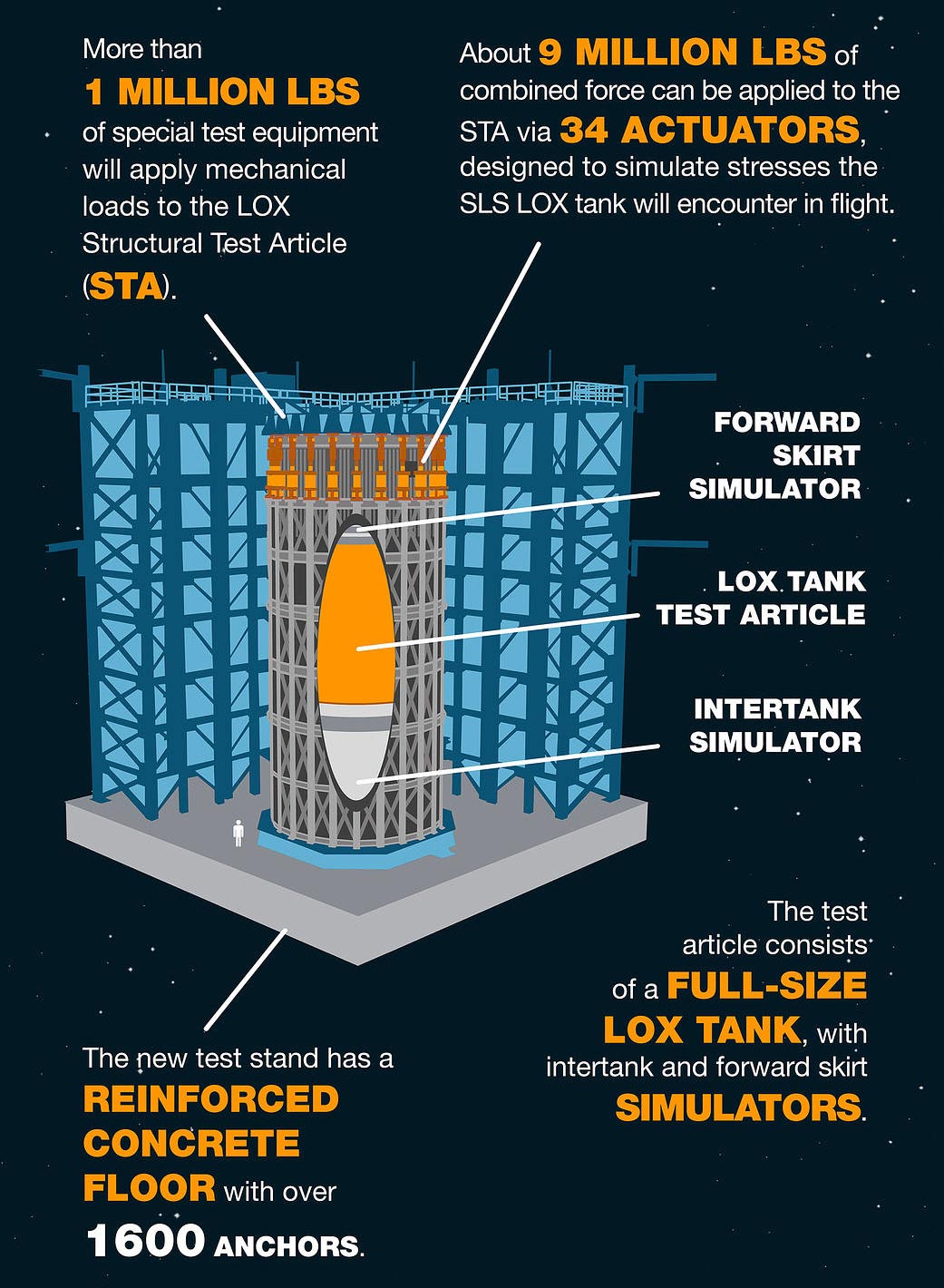
    (Click image for full view.) NASA’s Space Launch System Program concludes its structural qualification test campaign at NASA’s Marshall Space Flight Center in Huntsville, Alabama, with the testing of the rocket’s liquid oxygen tank. Before the SLS rocket launches NASA’s Artemis missions to the Moon, the rocket’s liquid oxygen tank, the smaller of the two propellant tanks in its 212-foot-tall core stage, must undergo testing to ensure its structure is strong enough to withstand the extreme forces it will experience during launch and flight. Secured in the test stand, giant simulators push and pull on the tank to mimic the extreme forces of launch and flight. Credit: NASA/Kevin O’Brien

    In the name of science, engineers will try to break a structural test article of the tank — on purpose. The liquid oxygen tank’s structure is identical to the tank that is part of the SLS core stage, which will provide power to help launch the Artemis missions to the Moon. The tank is enclosed in a cage-like structure that is part of the test stand. Hydraulic systems will apply millions of pounds of force to push, pull and bend the liquid oxygen tank test article to see just how much pressure the tank can take. The forces simulate what the tank is expected to experience during launch and flight. For the test, the tank will be filled with water to simulate the liquid oxygen propellant used for flight, and when the tank ruptures, the water may create a loud sound as it bursts through the tank’s skin.

    “We take rocket tanks to extreme limits and break them because pushing systems to the point of failure gives us a data to help us build rockets more intelligently,” said Neil Otte, chief engineer for the SLS Stages Office at Marshall. “Breaking the propellant tank today on Earth will provide us with valuable data for safely and efficiently flying SLS on the Artemis missions to the Moon.”

    Earlier this year, NASA and Boeing engineers subjected the tank to 23 baseline tests that simulate actual flight conditions, and the tank aced the tests. The tank is fitted with thousands of sensors to measure stress, pressure, and temperature, while high-speed cameras and microphones capture every moment to identify buckling or cracking in the cylindrical tank wall. This final test will apply controlled forces stronger than those engineers expect the tank to endure during flight, similar to the test that ruptured the liquid hydrogen tank and created noise heard in some Huntsville neighborhoods near Marshall.

    This is the final test in a series of structural qualification tests that have pushed the rocket’s structures to the limits from top to bottom to help ensure the rocket is ready for the Artemis lunar missions. Completion of this upcoming test will mark a major milestone for the SLS Program.

    The Marshall team started structural qualification testing on the rocket in May 2017 with an integrated test of the upper part of the rocket stacked together: the Interim Cryogenic Propulsion Stage, the Orion stage adapter, and the launch vehicle stage adapter. Then the team moved on to testing the four largest structures that make up the 212-foot-tall (65-meter-tall) core stage. The last baseline test for Artemis I was completed in March 2020 before the team’s access to Marshall was restricted because of the COVID-19 pandemic. The NASA and Boeing team returned to work the first week in June to prepare for conducting the final liquid oxygen test to failure.
    Space Launch System Leaves Earth
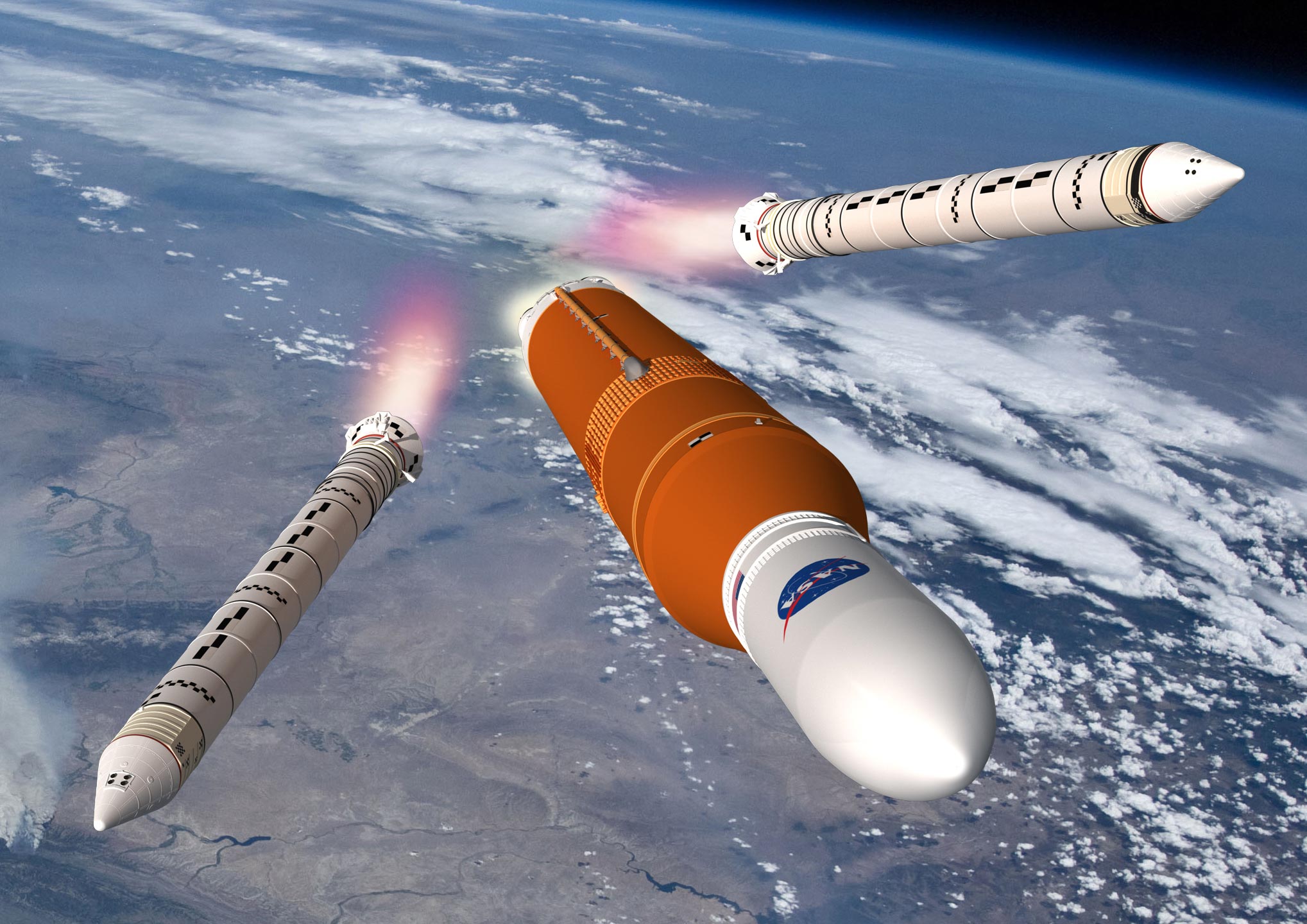
    This illustration depicts NASA’s Space Launch System (SLS) in the Block 1 cargo configuration as it leaves Earth. To first lift SLS to orbit, the solid rocket boosters along with the core stage engines produce 8.8 million pounds (4 million kilograms) of thrust. So that the rocket doesn’t have to carry all the weight of the boosters and the core stage to the Moon, they separate from the rocket. Then, the rocket’s upper stage provides power to send payloads to more distant destinations. The Block 1 configuration is capable of sending more than 57,000 pounds (26,000 kilograms), about the same weight as 12 fully grown elephants, to the Moon. Credit: NASA

    The structural qualification tests help verify models showing the structural design can survive the flight. Structural testing has been completed on three of the largest core stage structures: the engine section, the intertank, and the liquid hydrogen tank. The liquid oxygen tank has completed baseline testing and will now wrap up core stage testing with the upcoming test to find the tank’s point of failure.

    “The liquid oxygen tests and the other tests to find the point of failure really put the hardware through the paces,” said April Potter, the SLS test project manager for liquid oxygen and liquid hydrogen structural tests. “NASA will now have the information to build upon our systems and push exploration farther than ever before.”

    The SLS rocket, Orion spacecraft, Gateway, and human landing system are part of NASA’s backbone for deep space exploration. The Artemis program is the next step in human space exploration. It is part of America’s broader Moon to Mars exploration approach, in which astronauts will explore the Moon and gain experience to enable humanity’s next giant leap, sending humans to Mars.

    Never miss a breakthrough: Join the SciTechDaily newsletter.
    Follow us on Google and Google News.

    ARTEMIS Mission NASA Popular Space Launch System
    Share. Facebook Twitter Pinterest LinkedIn Email Reddit

    Related Articles

    NASA’s Engineering Marvel: Preparing the Gateway to the Moon

    Moonbound Majesty: Astronauts’ Inside Look at SLS, the Engine of Artemis Dreams

    NASA Tests Upgraded Artemis Moon Rocket Engines at 113% Power Level

    NASA’s Artemis I Moon Rocket Ready To Launch – How To Watch Live

    NASA Completes Artemis I Moon Rocket Test, Moves Forward Toward Launch

    NASA Artemis I Moon Rocket Test: SLS Fully Fueled for First Time Despite Leak

    NASA Conducts 2nd RS-25 Engine Hot Fire Test for World’s Most Powerful Rocket

    NASA Conducts Massive SLS Rocket Booster Test for Artemis Mission to the Moon

    NASA Artemis Missions Set to Begin Next Year as SLS Rocket Costs Climb

    Leave A Reply Cancel Reply

    • Facebook
    • Twitter
    • Pinterest
    • YouTube

    Don't Miss a Discovery

    Subscribe for the Latest in Science & Tech!

    Trending News

    What Causes Chronic Pain? Scientists Identify Key Culprit in the Brain

    Semaglutide Shows Surprising Mental Health Benefits in Massive 100,000-Person Study

    This Liquid Snapped Instead of Flowing and Scientists Were Shocked

    Breakthrough Alzheimer’s Drug Rewires the Brain Instead of Just Clearing Plaques

    Scientists Discover Hidden “Footprint of Death” That Could Transform How We Fight Disease

    A Simple Nose Swab Could Detect Alzheimer’s Years Before Symptoms Appear

    Scientists Just Rewrote the Timeline of Complex Life on Earth

    Teenager’s Fossil Find Leads to Discovery of Shark Teeth in 5 Million-Year-Old Whale Skull

    Follow SciTechDaily
    • Facebook
    • Twitter
    • YouTube
    • Pinterest
    • Newsletter
    • RSS
    SciTech News
    • Biology News
    • Chemistry News
    • Earth News
    • Health News
    • Physics News
    • Science News
    • Space News
    • Technology News
    Recent Posts
    • Even “Failed” Diets May Deliver Long-Term Health Gains, Study Finds
    • Childhood Junk Food May Rewire the Brain for Life
    • NIH Scientists Discover Powerful New Opioid That Relieves Pain Without Dangerous Side Effects
    • Breakthrough Study Reveals Why Damaged Nerves Struggle To Heal
    • 20-Year Study Reveals Cholera’s Surprising Weakness
    Copyright © 1998 - 2026 SciTechDaily. All Rights Reserved.
    • Science News
    • About
    • Contact
    • Editorial Board
    • Privacy Policy
    • Terms of Use

    Type above and press Enter to search. Press Esc to cancel.