
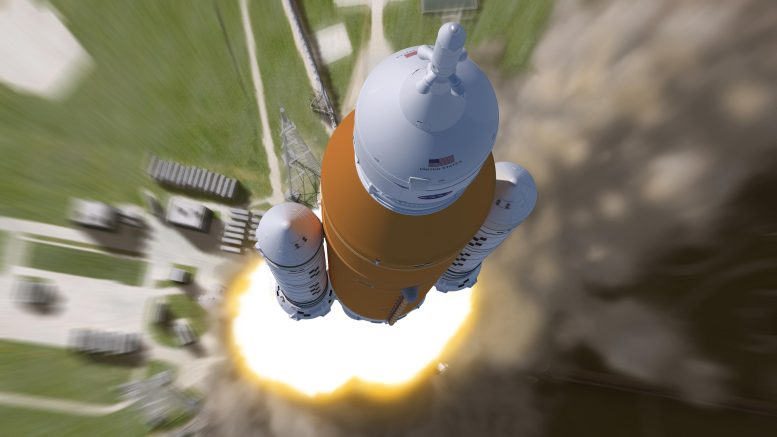
NASA has confirmed that it remains on track for the launch of the Artemis I Moon mission during a two-hour launch window that opens at 1:04 a.m. EST on Wednesday, November 16.
The launch countdown will begin at 1:24 a.m. on Monday, November 14.
Artemis I is the first integrated flight test of NASA’s Space Launch System (SLS) rocket, an uncrewed Orion spacecraft, and the ground systems at the agency’s Kennedy Space Center in Florida. SLS is a super heavy-lift launch vehicle with unprecedented power and capabilities that provides the foundation for human exploration beyond Earth’s orbit. Orion is NASA’s new human spacecraft for deep-space missions that will serve as the exploration vehicle that will carry the crew to space, provide emergency abort capability, sustain astronauts during their missions and provide safe re-entry from deep space return velocities. The Artemis I mission will pave the way for a crewed test flight and future human lunar exploration as part of Artemis.
Following Hurricane Nicole, teams conducted thorough assessments of the rocket, spacecraft, and associated ground systems and confirmed that there were no significant impacts from the severe weather. The SLS rocket and Orion spacecraft arrived at Kennedy’s Launch Pad 39B on November 4 and rode out the storm there.
Live coverage of briefings and events will air on NASA Television, the NASA app, and the agency’s website at: https://www.nasa.gov/live
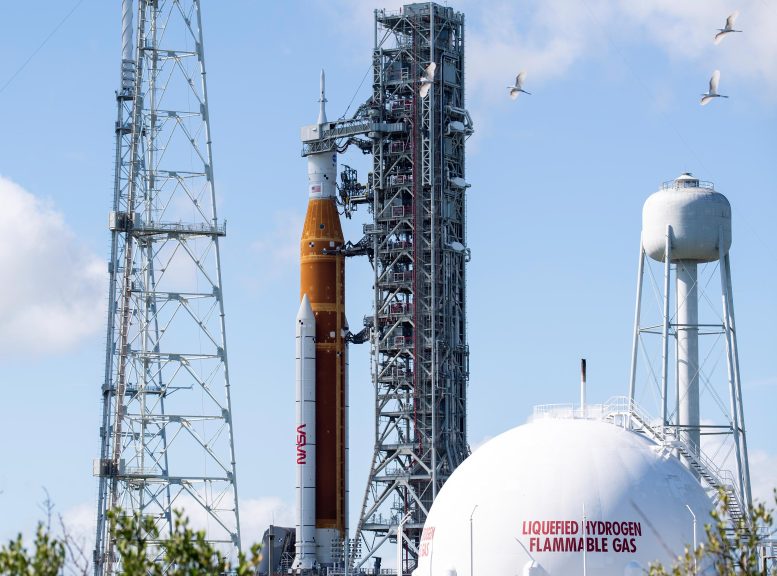
Engineers previously rolled the rocket back to the Vehicle Assembly Building (VAB) on September 26 ahead of Hurricane Ian and after waving off two previous launch attempts on August 29 due to a faulty temperature sensor, and September 4 due to a liquid hydrogen leak at an interface between the rocket and mobile launcher. Before to rolling back to the VAB, teams successfully repaired the leak and demonstrated updated tanking procedures. While in the VAB, teams performed standard maintenance to repair minor damage to the foam and cork on the thermal protection system and recharge or replace batteries throughout the system.
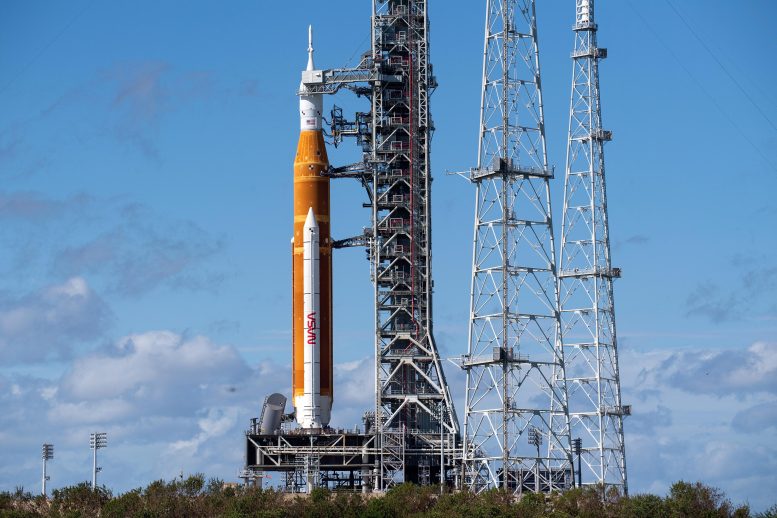
Full launch coverage is as follows. All times are Eastern, and the information is subject to change.
Sunday, November 13
7 p.m.: NASA will hold a prelaunch media teleconference following a mission management team meeting with the following participants:
- Bill Nelson, NASA administrator
- Mike Sarafin, Artemis mission manager, NASA Headquarters
- Charlie Blackwell-Thompson, Artemis launch director, Exploration Ground Systems Program, Kennedy
- Emily Nelson, chief flight director, NASA Johnson
- Melody Lovin, weather officer, U.S. Space Launch Delta 45
Monday, November 14
12 p.m.: NASA will hold a prelaunch media briefing on NASA TV to provide a status on the launch countdown with the following participants:
- Jeremy Parsons, Exploration Ground Systems Program deputy manager, NASA Kennedy
- Melody Lovin, weather officer, U.S. Space Launch Delta 45
Tuesday, November 15
3:30 p.m.: NASA TV commentary coverage of tanking operations to load propellant into the SLS rocket begins, including views of the rocket and Launch Control Center, and audio from a commentator.
10:30 p.m.: NASA TV commentary coverage of launch begins in English. Coverage will continue through translunar injection and spacecraft separation, setting Orion on its path to the Moon.
Wednesday, November 16
12 a.m.: NASA TV commentary coverage of launch begins in Spanish on NASA’s Spanish-language YouTube account and will continue approximately 15 minutes after liftoff. Mission coverage updates will be posted on the NASA en español social media channels.
4 a.m.: NASA TV coverage of the postlaunch news conference will follow approximately one hour after the live launch broadcast ends. Coverage start time is subject to change, based on the exact liftoff time. The postlaunch news conference will include the following participants:
- Bill Nelson, NASA administrator
- Mike Sarafin, Artemis mission manager, NASA Headquarters
- Mike Bolger, Exploration Ground Systems Program manager, Kennedy
- John Honeycutt, Space Launch System Program manager, Marshall
- Howard Hu, Orion Program manager, NASA’s Johnson Space Center
- Emily Nelson, chief flight director, Johnson
8:30 a.m.: NASA TV commentary coverage of Orion’s first outbound trajectory burn on the way to the Moon. Coverage start time is subject to change, based on the exact liftoff time.
10 a.m.: NASA TV commentary coverage of first Earth views from Orion during outbound coast to the Moon.
NASA Television coverage of additional events throughout the mission is available online.

Attend Launch Virtually
Members of the public can register to attend the launch virtually. NASA’s virtual guest program for the mission includes curated launch resources, notifications about related opportunities or changes, and a stamp for the NASA virtual guest passport following a successful launch.
Watch, Engage on Social Media
Stay connected with the mission and let people know you are following the launch on Twitter, Facebook, and Instagram with #Artemis. Follow and tag these accounts:
- Twitter: @NASA, @NASAArtemis
- Facebook: NASA, NASAArtemis
- Instagram: NASA, NASAArtemis
The public can track the Artemis I mission as it happens using to Artemis Real-time Orbit Website, which will provide information about where Orion is in relation to the Earth and the Moon. Individuals also can also download a virtual boarding pass to commemorate the historic flight.
Through Artemis missions, NASA will land the first woman and the first person of color on the lunar surface and establish long-term exploration at the Moon in preparation for human missions to Mars. SLS and NASA’s Orion spacecraft, along with the commercial human landing system and the Gateway in orbit around the Moon, are NASA’s backbone for deep space exploration. SLS is the only rocket that can send Orion, astronauts, and supplies to the Moon in a single mission.
Never miss a breakthrough: Join the SciTechDaily newsletter.
Follow us on Google and Google News.
15 Comments
We shall see if this thing gets off the ground this time. Maybe, maybe not…
Too bad NASA didn’t ask SpaceX how to land first stage so they could reuse it. I mean SpaceX IS fairly close by.
I’ll be surprised, pleasantly, if everything actually works. But somehow I doubt it.
The article main title image isn’t an artist rendering but a screen shot from the video game Kerbal Space Program
I guess the launch info changes according to weather conditions. Anyone made weather control tech yet? JK
Someone was looking over my shoulder and asked me if I played that game. I didn’t know why until I saw your comment
Folks…
Is this project really worth 50 BILLION DOLLARS?
What’s it going to do for you? Give you a house on the moon? … Or what?
That 50 BILLION DOLLARS could have better spent to improve the life of the PEOPLE OF THE UNITED STATES !!!!!
1 ROCKET…50 BILLION DOLLARS…Makes no sense to me!
GO NASA…Your terribly weak contributions yield exceedingly poor benefits!
“makes no sense to me!” yep, and that’s why you don’t work for NASA.
The US government could’ve bought a social media platform for that amount of cash.
Artist rendering?
That’s a screenshot from Kerbal Space Program.
Not impressed when for Artemis you need a separate rocket!! for the lunar lander & rover! This rocket should be a lot smaller than the Saturn V! aint it?
It will be good to see forward progress on our space program again. The increasing technology will help us accelerate new advances in fuel, energy and understanding of science.
I wouldn’t say that NASA “will” land the first woman on the moon, but China may beat us yet. Better to say we “hope to.”
Finally… Is it really going to happen. All that time and money and delays… It better.
Or this might spell the end for NASA. At least for the bigger prodjects.
We gotta get there now ro claim the water..else it will fall to the Chinese….honestly you guys really not understand this? Sheesh…thus has got to work….forget the price tag…he who claims the water owns the moon…simple…lol yes space rocks, how about we just enjoy the show. There is also alot to be said about nurturing different supply chains…Boeing needs a win…
Question wondering if the Aretmis 1 mission will have dummy’s aboard the rocket flying to the moon how will nasa test the communications on that rocket on this mission for further missions when they do have astronauts on board ?
If the Aretmis 1 mission will have dummy”s onboard flying to the moon how will Nasa test the communications system of the rocket for future astronauts fly onboard.