
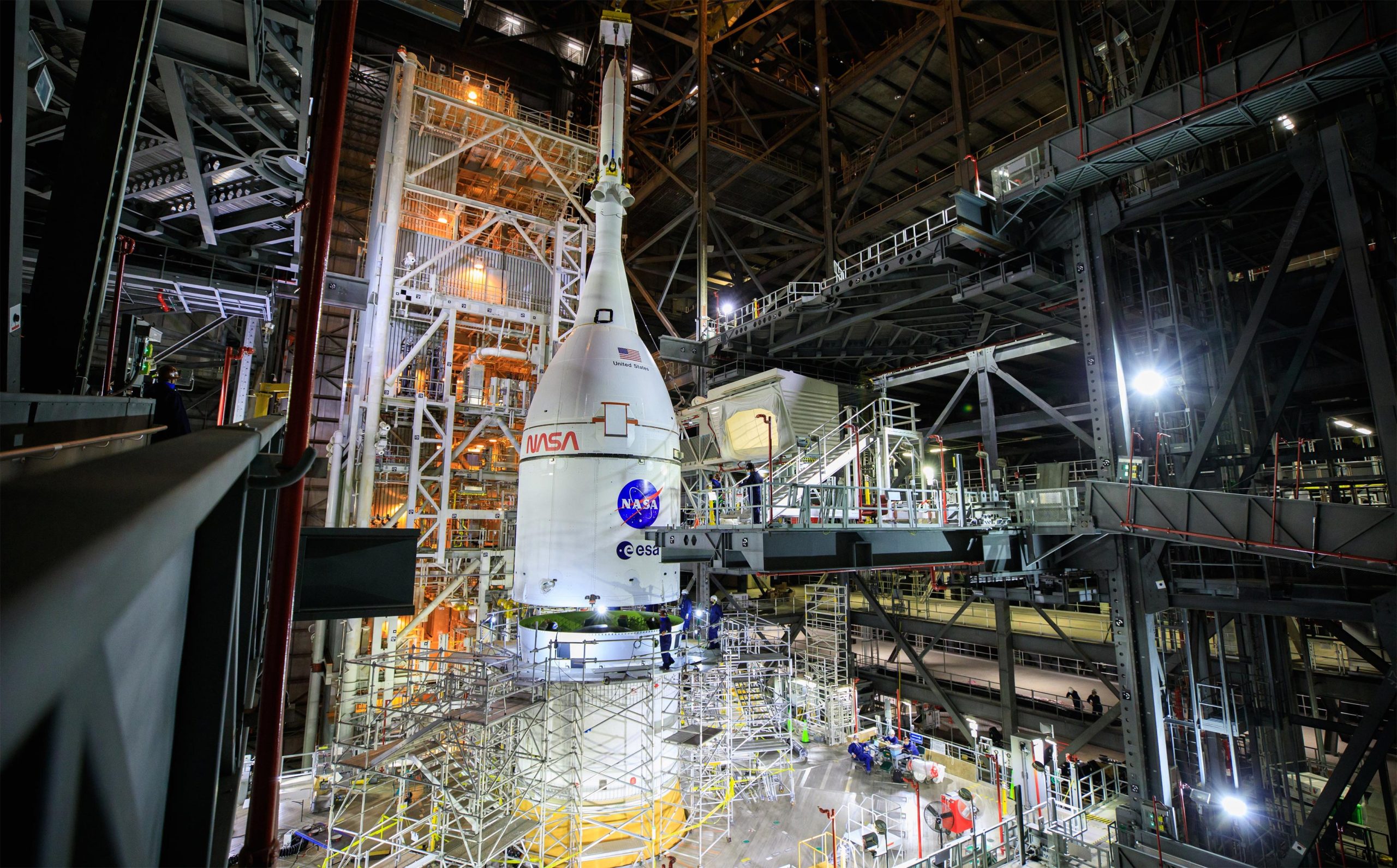
NASA’s Orion spacecraft is secured atop the agency’s powerful Space Launch System rocket, and the integrated system is entering the final phase of preparations for an upcoming uncrewed flight test around the Moon. The mission, known as Artemis I, will pave the way for a future flight test with crew before NASA establishes a regular cadence of more complex missions with astronauts on and around the Moon under Artemis. With stacking complete, a series of integrated tests now sit between the mega-Moon rocket and targeted liftoff for deep space in February 2022.
“It’s hard to put into words what this milestone means, not only to us here at Exploration Ground Systems, but to all the incredibly talented people who have worked so hard to help us get to this point,” said Mike Bolger, Exploration Ground Systems program manager. “Our team has demonstrated tremendous dedication preparing for the launch of Artemis I. While there is still work to be done to get to launch, with continued integrated tests and Wet Dress Rehearsal, seeing the fully stacked SLS is certainly a reward for all of us.”
Time-lapse of the stacking of the Orion spacecraft on top of the fully assembled Space Launch System (SLS) rocket at NASA’s Kennedy Space Center in Florida, on October 21, 2021, in preparation for the uncrewed Artemis I launch. Credit: ESA – European Space Agency
Each of the test campaigns will evaluate the rocket and spacecraft as an integrated system for the first time, building upon each other and culminating in a simulation at the pad to prepare for launch day.
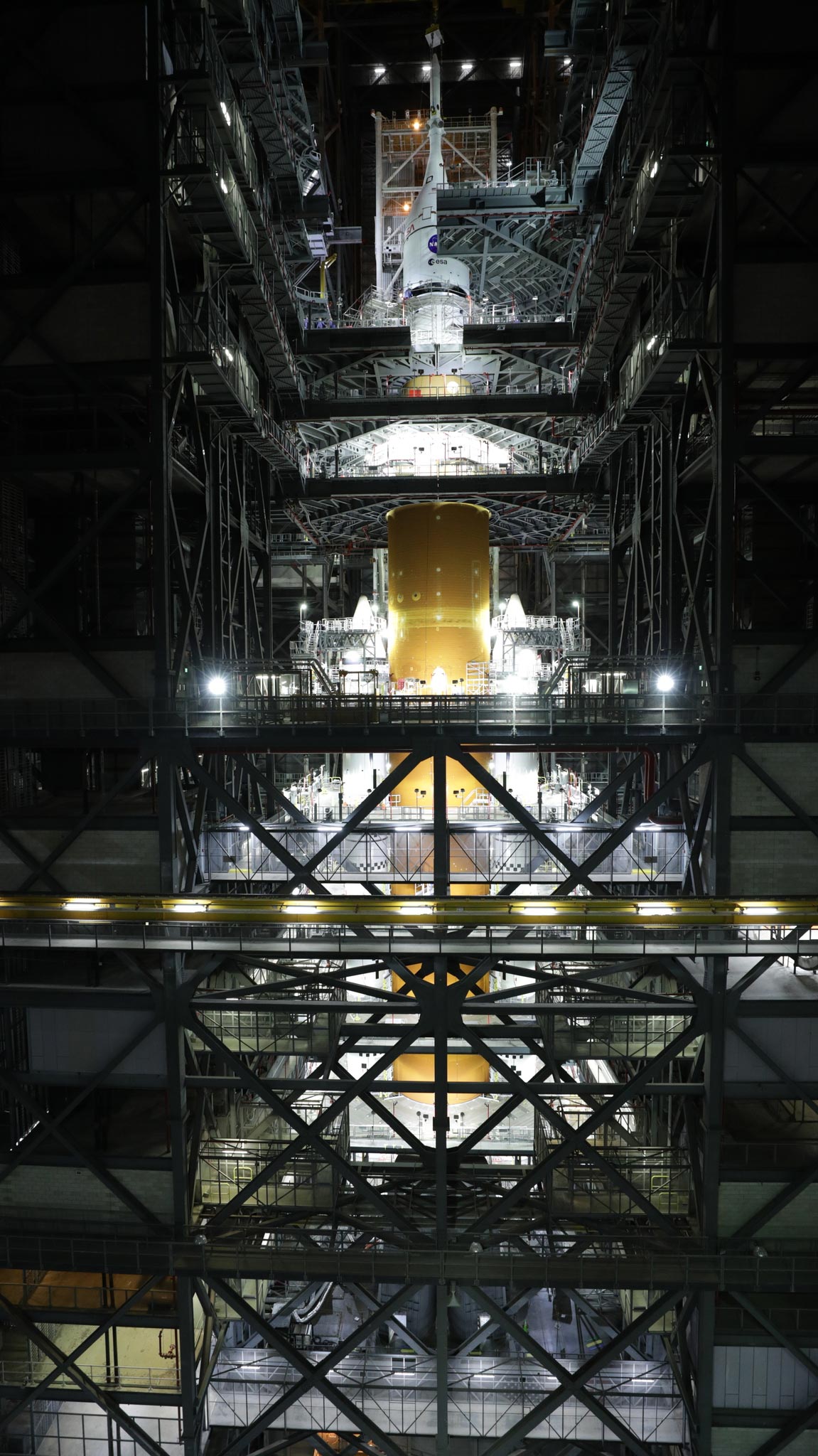
Interface Verification Testing – verifies the functionality and interoperability of interfaces across the elements and systems. Teams will conduct this test from the firing room in the Launch Control Center and will start by powering up Orion to charge the batteries and perform health and status checks of various systems. Next, the teams will do the same to check interfaces between the core stage and boosters and the ground systems, and ensure functionality of different systems, including core stage engines and booster thrust control, as well as the Interim Cryogenic Propulsion Stage (ICPS). A final integrated test, with all wire harnesses installed throughout the rocket and spacecraft, will verify their ability to talk to each other and to ground systems.
Program Specific Engineering Testing – ensures functionality of a variety of different systems. Following the interface verification test for the core stage and boosters, additional testing will perform several checks in the Vehicle Assembly Building (VAB) for the core stage and booster systems, such as a booster thrust control test. Later, engineers will conduct an additional engineering test during the visit to pad 39B for wet dress rehearsal.
End-to-End Communications Testing – integrated test of radio frequencies from mission control to SLS, ICPS, and Orion – all to demonstrate our ability to communicate with the ground. This test uses a radio frequency antenna in the VAB, another near the pad that will cover the first few seconds of launch, as well as a more powerful antenna that uses the Tracking Data Relay Satellite and the Deep Space Network.
Countdown Sequencing Testing – conducts a simulated launch countdown inside the VAB to demonstrate the ground launch software and ground launch sequencer, which checks for health and status of the vehicle sitting on the pad. The teams will configure the rocket in the VAB for launch and run the sequencer to a predefined point in the countdown – testing the responses from the rocket and spacecraft and ensuring the sequencer can run without any issues. On launch day, the ground launch sequencer hands off to the rocket and spacecraft and an automated launch sequencer takes over around 30 seconds before launch.
Wet Dress Rehearsal Testing – demonstrates the ability to load cryogenic, or supercold, propellants, including detanking the propellants with the Artemis I rocket at the launch pad on the mobile launcher. Several weeks before the actual launch, Artemis I will roll the roughly four miles to Pad 39B atop the crawler-transporter. There it will undergo checkouts at the pad, and teams will practice the launch countdown and then recycle back to T-10 minutes to demonstrate the ability to scrub a launch and de-tank.
Prior to rolling out to the pad for wet dress, teams will conduct the first of a two-part test of the flight termination system inside the VAB. Once the systems are verified, the 322-foot-tall rocket will roll back into the VAB for final inspections and checkouts, including the second part of the flight termination system test, ahead of returning to the pad for launch.
Leading up to launch, Artemis I mission operations teams also will continue additional launch simulations to run the team through its paces, ensuring they are ready for any scenario with this new vehicle come launch day.
The agency will set a specific date for the launch following a successful wet dress rehearsal. The first in a series of increasingly complex missions, Artemis I will provide a foundation for human deep space exploration and demonstrate our commitment and capability to extend human existence to the Moon and beyond prior to the first flight with crew on Artemis II.
Never miss a breakthrough: Join the SciTechDaily newsletter.
Follow us on Google and Google News.