
Close Menu
    Facebook X (Twitter) Instagram
    SciTechDaily
    • Biology
    • Chemistry
    • Earth
    • Health
    • Physics
    • Science
    • Space
    • Technology
    Facebook X (Twitter) Pinterest YouTube RSS
    SciTechDaily
    Home»Space»NASA Artemis Missions Set to Begin Next Year as SLS Rocket Costs Climb
    Space

    NASA Artemis Missions Set to Begin Next Year as SLS Rocket Costs Climb

    By Kathy Lueders, NASAAugust 30, 20201 Comment6 Mins Read
    Facebook Twitter Pinterest Telegram LinkedIn WhatsApp Email Reddit
    Share
    Facebook Twitter LinkedIn Pinterest Telegram Email Reddit
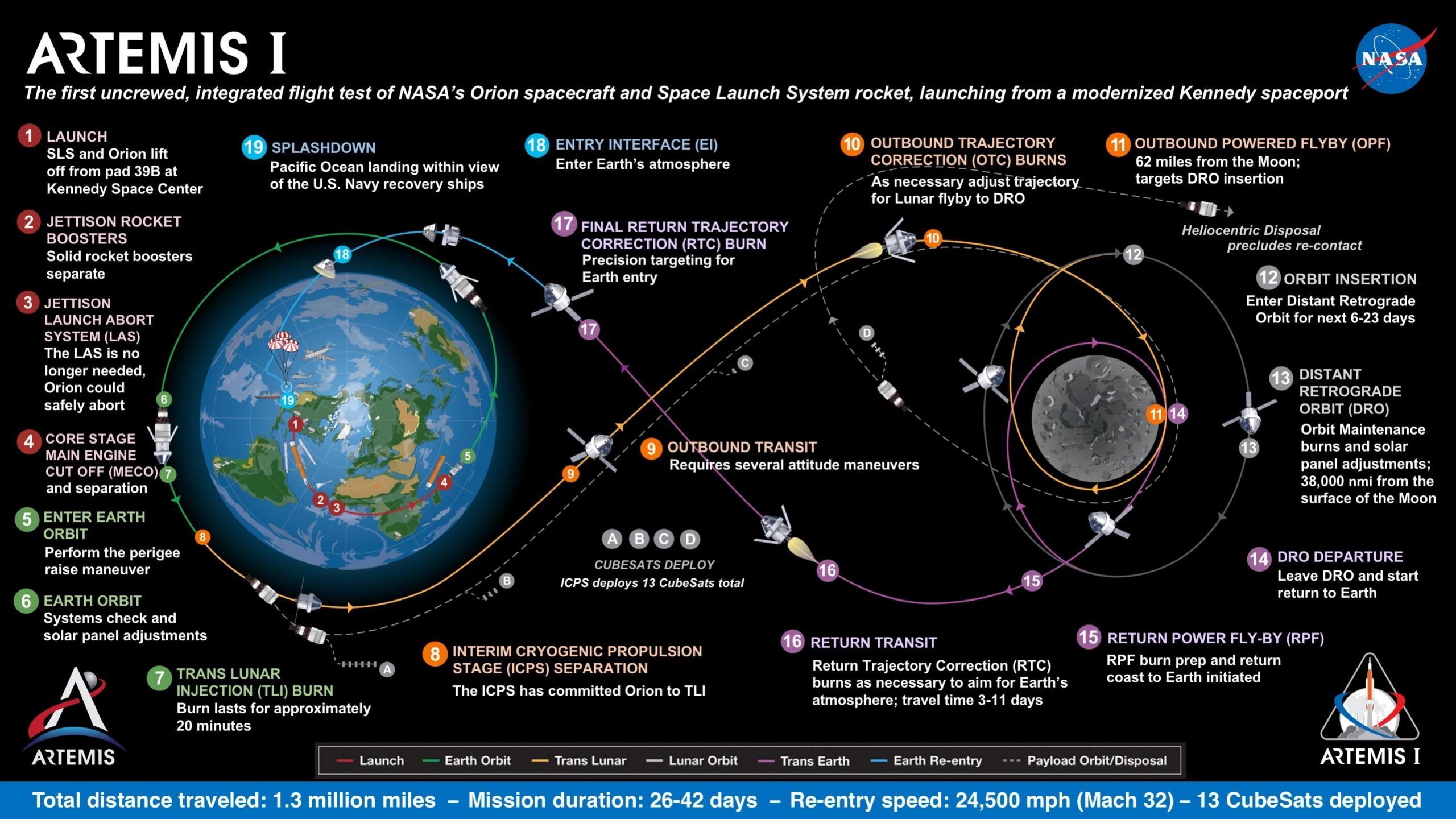
    Artemis I Infographic
    Artemis I will be the first integrated flight test of NASA’s deep space exploration system: the Orion spacecraft, Space Launch System (SLS) rocket and the ground systems at Kennedy Space Center in Cape Canaveral, Florida. The first in a series of increasingly complex missions, Artemis I will be an uncrewed flight that will provide a foundation for human deep space exploration, and demonstrate our commitment and capability to extend human existence to the Moon and beyond. During this flight, the uncrewed Orion spacecraft will launch on the most powerful rocket in the world and travel thousands of miles beyond the Moon, farther than any spacecraft built for humans has ever flown, over the course of about a three-week mission. Credit: NASA

    Jumping headfirst into the Artemis program has been one of the highlights in my transition as the associate administrator for human spaceflight. With an ongoing COVID-19 pandemic, there was little time for a transition period as mission essential work needed to continue as safely as possible.

    Already within my short time on the job, NASA is checking-off key milestones and marching swiftly toward Artemis I. That mission, the first uncrewed flight test of our powerful Space Launch System (SLS) rocket and Orion spacecraft, is just a little more than a year away from launch.

    I remain incredibly impressed by our team’s commitment to landing the first woman and next man on the Moon in 2024, and we all know that Artemis I is a critical step toward realizing that goal. A lot of the hard work is behind us, but it is not done yet. We’re gaining momentum– and it is tangible across the agency.
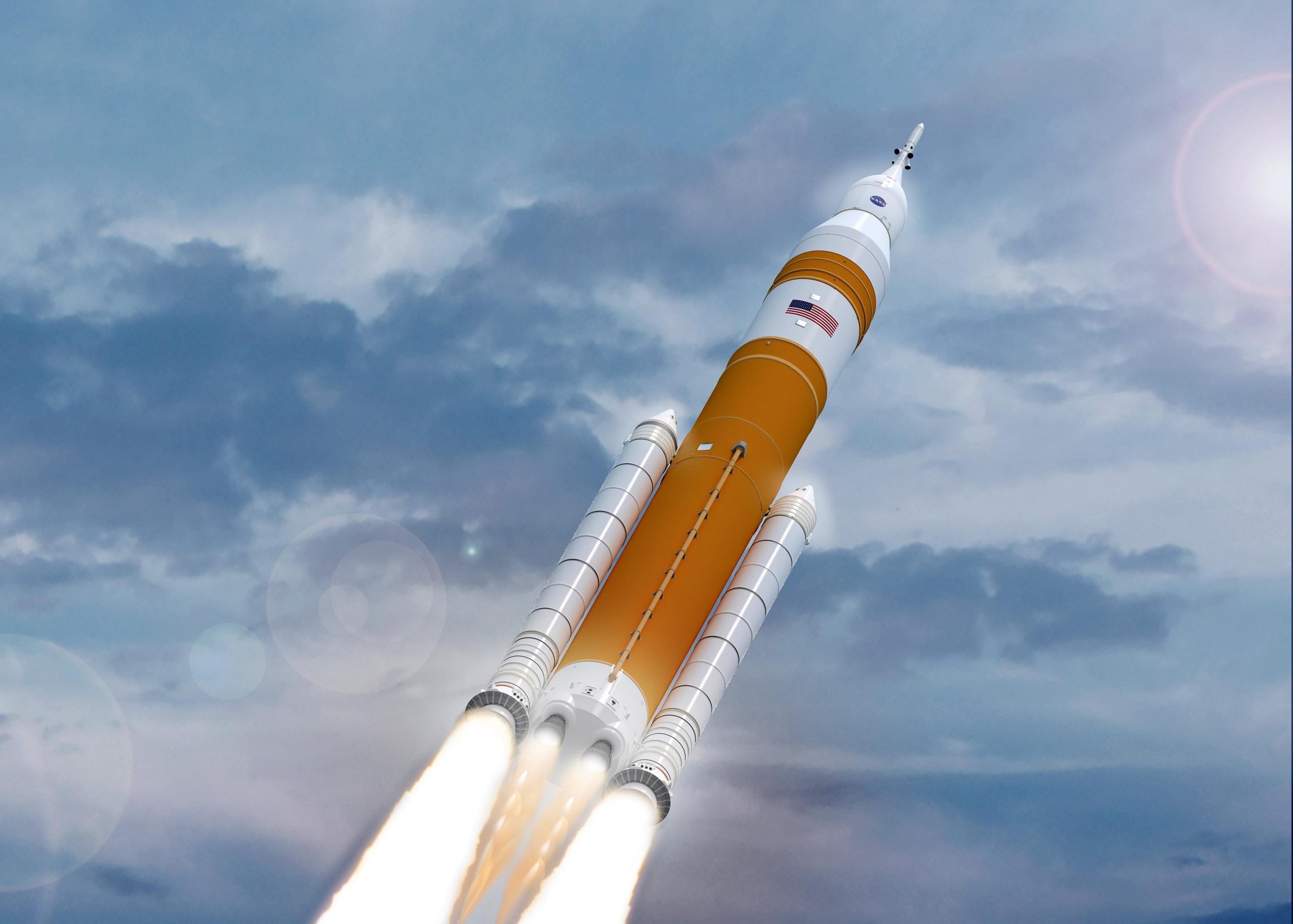
    Space Launch System in Flight
    The SLS is an advanced, heavy-lift rocket that will provide an entirely new capability for science and human exploration beyond Earth’s orbit. Credit: NASA

    Already this year, NASA has finished modifications and upgrades to ready Launch Pad 39B at our Kennedy Space Center in Florida for the mission. Teams there have also:

    • Simulated portions of the launch countdown with a realistic run-through of the terminal count
    • Delivered the launch vehicle stage adapter, which connects the core stage and the upper stage of the rocket
    • Conducted an Orion recovery test in the Pacific Ocean, validating timelines for recovery operations
    • Practiced stacking operations with pathfinder segments for the solid rocket boosters
    • Received booster segments for the mission to begin processing for launch

    The agency also completed a rigorous test campaign ahead of schedule on the Orion spacecraft, subjecting it to the extreme temperatures and electromagnetic conditions expected during flight. Orion is now in final assembly and checkout for launch, including installation of the spacecraft’s four solar arrays.

    On the SLS side of the house, NASA completed structural testing on the upper part of the rocket and four core stages structures. The rocket’s core stage for the first mission is the last piece of hardware that remains to be delivered to Kennedy. It is currently secured in a test stand at NASA’s Stennis Space Center in Mississippi and has completed four of the eight tests in the Green Run test series.
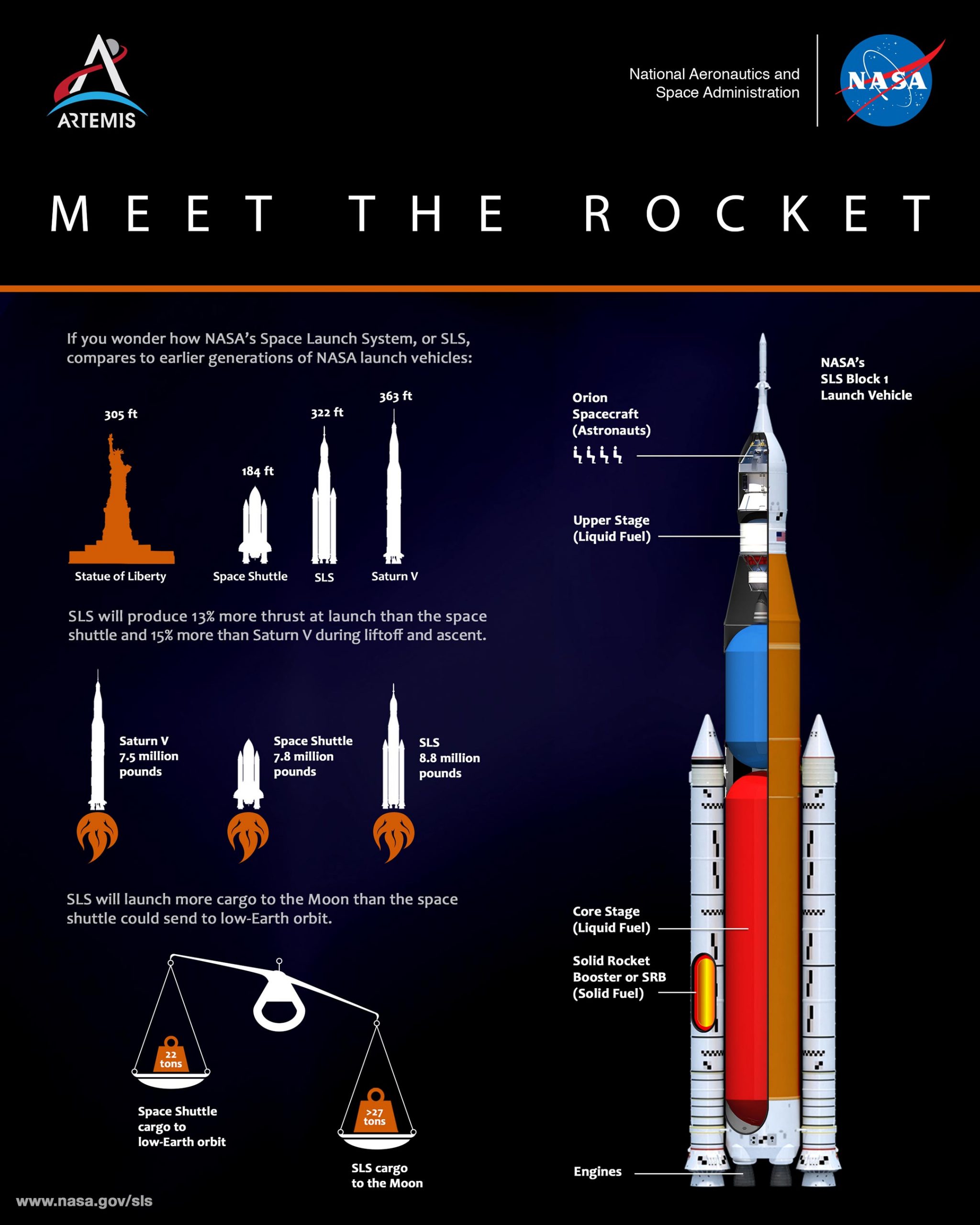
    Meet the SLS Rocket Infographic
    Offering more payload mass, volume capability and energy to speed missions through space, NASA’s Space Launch System (SLS) rocket, along with NASA’s Gateway in lunar orbit and Orion spacecraft, is part of the agency’s backbone for deep space exploration and the Artemis lunar program. SLS is the only launch vehicle that can send Orion, astronauts and supplies to space beyond Earth’s orbit to the Moon in a single mission. For the first mission of SLS and Orion, Artemis I, the rocket is capable of sending more than 26 metric tons (57,000 pounds) to the Moon. As the SLS evolves, it will have even more power and will be capable of sending more than 45 metric tons (99,000 pounds) to deep space. Credit: NASA/MSFC

    We are currently working our way through the fifth test to check out the thrust vector controls and related hydraulics. While we keep an eye on hurricane season, we continue to strive to conduct the final test by the end of October with the current pace of testing. During that test, engineers will fire all four RS-25 engines simultaneously, aiming to drain the fueled tanks in eight minutes, just as during flight. After the hot fire test, crews will refurbish, inspect, and configure the stage for shipment to Kennedy. The next time the rocket’s engines ignite, Artemis I will be taking flight.

    Prior to the COVID-19 pandemic, NASA also completed a detailed cost and schedule assessment for Artemis I and established a new agency commitment for launch readiness by November 2021. While it is too early to predict the full impact of COVID-19, we are confident a November 2021 date is achievable with the recent pace of progress, and a successful Green Run hot fire test will enable us to better predict a target launch date for the mission.

    Taking this new launch readiness date into account, NASA also aligned the development costs for the SLS and Exploration Ground Systems programs through Artemis I and established new cost commitments. The new development baseline cost for SLS is $9.1 billion, and the commitment for the initial ground systems capability to support the mission is now $2.4 billion. NASA’s cost and schedule commitment for Orion currently remains within original targets and is tied to demonstrating the capability to fly crew on the Artemis II mission by 2023.
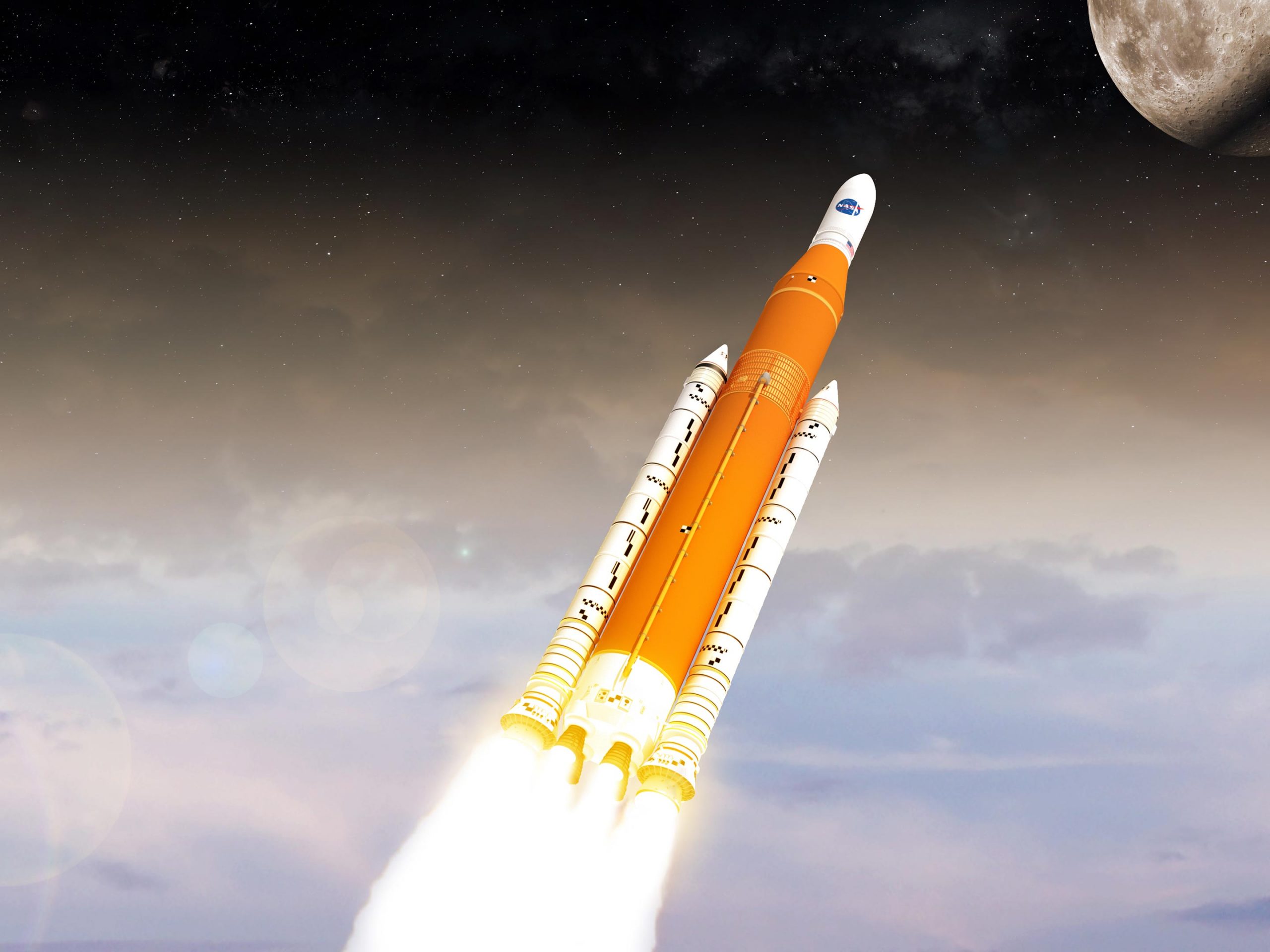
    SLS on the Way to the Moon
    This illustration shows NASA’s Space Launch System (SLS) in the Block 1 cargo configuration. In place of NASA’s Orion spacecraft, there is a fairing to protect cargo, or payloads, during launch. Credit: NASA

    NASA has notified Congress of these new commitments, and we are working at the best possible pace toward launch, including streamlining operational flow at Kennedy and assessing opportunities to further improve the efficiency of our integration activities. Now that the majority of the design development is done, as well as the first time build and an extensive test program, a lot of effort is behind us. We are well into builds for future missions, and we are seeing significantly improved build rates, high quality work, and efficiencies across the board. Moving forward, we aim to continue to reduce production costs for the world’s most capable launch system, as we take on new challenges of our lunar exploration program.

    We remain focused on the work ahead under the Artemis program, for the first SLS and Orion mission as well as future missions with crew, including Artemis III that will send the next astronauts to the surface of the Moon. With those kind of goals, there’s nowhere else in the world I’d rather be working. And yet, Artemis plans are just one of many great things underway within human spaceflight and across the agency – with much more ahead.

    NASA is on track to achieve great things with robots, technology and humans on and around the Moon. From the Moon, and soon to Mars, I hope you’re ready to jump in too.

    Kathryn Lueders serves as the program manager for NASA’s Commercial Crew Program.

    Never miss a breakthrough: Join the SciTechDaily newsletter.
    Follow us on Google and Google News.

    ARTEMIS Mission NASA Popular Space Launch System
    Share. Facebook Twitter Pinterest LinkedIn Email Reddit

    Related Articles

    NASA’s Engineering Marvel: Preparing the Gateway to the Moon

    Moonbound Majesty: Astronauts’ Inside Look at SLS, the Engine of Artemis Dreams

    NASA Tests Upgraded Artemis Moon Rocket Engines at 113% Power Level

    NASA’s Artemis I Moon Rocket Ready To Launch – How To Watch Live

    NASA Completes Artemis I Moon Rocket Test, Moves Forward Toward Launch

    NASA Artemis I Moon Rocket Test: SLS Fully Fueled for First Time Despite Leak

    NASA Conducts 2nd RS-25 Engine Hot Fire Test for World’s Most Powerful Rocket

    NASA Conducts Massive SLS Rocket Booster Test for Artemis Mission to the Moon

    Massive SLS Rocket Test: NASA to Apply Millions of Pounds of Force to Try to Break Oxygen Tank Structure

    1 Comment

    1. Thuận on April 2, 2022 5:01 pm

      NASA

      Reply
    Leave A Reply Cancel Reply

    • Facebook
    • Twitter
    • Pinterest
    • YouTube

    Don't Miss a Discovery

    Subscribe for the Latest in Science & Tech!

    Trending News

    AI Could Detect Early Signs of Alzheimer’s in Under a Minute – Far Before Traditional Tests

    What if Dark Matter Has Two Forms? Bold New Hypothesis Could Explain a Cosmic Mystery

    This Metal Melts in Your Hand – and Scientists Just Discovered Something Strange

    Beef vs. Chicken: Surprising Results From New Prediabetes Study

    Alzheimer’s Breakthrough: Scientists Discover Key Protein May Prevent Toxic Protein Clumps in the Brain

    Quantum Reality Gets Stranger: Physicists Put a Lump of Metal in Two Places at Once

    Scientists May Have Found the Key to Jupiter and Saturn’s Moon Mystery

    Scientists Uncover Brain Changes That Link Pain to Depression

    Follow SciTechDaily
    • Facebook
    • Twitter
    • YouTube
    • Pinterest
    • Newsletter
    • RSS
    SciTech News
    • Biology News
    • Chemistry News
    • Earth News
    • Health News
    • Physics News
    • Science News
    • Space News
    • Technology News
    Recent Posts
    • Century-Old Cleaning Chemical Linked to 500% Increased Risk of Parkinson’s Disease
    • What if Your Memories Never Happened? Physicists Take a New Look at the Boltzmann Brain Paradox
    • Students Found an Ancient Star That Shouldn’t Be in the Milky Way
    • Astronomers Solve 50-Year Mystery and Reveal Hidden Culprit Behind Strange X-Ray Emissions
    • One of the Universe’s Largest Stars May Be Getting Ready To Explode
    Copyright © 1998 - 2026 SciTechDaily. All Rights Reserved.
    • Science News
    • About
    • Contact
    • Editorial Board
    • Privacy Policy
    • Terms of Use

    Type above and press Enter to search. Press Esc to cancel.