
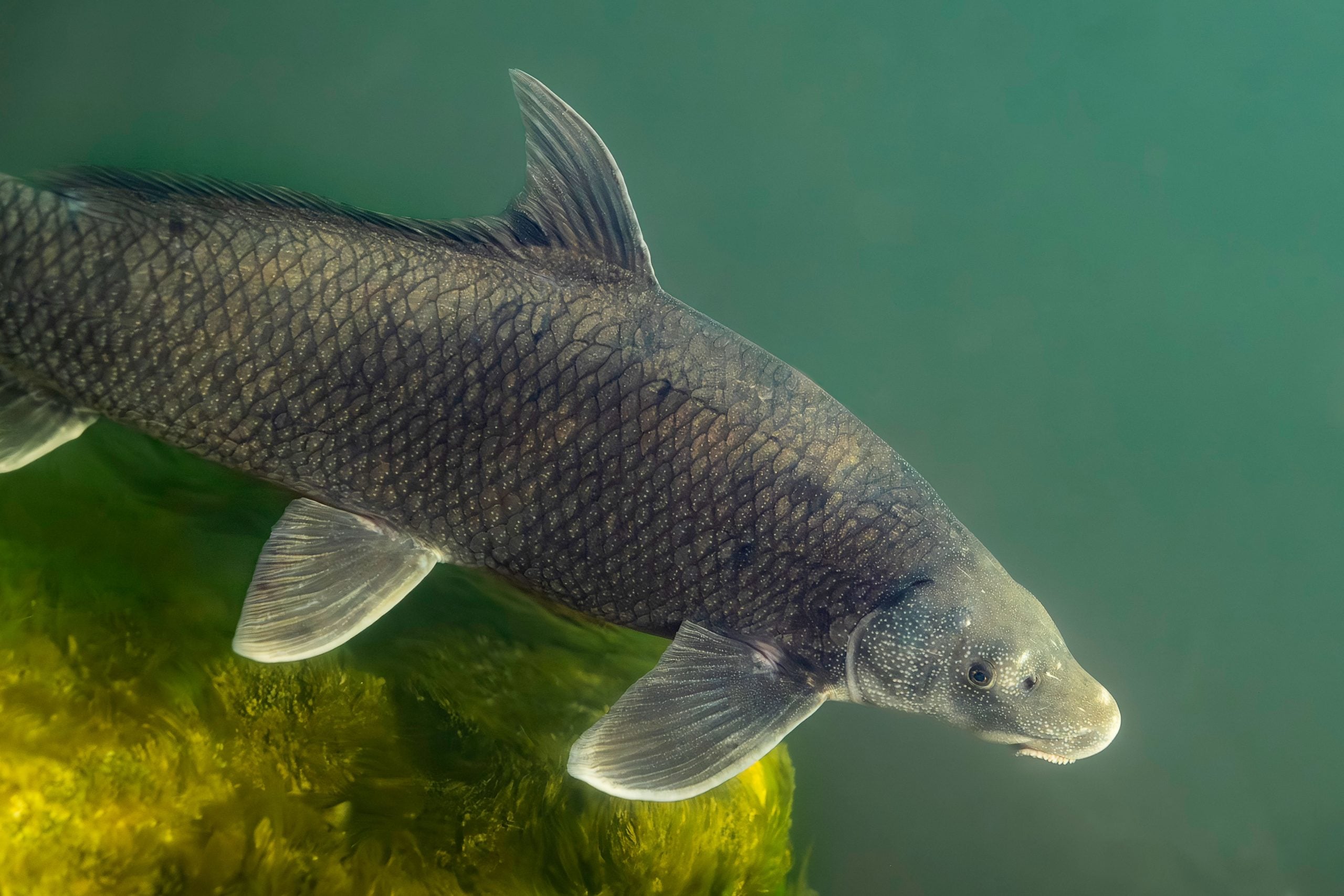
Scientists have discovered that a native Missouri River fish can live far longer than previously believed.
Some fish swimming in Montana’s Upper Missouri River today may have hatched before the 20th century began. Researchers have confirmed that blue suckers can live up to 130 years, more than three times their previously estimated lifespan of roughly 40 years. The discovery places the species among the longest-lived vertebrates in North America.
The findings, published in Communications Biology, come from a study co-led by Alec Lackmann of the University of Minnesota Duluth, Luke Holmquist of Montana Fish, Wildlife & Parks, and Allen Andrews of the University of Hawai’i at Mānoa. By examining microscopic structures inside the fishes’ heads and using a chemical signature left by nuclear weapons testing, the scientists uncovered evidence of extraordinary longevity and a population increasingly dominated by old individuals.
Ancient Fish With Few Young Replacements
The blue sucker (Cycleptus elongatus) is native to 23 U.S. states but is classified as imperiled in 22 of them. For decades, researchers monitoring the Upper Missouri River have observed increasingly large fish and remarkably few juveniles. The pattern suggests that young blue suckers have struggled to survive and join the adult population.
“For decades, there has been conservation concern for the species across much of its range,” the researchers wrote. “Nonetheless, no validated age-based life history information exists for the species, which is a major knowledge gap.”
To investigate, the team collected and examined nearly 50 blue suckers between 2023 and 2026. More than 60 percent were older than 90 years, and some had survived for approximately 130 years. Their age distribution suggests that successful recruitment of new generations has become less frequent since major dams were installed in the mid-1900s. Habitat fragmentation associated with those dams is a possible contributor, although the study does not establish it as the cause.
Tiny Earstones Reveal a Century of Life
The researchers determined the fishes’ ages by examining otoliths, tiny structures commonly called earstones that occur in approximately 97 percent of fish species. These structures grow throughout a fish’s life, accumulating annual layers that scientists can count under a microscope, much like the growth rings of a tree.
Blue suckers presented a technical challenge because their otoliths are exceptionally small. “Blue suckers have extremely small otoliths, smaller than the buffalofishes, but we figured out how to work with them,” Lackmann said.
As the researchers examined the growth layers, they encountered ages that far exceeded established expectations. In fish previously thought to live around four decades, “we were seeing the population had ages up to 130 years old,” Lackmann said. “When age estimates are that much older than previously thought, an additional line of evidence is needed to rigorously test their validity.”
Nuclear Bomb Tests Provide a Time Marker
To independently verify the ages, the team turned to bomb radiocarbon dating, a technique that uses the atmospheric changes caused by nuclear weapons testing during the Cold War. Those tests produced a distinctive increase in radioactive carbon-14 that became incorporated into living organisms, including the tissues of fish.
“Thermonuclear bombs that were tested in the mid to late 1950s and early 1960s more than doubled the amount of radiocarbon in the atmosphere,” said Lackmann.
“This left a time-specific marker in organisms that lived through the bomb pulse. And if you’re able to quantify growth bands in an individual (for example, in trees, otoliths of bony fish, etc.) that is estimated to have lived through the bomb pulse, you can actually test to determine if the ages you are quantifying are accurate. Bomb radiocarbon dating is one of the best ways to age-validate long-lived organisms. So that’s where we have multiple lines of evidence here, otoliths providing the age estimates, and bomb radiocarbon confirming and validating the otolith ages and extreme longevity of the blue sucker.”
By comparing the carbon-14 signatures in the otoliths with the known timing of the atmospheric radiocarbon increase, the researchers validated the ages estimated from the growth layers. This independent evidence confirmed that blue suckers can survive for more than a century.
A River Fish That Defies Lifespan Expectations
The blue sucker is now the fourth member of the sucker fish family (Catostomidae) found to reach 100 years or older, joining the bigmouth buffalo, smallmouth buffalo, and black buffalo. All four species have had their exceptional longevity documented since 2019, partly through advances in fish aging techniques.
Blue suckers also challenge expectations about how river environments shape animal lifespans. Unlike fish inhabiting relatively calm lakes, they spend their lives in fast-flowing rivers, where maintaining position and navigating currents can require considerable energy. Such environments have often been associated with faster life histories, making the species’ extreme longevity particularly unexpected.
The oldest fish examined had already been alive for decades when many of the dams now shaping the Missouri River system were constructed. Their survival across more than a century of environmental change contrasts with the apparent scarcity of younger generations, raising conservation concerns about whether aging adults are being replaced.
“To put a timeline on some of those older fish: the oldest one hatched around two years after Montana became a state, around the dawn of the automobile, like 20 years before the Titanic sank – it’s just wild,” said Holmquist.
“We start putting it in the context of what the landscape looked like when these fish hatched, and all the changes that have happened since—and they just keep swimming along in the river.”
Reference: “Bomb-radiocarbon validated otoliths reveal 130-year lifespans and declining recruitment for blue sucker Cycleptus elongatus of the Upper Missouri River, Montana, USA” by Alec R. Lackmann, Allen H. Andrews, Luke M. Holmquist, Negar Haghipour, Grant Grisak, Molly A. H. Webb, Mark E. Clark and Zachary R. Shattuck, 18 November 2026, Communications Biology.
DOI: 10.1038/s42003-026-11219-3
Funding for this project was provided by Montana Fish, Wildlife & Parks and NorthWestern Energy. The study was also coauthored by Negar Haghipour (ETH Zürich), Grant Grisak (NorthWestern Energy), Molly Webb (USFWS), Mark Clark (UMD – Biology), and Zach Shattuck (MTFWP).
Never miss a breakthrough: Join the SciTechDaily newsletter.
Follow us on Google and Google News.
2 Comments
EVERYONE NEEDS SALVATION HERE ARE THE WORDS OF SALVATION PLEASE FORGIVE ME JESUS IM A SINNER COME INTO MY HEART AND SAVE ME FROM MY SIN I NO THAT YOU ARE THE SAVIOR AND I NO THAT YOU DIED FOR ME ON CALVARY AND I NO THAT GOD RAISE YOU FROM THE DEAD AND YOU ARE ALIVE AND I THANKYOU FOR YOUR SALVATION IN JESUS HOLY NAME AMEN AND ITS IMPORTANT TO ALWAYS ASK FOR FORGIVENESS EVERY NIGHT AND HOPE SOMEONE GETS SAVED ITS IMPORTANT
Gee, there’s nothing like humans messing up the environment to make the lives of our animal friends so much worse! If this continues, we will be the lone inhabitants of planet Earth!