
Close Menu
    Facebook X (Twitter) Instagram
    SciTechDaily
    • Biology
    • Chemistry
    • Earth
    • Health
    • Physics
    • Science
    • Space
    • Technology
    Facebook X (Twitter) Pinterest YouTube RSS
    SciTechDaily
    Home»Earth»Space Storm Hunter Captures First Images and Data
    Earth

    Space Storm Hunter Captures First Images and Data

    By Philippe Willekens, European Space AgencyMay 23, 2018No Comments3 Mins Read
    Facebook Twitter Pinterest Telegram LinkedIn WhatsApp Email Reddit
    Share
    Facebook Twitter LinkedIn Pinterest Telegram Email Reddit
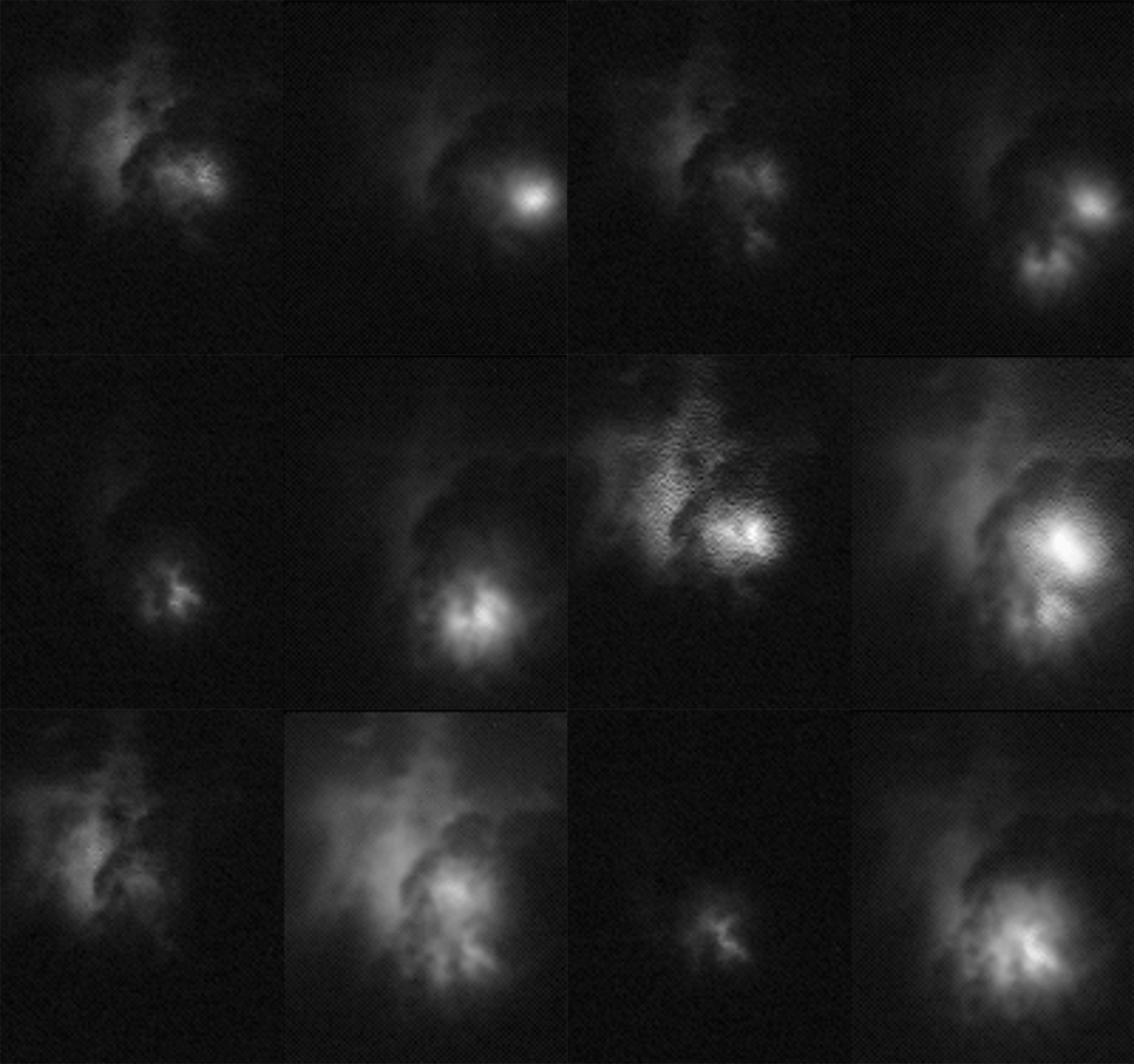
    Space Storm Hunter Views First Target
    The two cameras of the Atmosphere-Space Interactions Monitor, also known as the Space Storm Hunter, captured the strong signature of lightning with unprecedented accuracy 400 kilometers (250 miles) above Earth. As the International Space Station flew over the Indonesian coast of Sumatra on an April night, lightning bursts from a thunderstorm reached the upper layers of the atmosphere. Even with the clouds partly blocking the lightning, the instruments show powerful electrical discharges high in the atmosphere. Scientists believe it is an elve. Elves are the highest of all the ‘transient luminous events’ known to date. In the blink of an eye concentric rings appear as a dim, expanding glow hundreds of kilometers wide formed by electrons colliding and excited nitrogen molecules.

    As the International Space Station flew over the Indonesian coast of Sumatra on an April night, lightning from a thunderstorm reached the upper layers of the atmosphere and its light show was captured by ESA’s latest observatory in space.

    The Atmosphere-Space Interactions Monitor, also known as the Space Storm Hunter, is completing its initial tests a month after it was installed outside Europe’s Columbus laboratory.

    The first images and data captured the strong signature of lightning with unprecedented accuracy 400 kilometers (250 miles) above Earth.

    “We collected 100,000 measurements per second of this amazing force of nature,” explains Torsten Neubert, science team coordinator at the Technical University of Denmark, “this is a fantastic example of how powerful our photometers are.”

    Elves and the power of light

    The observatory points straight down at Earth so the atmosphere filters as little of the light as possible. The storm hunter’s photometers are hundreds of times more sensitive than an average camera on Earth. In the storm above Indonesia the instruments recorded a spike across three wavelengths.
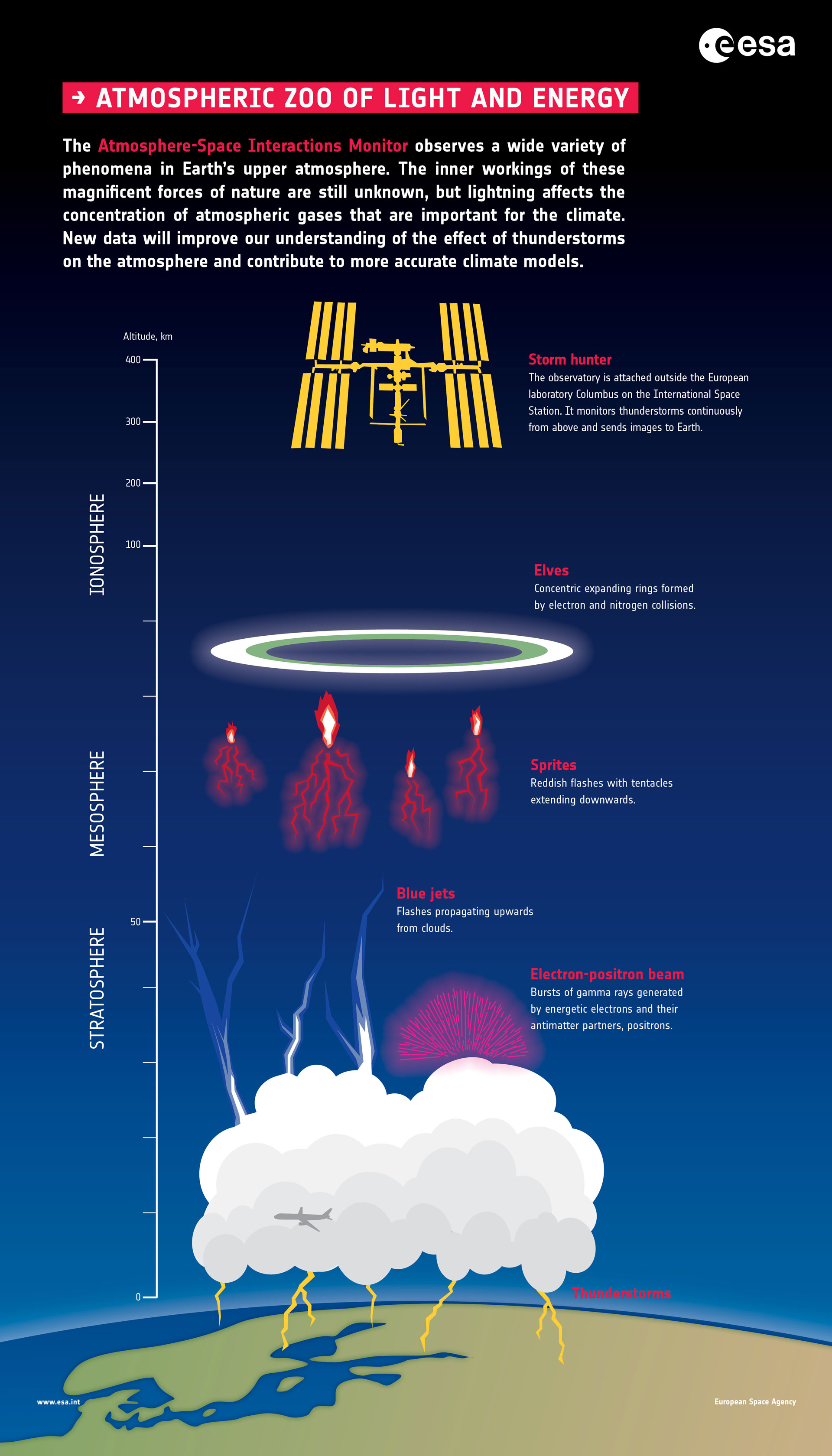
    Storm Hunter Infographics
    The Atmosphere-Space Interactions Monitor (ASIM) is a collection of optical cameras, photometers and an X- and gamma-ray detector designed to look for electrical discharges born in stormy weather conditions that extend above thunderstorms into the upper atmosphere.

    “Even with the clouds partly blocking the lightning, the instruments show powerful electrical discharges high in the atmosphere. We think it shows an elve,” says Torsten.

    Elves are the highest of all the ‘transient luminous events’ known to date. In the blink of an eye concentric rings appear as a dim, expanding glow hundreds of kilometers wide formed by electrons colliding and excited nitrogen molecules.

    The images are surprisingly similar to a sequence captured by ESA astronaut Andreas Mogensen from the International Space Station in 2015.

    “Thanks to Andreas’s discovery we know exactly how to interpret the images,” says Torsten. The data will allow scientists to investigate the phenomenon, and distinguish between layers of lightning and other high-energy discharges.

    More to come

    Setting up one of the most complex facilities ever flown on Columbus is a matter of trial and error. Each element is tested, including measures to avoid sunlight burning the sensors.

    The first images are from the facilities visual cameras. A second suite of instruments detects high and low energy and has not finished calibration yet.

    The first images are only a taster of its capabilities. “The most exciting science is yet to come – we will soon be able to correlate these optical data with terrestrial gamma-ray measurements,” ends Torsten.


    The Atmosphere-Space Interactions Monitor, also known as the Space Storm Hunter, completed its trip to space in April 2018. This video shows the different stages of that voyage, from launch to installation on the International Space Station.

    Never miss a breakthrough: Join the SciTechDaily newsletter.
    Follow us on Google and Google News.

    Earth Science European Space Agency Weather
    Share. Facebook Twitter Pinterest LinkedIn Email Reddit

    Related Articles

    NASA Shows Current Sierra Snowpack Bigger Than Last Four Years Combined

    New Research Examines the Intersection of Weather and Climate

    MIT Study Predicts Frequency of Heavy Precipitation with Global Warming

    AIM Spacecraft Observes Early Noctilucent Ice Clouds Over Antarctica

    El Niño Continues to Grow, Set to Bear Down on U.S.

    2015 El Niño Appears Likely to Equal the Event of 1997-98

    “Grey Swan” Cyclones Will Become More Frequent and Intense

    CryoSat Satellite Shows Increased Volume of Arctic Sea Ice

    MSG-3 Weather Satellite Captures Its First Image of Earth

    Leave A Reply Cancel Reply

    • Facebook
    • Twitter
    • Pinterest
    • YouTube

    Don't Miss a Discovery

    Subscribe for the Latest in Science & Tech!

    Trending News

    Massive Study Warns Marijuana Use in Teens Is Linked to Serious Mental Illness

    Scientists Discover a Completely Unexpected Way T Cells Kill Cancer

    Scientists Just Found the Solar System’s Original “Planet Factory”

    Study Warns Widely Used Food Preservatives Linked to High Blood Pressure and Heart Disease

    New Treatment Could Reverse Osteoarthritis Within Weeks

    Physicists Have Measured “Negative Time” in Bizarre Quantum Experiment

    The Deadly Tapeworm Spreading Across America Has Reached the Pacific Northwest

    Could Low Vitamin D Be Making Your Pain Worse?

    Follow SciTechDaily
    • Facebook
    • Twitter
    • YouTube
    • Pinterest
    • Newsletter
    • RSS
    SciTech News
    • Biology News
    • Chemistry News
    • Earth News
    • Health News
    • Physics News
    • Science News
    • Space News
    • Technology News
    Recent Posts
    • Stanford’s Revolutionary New Microscope Reveals Living Cells in Stunning Detail
    • Scientists Discover a Sea Slug Smaller Than a Sesame Seed in Taiwan
    • Wasp Colonies Explode Into Violence After Losing Their Queen
    • Antarctica Suddenly Became Far More Sensitive to Climate Change 1 Million Years Ago
    • A Hidden Arctic Ocean Crisis Is Unfolding Beneath the Melting Ice
    Copyright © 1998 - 2026 SciTechDaily. All Rights Reserved.
    • Science News
    • About
    • Contact
    • Editorial Board
    • Privacy Policy
    • Terms of Use

    Type above and press Enter to search. Press Esc to cancel.