
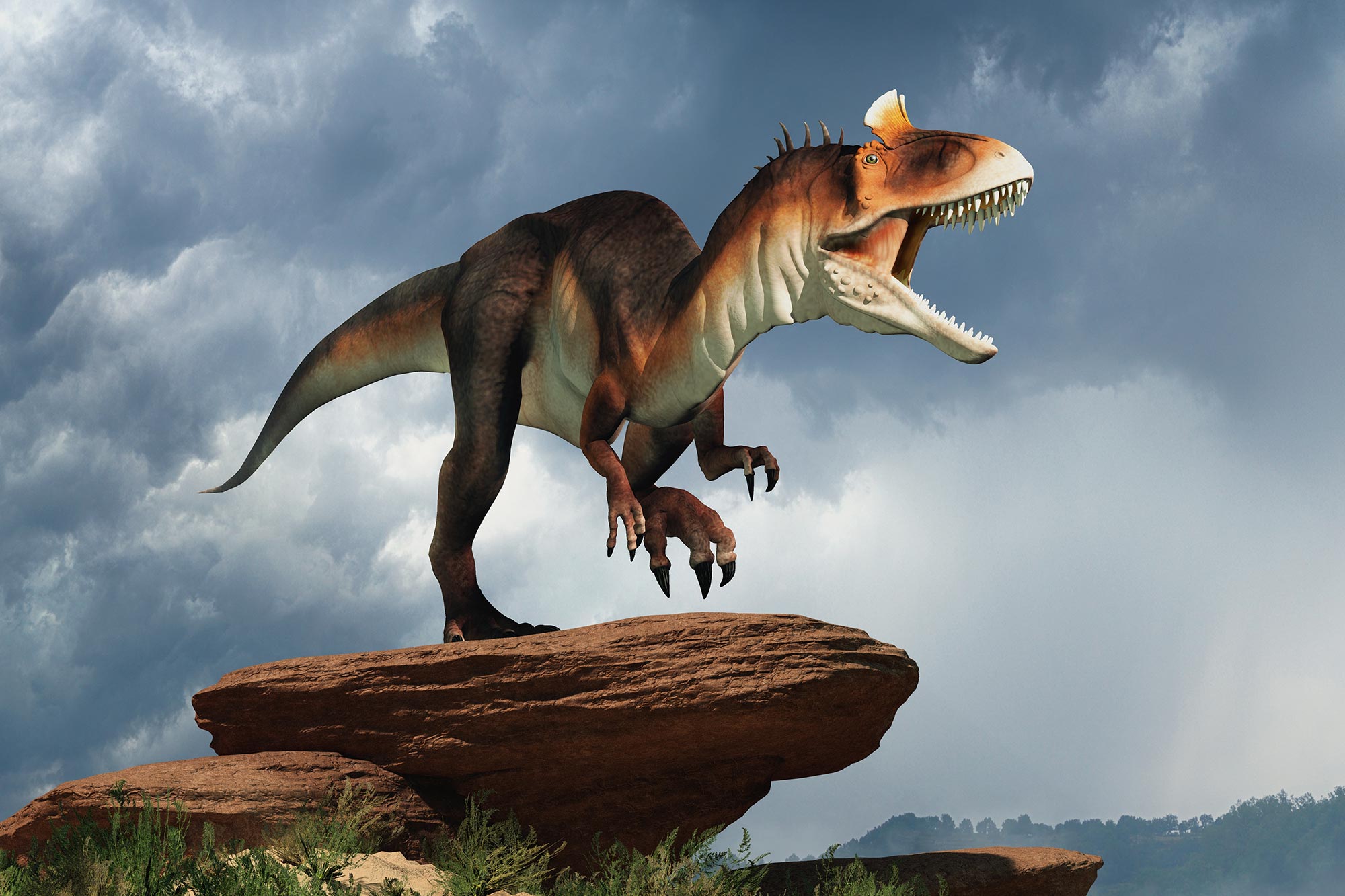
Experiments with a replica dinosaur tooth suggest that prehistoric predators may have relied on more than powerful jaws to tear through flesh efficiently.
Komodo dragons are the only living reptiles with teeth resembling those of many meat-eating dinosaurs. The way they tear flesh by pulling backward, a feeding motion also used by birds of prey, may offer clues to how prehistoric predators ate millions of years ago.
Scientists at the University of Reading and the University of Illinois Urbana-Champaign found that the curved, serrated teeth of predatory dinosaurs required about a third less force to cut through a flesh-like material when pulled diagonally backward rather than pushed straight down. Published in Palaeontology, the study is the first to physically test the cutting performance of these teeth.
Putting dinosaur teeth to the test
Many theropods, a group of dinosaurs that includes Allosaurus, Velociraptor, and modern birds, had flat, backward-curving teeth with serrations along both edges, much like the blade of a steak knife. To investigate how these teeth worked, the researchers built a machine called the DinoSAW, which drove a replica allosaur tooth into ballistic gel, a material commonly used to mimic flesh.
Sensors recorded an average peak force of 14 newtons for a diagonal pull, compared with 21.4 newtons for a vertical bite. The researchers also filmed the gel under polarized light, allowing them to see how stress developed inside the material. Biting straight down produced bright flashes of concentrated stress, while pulling backward distributed lower levels of stress more evenly.
Dr. Manabu Sakamoto, a paleobiologist at the University of Reading who led the study, said: “We often picture meat-eating dinosaurs crunching straight down on their prey, but their teeth tell a different story. These teeth are curved backwards and serrated on both edges, so we wanted to test whether pulling them through flesh worked better than biting down. It did, by a clear margin.
“This suggests these dinosaurs fed much like an eagle tearing at a carcass, sinking their teeth in and using their strong necks to pull back. It also means scientists modeling dinosaur skulls and teeth need to think about the direction of the bite, not just its strength. You might say this is the most cutting-edge dinosaur science ever conducted.”
Two cutting edges instead of one
When a tooth is driven straight down, only its serrated front edge cuts through the material. Pulling backward follows the natural curvature of the tooth, allowing both edges to contribute to the cut. The researchers suspect that theropods used their powerful, S-shaped necks to drive this motion. Fossil evidence supports this interpretation, as bite marks on dinosaur bones often take the form of grooves left by teeth dragged across the surface.
The experiments also challenge an earlier theory that theropods bit down before pulling backward. Such a feeding strategy would likely have wasted energy, since the pulling motion itself could have been responsible for both piercing and slicing through flesh.
“We can never truly know how an extinct animal behaved since we cannot directly observe it,” added study co-author Dr. Philip Anderson, a professor of evolution, ecology, and behavior at the University of Illinois Urbana-Champaign. “But using theory and methods from physics and engineering allows us to investigate what types of feeding behaviors may have been more efficient and perhaps more likely to have occurred.”
The researchers plan to extend their experiments beyond dinosaurs, using the DinoSAW to investigate other prehistoric feeding mechanisms, including how extinct saber-toothed cats used their cookie-cutter incisors.
Reference: “Recurved teeth of theropod dinosaurs are more efficient at diagonal pull-cutting than vertical puncturing” by Manabu Sakamoto and Philip S. L. Anderson, 25 November 2026, Palaeontology.
DOI: 10.1111/pala.70096
Never miss a breakthrough: Join the SciTechDaily newsletter.
Follow us on Google and Google News.