
Close Menu
    Facebook X (Twitter) Instagram
    SciTechDaily
    • Biology
    • Chemistry
    • Earth
    • Health
    • Physics
    • Science
    • Space
    • Technology
    Facebook X (Twitter) Pinterest YouTube RSS
    SciTechDaily
    Home»Science»Deadly Teeth of T. rex Were Hidden Behind Scaly Lips, Shattering Prehistoric Perceptions
    Science

    Deadly Teeth of T. rex Were Hidden Behind Scaly Lips, Shattering Prehistoric Perceptions

    By American Association for the Advancement of Science (AAAS)March 30, 20231 Comment3 Mins Read
    Facebook Twitter Pinterest Telegram LinkedIn WhatsApp Email Reddit
    Share
    Facebook Twitter LinkedIn Pinterest Telegram Email Reddit
    Tyrannosaurus Lipped Mouth
    A juvenile Edmontosaurus disappears into the enormous, lipped mouth of Tyrannosaurus. Credit: Mark Witton

    A new study challenges the long-held belief that large theropod dinosaurs, including Tyrannosaurus rex, had exposed teeth when their mouths were closed. Instead, the research suggests their teeth were covered by thin, scaly lips, similar to modern Komodo dragons. The findings could impact our understanding of dinosaur dental anatomy, feeding ecology, biomechanics, and their portrayal in scientific and popular culture.

    Contrary to more than a century of scientific and popular depictions, the large teeth of Tyrannosaurus rex and other toothy theropod dinosaurs were likely completely covered by thin, scaly “lips” when the mouth was closed. This is according to a new study published today (March 30) in the journal Science. The findings shift perceptions about the appearance and oral anatomy of such iconic prehistoric predators.

    Nonavian theropod dinosaurs are renowned for their large, dagger-like teeth. As a result, scientific and popular reconstructions of these dinosaurs have often featured these teeth as exposed – prominently protruding outside their closed mouths like crocodiles – rather than covered by soft facial tissues of the mouth as they are in most other terrestrial reptiles, like modern Komodo dragons.
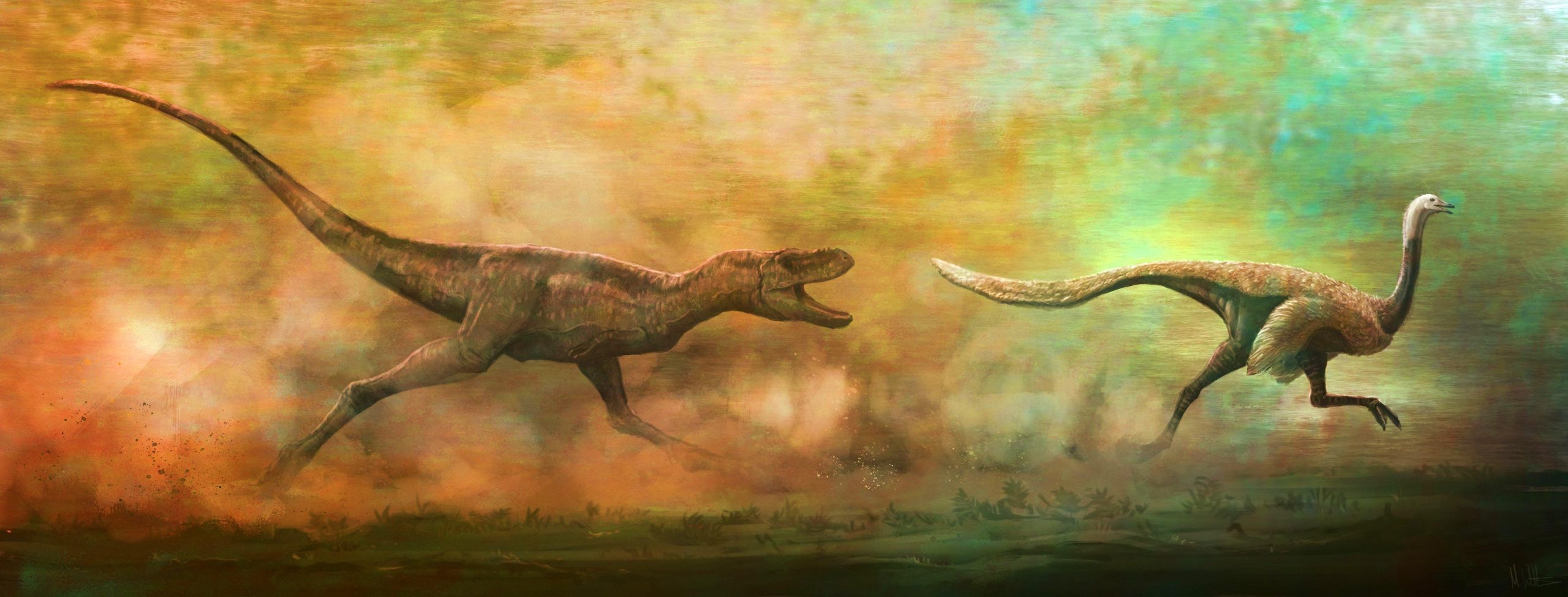
    T. rex Juvenile Running
    A half-grown Tyrannosaurus, sporting a full set of lips, runs down Struthiomimus, a beaked ostrich dinosaur. Credit: Mark Witton

    However, theropod teeth are known to have relatively thin enamel. Since large theropod species likely retained their sharp and serrated teeth over long periods of time, it’s thought that constant exposure would likely lead to damaging tooth desiccation and wear. Whether these ancient apex predators’ teeth were permanently exposed, as is often depicted, or covered by lip-like labial scales like a Komodo dragon, remains uncertain.

    To test alternate hypotheses of theropod facial reconstructions, Thomas Cullen and colleagues evaluated the relationship between skull length and tooth size for a range of theropod dinosaurs and living and extinct toothed reptiles. They performed a comparative histological analysis of tooth wear patterns for tyrannosaurid and crocodilian teeth.
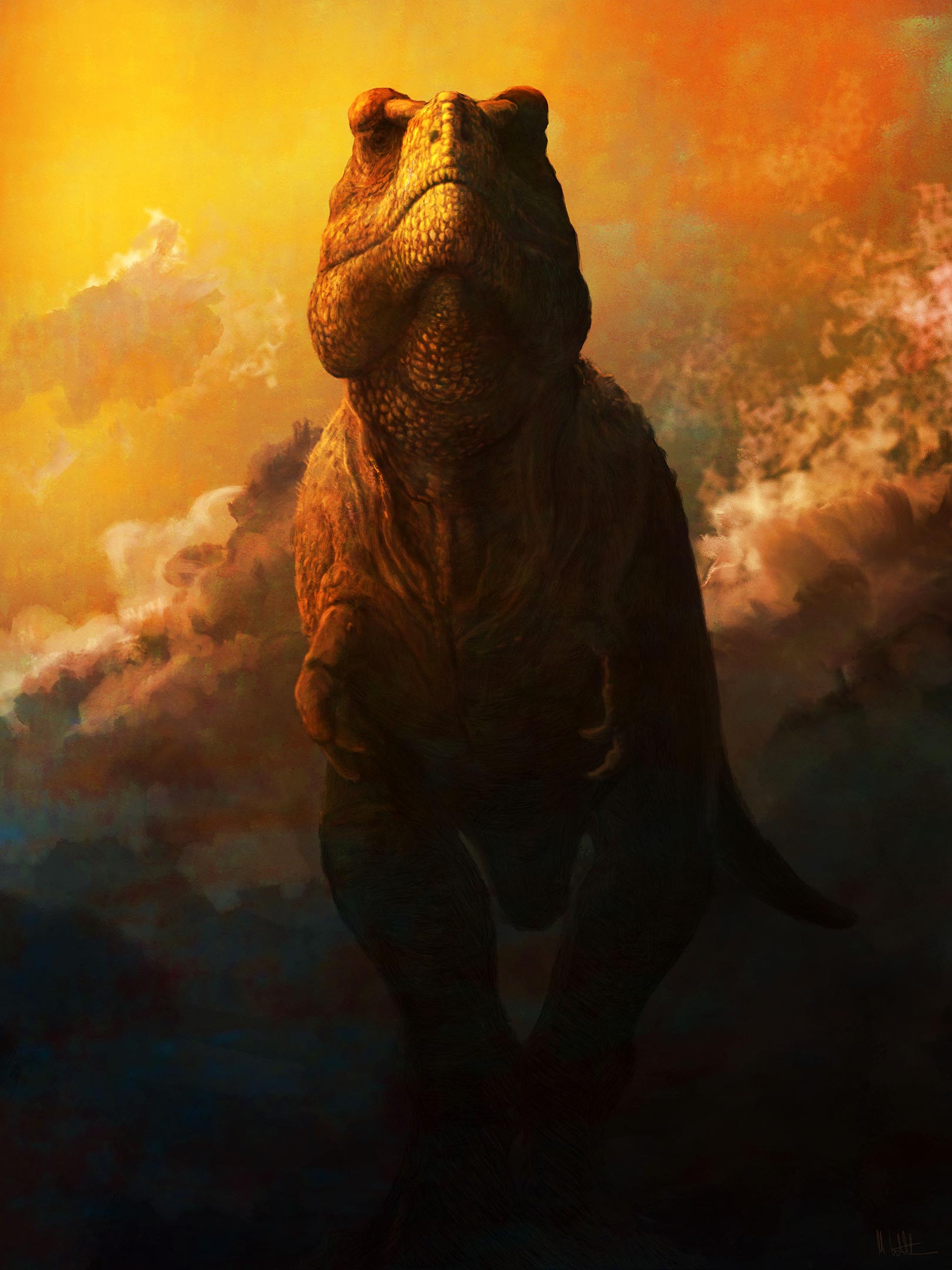
    Tyrannosaurus rex Bellowing
    Tyrannosaurus rex bellowing with its mouth shut, like a vocalising alligator. With its mouth closed, all of the enormous teeth of T. rex would be invisible behind its lips. Credit: Mark Witton

    According to Cullen et al., in contrast to their closest toothed crocodilian relatives, theropod teeth lacked any evidence of outer surface wear, indicating the existence of extraoral tissues and oral secretions needed to keep them hydrated and protected from exposure. What’s more, the authors found that, even though the skulls and teeth of some theropods were far larger than extant reptiles, the tooth-skull size relationship in theropods closely aligned with that of living reptiles, particularly monitor lizards, who do not have exposed teeth.

    These findings suggest that theropod teeth were not too big to fit in their mouth without having to be exposed. Cullen et al. argue that the data suggests that all theropod dinosaurs had teeth completely covered by labial scales when the mouth was closed – findings that could have implications on our understanding of dinosaur dental anatomy, feeding ecology, and biomechanics, as well as on the portrayal of dinosaurs in science and popular culture.
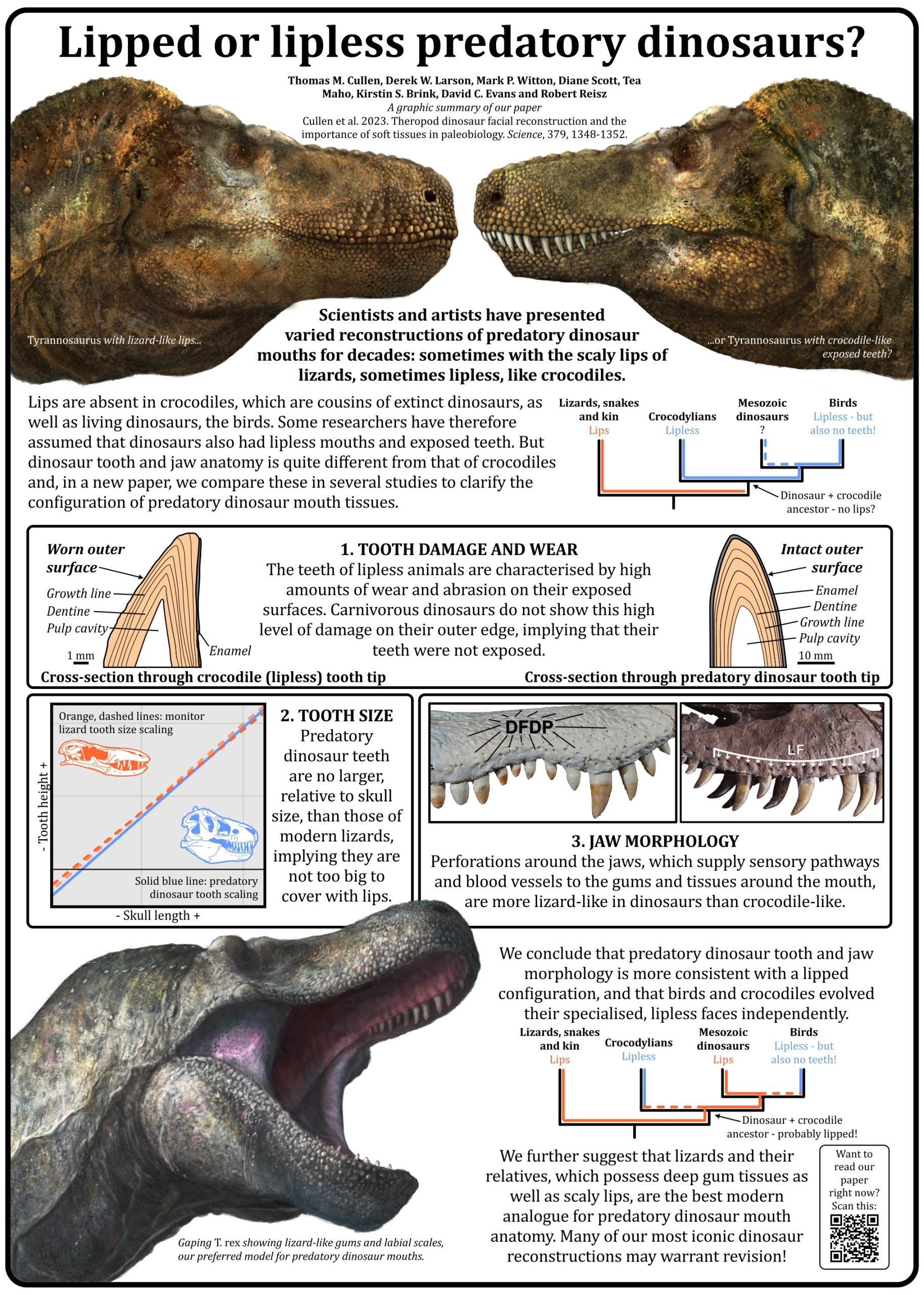
    Theropods Lips Infographic
    A one-sheet summary of the main investigations and conclusions of the study. Credit: Mark Witton

    Reference: “Theropod dinosaur facial reconstruction and the importance of soft tissues in paleobiology” by Thomas M. Cullen, Derek W. Larson, Mark P. Witton, Diane Scott, Tea Maho, Kirstin S. Brink, David C. Evans and Robert Reisz, 30 March 2023, Science.
    DOI: 10.1126/science.abo7877

    Never miss a breakthrough: Join the SciTechDaily newsletter.
    Follow us on Google and Google News.

    American Association for the Advancement of Science Dinosaurs Paleontology Popular Teeth Theropod
    Share. Facebook Twitter Pinterest LinkedIn Email Reddit

    Related Articles

    120-Million-Year-Old Fossils in Australia Just Rewrote Dinosaur Evolution

    Scientists Have Discovered Evidence of Giant Clawed Dinosaurs Roaming Australia’s Southern Coast

    Bridging the Evolutionary Gap: Paleontologists Discover Bizarre New Species of Bird-Like Dinosaur

    Shattering Preconceptions: Diverse Spinosaur Species Roamed Cretaceous Britain

    140 Million-Year-Old Tooth Reveals Diversity of Spinosaurs in Ancient Britain

    Jurassic Makeover: Revealing the True Faces of Predatory Dinosaurs Like T. rex

    Unearthing Prehistoric Predators: Giant Megaraptors Among Diverse Dinosaurs in Patagonia

    “Baby Yingliang” – Exquisitely Preserved Dinosaur Embryo Discovered Inside Oviraptorosaur Egg

    Exquisitely Preserved Dinosaur Embryo Found Inside Fossilized Oviraptorosaur Egg

    1 Comment

    1. Paulyuk6 on March 31, 2023 7:11 am

      So does this mean that dinosaurs were good kissers?

      Reply
    Leave A Reply Cancel Reply

    • Facebook
    • Twitter
    • Pinterest
    • YouTube

    Don't Miss a Discovery

    Subscribe for the Latest in Science & Tech!

    Trending News

    Scientists Discover 132-Million-Year-Old Dinosaur Tracks on South Africa’s Coast

    Scientists Uncover the Secret Ingredient Behind the Spark That May Have Started Life on Earth

    Physicists Observe Matter in Two Places at Once in Mind-Bending Quantum Experiment

    Stanford Scientists Discover Hidden Brain Circuit That Fuels Chronic Pain

    New Study Reveals Why Ozempic Works Better for Some People Than Others

    Climate Change Is Altering a Key Greenhouse Gas in a Way Scientists Didn’t Expect

    New Study Suggests Gravitational Waves May Have Created Dark Matter

    Scientists Discover Why the Brain Gets Stuck in Schizophrenia

    Follow SciTechDaily
    • Facebook
    • Twitter
    • YouTube
    • Pinterest
    • Newsletter
    • RSS
    SciTech News
    • Biology News
    • Chemistry News
    • Earth News
    • Health News
    • Physics News
    • Science News
    • Space News
    • Technology News
    Recent Posts
    • Researchers Discover Long-Lost Words of Ancient Greek Philosopher After 2,000 Years
    • New Study Warns: Asia’s Lifeline Water Source Is Rapidly Draining
    • 100 Times Worse? Thawing Permafrost May Be More Dangerous Than Previously Thought
    • “Pretty Close to Home”: The Hidden Earthquake Threat Beneath Seattle
    • The Surprising Reason You Might Want To Sleep Without a Pillow
    Copyright © 1998 - 2026 SciTechDaily. All Rights Reserved.
    • Science News
    • About
    • Contact
    • Editorial Board
    • Privacy Policy
    • Terms of Use

    Type above and press Enter to search. Press Esc to cancel.