
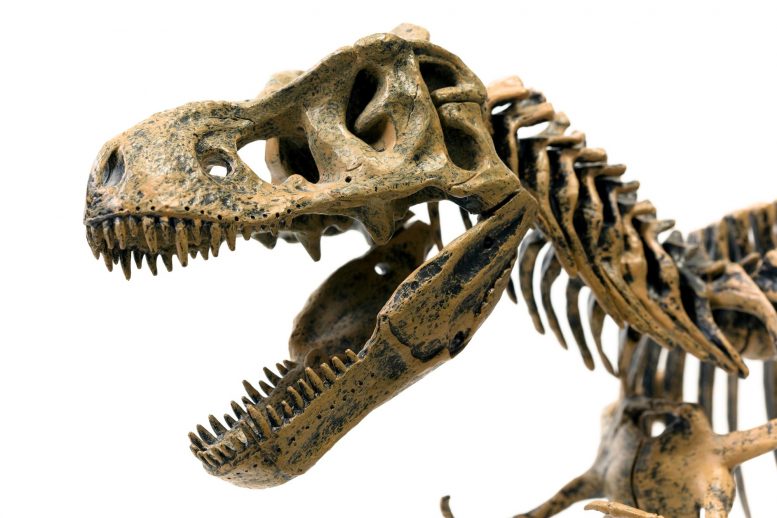
Research suggests that Tyrannosaurus rex may consist of three species based on differences in femur robustness and dental structures.
A new analysis of Tyrannosaurus skeletal remains reveals physical differences in the femur, other bones, and dental structures across specimens that could suggest Tyrannosaurus rex specimens need to be re-categorized into three distinct groups or species, reports a study published in Evolutionary Biology.
Tyrannosaurus rex is the only recognized species of the group of dinosaurs, or genus, Tyrannosaurus to date. Previous research has acknowledged variation across Tyrannosaurus skeletal remains in the femur (thighbone) and specimens with either one or two slender incisor teeth on each side of front ends of the jaw.
Gregory Paul and colleagues analyzed the bones and dental remains of 37 Tyrannosaurus specimens. The authors compared the robustness of the femur in 24 of the specimens, a measure calculated from the length and circumference that gives an indication of the strength of the bone. They also measured the diameter of the base of teeth or space in the gums to assess if specimens had one or two slender incisiform teeth.
Femur Robustness and Growth Analysis
The authors observed that the femur varied across specimens, some with more robust femurs and others with more gracile femurs. The authors found there were two times more robust femurs than gracile ones across specimens, which suggests that this is not a difference caused by sex, which would likely result in a more even split. The authors also suggest that the variation in femurs is not related to growth of the specimen as robust femurs were found in some juvenile specimens two thirds the size of an adult and gracile femurs were found in some specimens that were full adult size.
Dental structure also varied across specimens, although those with both femur measurements and dental remains was low (12 specimens). Specimens with one incisor tooth were correlated with often having higher femur gracility.
Of the Tyrannosaurus specimens, 28 could be identified in distinct layers of sediment (stratigraphy) at the Lancian upper Masstrichtian formations in North America (estimated to be from between 67.5 to 66 million years ago). The authors compared Tyrannosaurus specimens with other theropod species found in lower layers of sediment.
Only robust Tyrannosaurus femurs were found in the lower layer of sediment (six femurs). The variation of femur robustness in the lower layer was not different to that of other theropod species, which indicates that likely only one species of Tyrannosaurus existed at this point. Only one gracile Tyrannosaurus femur was identified in the middle layer with five other gracile femurs in the upper layer, alongside other robust femurs. The variation in Tyrannosaurus femur robustness in the top layer of the sediments was higher than what was observed in some earlier theropod specimens. This suggests that the Tyrannosaurus specimens found at higher layers of sediment physically developed into more distinct forms compared to specimens from lower layers, and other dinosaur species.
Gregory Paul, lead author, said: “We found that the changes in Tyrannosaurus femurs are likely not related to the sex or age of the specimen. We propose that the changes in the femur may have evolved over time from a common ancestor who displayed more robust femurs to become more gracile in later species. The differences in femur robustness across layers of sediment may be considered distinct enough that the specimens could potentially be considered separate species.”
Proposed New Tyrannosaurus Species: T. imperator and T. regina
The authors nominate two potential new species of Tyrannosaurus based on their analysis. The first, Tyrannosaurus imperator (tyrant lizard emperor), relates to specimens found at the lower and middle layers of sediment, characterized with more robust femurs and usually two incisor teeth. The authors argue these features have been retained from earlier ancestors (tyrannosaurids). The second, Tyrannosaurus regina (tyrant lizard queen), is linked to specimens from the upper and possibly middle layers of sediment, characterized with slenderer femurs and one incisor tooth. The recognized species Tyrannosaurus rex (tyrant lizard king) was identified in the upper and possibly middle layer of sediment with specimens classed as retaining more robust femurs while having only one incisor tooth. Some specimens could not be identified based on their remains so were not assigned to a species.
The authors acknowledge that they cannot rule out that the observed variation is due to extreme individual differences, or atypical sexual dimorphism, rather than separate groups, and they also caution that the location within sediment layers is not known for some specimens. The authors discuss the difficulties of assigning fossil vertebrates to a potential new species.
The authors conclude that the physical variation found in Tyrannosaurus specimens combined with their stratigraphy are indicative of three potential groups that could be nominated as two new species, T. imperator and T. regina, alongside the only recognized species to date, T. rex.
Reference: “The Tyrant Lizard King, Queen and Emperor: Multiple Lines of Morphological and Stratigraphic Evidence Support Subtle Evolution and Probable Speciation Within the North American Genus Tyrannosaurus” by Gregory S. Paul, W. Scott Persons IV and Jay Van Raalte, 1 March 2022, Evolutionary Biology.
DOI: 10.1007/s11692-022-09561-5
Never miss a breakthrough: Join the SciTechDaily newsletter.
Follow us on Google and Google News.
4 Comments
Along with every existing species we know of, there is a tremendous variety of body shapes in modern humans. A future paleontologist is going to compare the skeletons of a midget, a basketball player, and a pygmy, and conclude that they must have been separate species.
We have all seen families that have distinct characteristics. Stout or slender, shape of nose, chin, or any number of body traits that are passed on may make us look distinctly different from one another and yet we are still the same species.
Rather than three species of Tyrannosaurus, perhaps they are just from three family groupings/lineages. After all, 37 specimens is a very tiny sample for making such conclusions about an entire species.
Since Tyrannosaurus Rex existed for millions of years, it’s always possible that some of the samples were from widely separated time periods and could point to continued evolution of T. Rex. But again, 37 samples isn’t much to base any sweeping conclusions on. Though it would certainly be extraordinarily helpful if they could establish accurate relative ages for the samples.
Interesting.
We need to figure out ways of discovering Fossils using sattelites by peering through the mante of the earth! Such smaples would be comparatively pristine.
Views expressed are personal and not binding on anypne.
Interesting this is a big story another t.rex feature link with spinosauridae and gator. But there is a lot allready.2 teeth in one socket is found in a Brazil spinosauridae one early mesoeucrocodylia gator ankle mesoeucrocodylia.bandit news is ban know media will cover it.clearly t.imperatator is a new species badit scientist nothing support your story it’s a fact.this is strange t.rex like has these teeth this is the first time found in a ziphodont dinosaur this should be the news headline.gator is a tyrannosaur the full palate dinosaur spinosaurus allso too.
Oxalaia the spinosaurid with two teeth in one socket .koumpiodontosuchus is the mesoeucrocodylia with two teeth in one socket.bernissartia and koumpiodontosuchus are bernissartidae they are different species because of the teeth there is is no debate if they were the same species the same for oxalaia no out cry by scientist they agree they are different species because of the tooth .koumpiodontosuchus is a gator ankle mesoeucrocodylia.t.imperator is a primitive tyrannosaur .baryonyx and gator are a advance tyrannosaur.