
First Real-Time Glimpse Into the Growth Habits of Nanoparticles
- Found in salt, sugar, snowflakes, and gemstones, crystals are highly ordered, layered structures
- Although crystals are ubiquitous in nature, how they form has remained a mystery
- Using optimized microscopy, researchers have watched nanoparticles form crystals in real time
- Researcher: “I can’t believe we can see this. We have never seen the growth process before.”
For the first time ever, researchers have watched the mesmerizing process of nanoparticles self-assembling into solid materials. In the stunning new videos, particles rain down, tumble along stairsteps and slide around before finally snapping into place to form a crystal’s signature stacked layers.
Led by Northwestern University and the University of Illinois, Urbana-Champaign, the research team says these new insights could be used to design new materials, including thin films for electronic applications.
The research will be published today (March 30) in the journal Nature Nanotechnology.
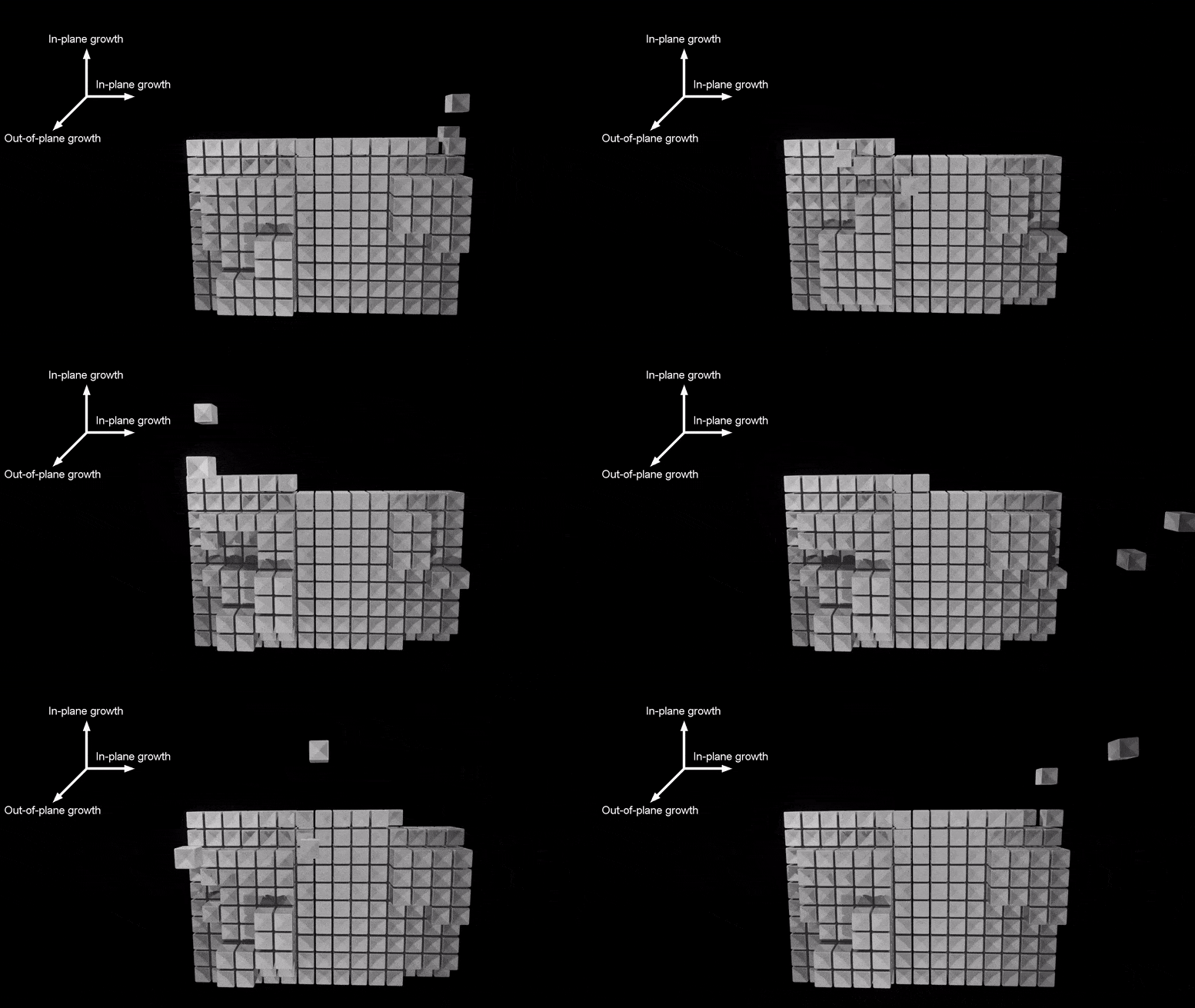
Animation illustrating in-plane and out-of-plane growth modes for crystals of gold concave nanocubes inside a liquid-phase transmission electron microscope (TEM) chamber. Credit: Erik Luijten and Qian Chen
Described by the researchers as an “experimental tour de force,” the study used a newly optimized form of liquid-phase transmission electron microscopy (TEM) to gain unprecedented insights into the self-assembly process. Before this work, researchers have used microscopy to watch micron-sized colloids — which are 10 to 100 times larger than nanoparticles — self-assemble into crystals. They also have used X-ray crystallography or electron microscopy to visualize single layers of atoms in a crystalline lattice. But they were unable to watch atoms individually move into place.
Completing the Length Scale Spectrum
“We know that atoms use a similar scheme to assemble into crystals, but we have never seen the actual growth process,” said Northwestern’s Erik Luijten, who led the theoretical and computational work to explain the observations. “Now we see it coming together right in front of our eyes. By viewing nanoparticles, we are watching particles that are larger than atoms, but smaller than colloids. So, we have completed the whole spectrum of length scales. We are filling in the missing length.”
“Previously, our team resolved the mystery of nucleation, namely how the embryos of crystals composed of tens of nanoparticles are formed, which follows a nonclassical pathway in solution,” said Illinois’ Qian Chen, who led the experimental work. “With recent advances in liquid-phase TEM and data science, in this work, we are now able to capture and track motions of thousands of nanoparticles over time. These nanoparticles wiggle in solution and grow into crystals of various morphologies like polyhedral or wedding cake.”
Liquid-phase TEM video of layer-by-layer growth of a crystal with smooth surface from gold concave nanocubes. Surface particles on the growing crystal are tracked (center positions overlaid with yellow dots). Credit: Erik Luijten and Qian Chen
Luijten is a professor of materials science and engineering at Northwestern’s McCormick School of Engineering, where he also is an associate dean. Chen is an associate professor of materials science and engineering at Illinois.
Decoding Crystallization with Nanoparticles
Most people are familiar with crystals in the forms of salt, sugar, snowflakes, and sparkling gems, such as diamonds. Although crystallization is a ubiquitous phenomenon, exactly how crystals form has remained a mystery. The building blocks — atoms, molecules, or ions — that compose crystalline materials are highly ordered, forming lattices of equally spaced building blocks. These lattices then stack on top of each other to form a three-dimensional solid material.
“The stacking of atoms into regular arrangements is the reason that crystals have smooth, flat faces,” Luijten said. “That’s why they break along straight edges.”
Up until now, researchers have studied crystallization by examining much larger particles called colloids. But watching colloids self-arrange into crystals did not give insights into how atoms behave. Whereas crystals have flat, uniform surfaces, crystalline structures made from micron-sized colloids tend to adopt non-uniform, rough surfaces.
“Colloids are so much larger than atoms that it is doubtful they follow the same steps when crystallizing,” Luijten said. “So, they do not teach us what atoms do. The analogy of colloids to atoms doesn’t really hold.”
To glean deeper insights into the crystallization process, Luijten, Chen, and their teams turned to nanoparticles. Recent advances to improve liquid-phase TEM have made it possible to view nanoparticles in real-time as they form solid materials. Chen’s team spent years optimizing the process to ensure the electron beam could view the particles without damaging them. In the new study, the researchers used differently shaped nanoparticles — cubes, spheres, and indented cubes — to explore how shape affects behavior.
The researchers first visualized crystal formation with advanced computer simulations, which were performed by Northwestern graduate students Ziwei Wang and Garrett Watson as well as postdoctoral fellow Tine Curk. Then they performed experiments with liquid-phase TEM to watch the nanoparticles self-assemble in real-time. In the experiments, the researchers noticed the particles collided into each other, sticking together to form layers. Then, to form the layer-by-layer crystalline structure, the particles first formed a horizontal layer and then stacked vertically. Sometimes, after sticking to each other, the particles briefly detached to fall onto a layer below.
“They run along and then hesitate at the edge before falling,” Luijten said. “It’s like a diver hesitating at the edge of a diving board. I can’t believe we can actually see this. We have never seen the actual growth process before — only the result.”
Luijten said this information will help engineers design new materials. The insight specifically could help with the design of thin-film materials, which are often used to build flexible electronics, light-emitting diodes, transistors, and solar cells.
“Knowing how particles come together will enable us to control the shape of a surface,” Luijten said. “Do you want a flat or rough surface? Changing particle shape or how fast the particles fall can affect the surface.”
Reference: “Unravelling the crystal growth of nanoparticles” 30 March 2023, Nature Nanotechnology.
DOI: 10.1038/s41565-023-01355-w
The study was supported by the U.S. Department of Energy (award numbers DE-SC0020723 and DE-SC0020885) and the National Science Foundation (award number DGE-1842165).
Never miss a breakthrough: Join the SciTechDaily newsletter.
Follow us on Google and Google News.
1 Comment
Let us try to understand the roll of cymatics or sound vibration for self organizing bodies… This is really important and undervalued or it’s kept suppressed.