
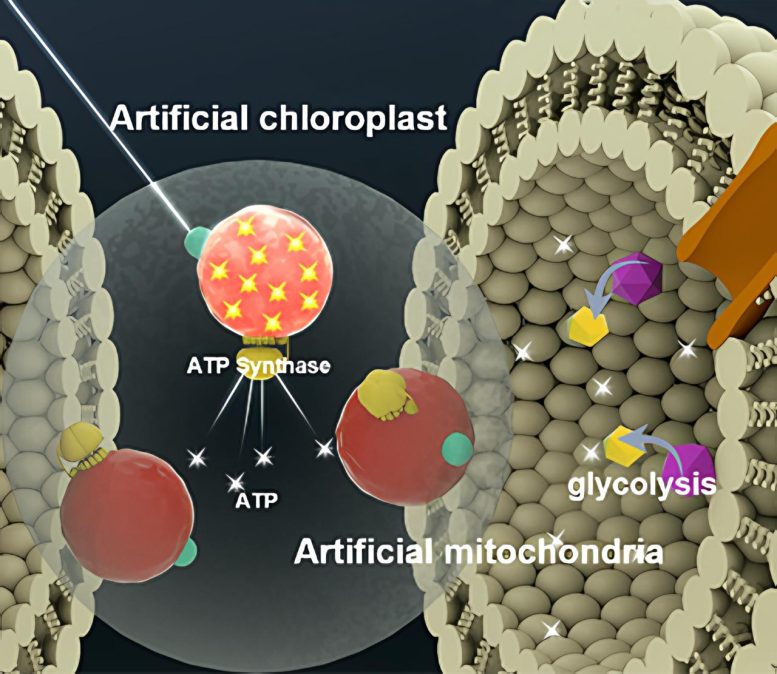
Assessing how energy-generating synthetic organelles could sustain artificial cells.
Researchers have assessed the progress and challenges in creating artificial mitochondria and chloroplasts for energy production in synthetic cells. These artificial organelles could potentially enable the development of new organisms or biomaterials. The researchers identified proteins as the most crucial components for molecular rotary machinery, proton transport, and ATP production, which serves as the cell’s primary energy currency.
Energy production in nature is the responsibility of chloroplasts and mitochondria and is crucial for fabricating sustainable, synthetic cells in the lab. Mitochondria are not only “the powerhouses of the cell,” as the middle school biology adage goes, but also one of the most complex intracellular components to replicate artificially.
In Biophysics Reviews, by AIP Publishing, researchers from Sogang University in South Korea and the Harbin Institute of Technology in China identified the most promising advancements and greatest challenges of artificial mitochondria and chloroplasts.
“This could be an important milestone in understanding the origin of life and the origin of cells.” Kwanwoo Shin
“If scientists can create artificial mitochondria and chloroplasts, we could potentially develop synthetic cells that can generate energy and synthesize molecules autonomously. This would pave the way for the creation of entirely new organisms or biomaterials,” author Kwanwoo Shin said.
In plants, chloroplasts use sunlight to convert water and carbon dioxide into glucose. Mitochondria, found in plants and animals alike, produce energy by breaking down glucose.
Once a cell produces energy, it often uses a molecule called adenosine triphosphate (ATP) to store and transfer that energy. When the cell breaks down the ATP, it releases energy that powers the cell’s functions.
“In other words, ATP acts as the main energy currency of the cell, and it is vital for the cell to perform most of the cellular functions,” said Shin.
Advancements in Artificial Organelles
The team describes the components required to construct synthetic mitochondria and chloroplasts and identifies proteins as the most important aspects for molecular rotary machinery, proton transport, and ATP production.
Previous studies have replicated components that make up the energy-producing organelles. Some of the most promising work investigates the intermediate operations involved in the complex energy-generating process. By connecting the sequence of proteins and enzymes, researchers have improved energy efficiency.
One of the most significant challenges remaining in trying to reconstruct the energy production organelles is enabling self-adaptation in changing environments to maintain a stable supply of ATP. Future studies must investigate how to improve upon this limiting feature before synthetic cells are self-sustainable.
The authors believe it is important to create artificial cells with biologically realistic energy-generation methods that mimic natural processes. Replicating the entire cell could lead to future biomaterials and lend insight into the past.
“This could be an important milestone in understanding the origin of life and the origin of cells,” Shin said.
Reference: “Artificial organelles for sustainable chemical energy conversion and production in artificial cells: Artificial mitochondrion and chloroplasts” by Hyun Park, Weichen Wang, Seo Hyeon Min, Yongshuo Ren, Kwanwoo Shin and Xiaojun Han, 28 March 2023, Biophysics.
DOI: 10.1063/5.0131071
Never miss a breakthrough: Join the SciTechDaily newsletter.
Follow us on Google and Google News.
2 Comments
Powerhouse of the future, what is this, fusion? This has been going on since the proteins were first characterized (Racker and Stoeckenius 1974). The problem of the proteins degrading has not changed. Why is there no discussion of what to do when the proteins degrade. All electron transfer processes form a constant stream of unpaired electrons that wreak havoc on the protein scaffolds. Look at the rate at which the D1 subunits are switched out in a plant due to damage during light reactions:
(see Int J Mol Sci 2022 Feb 25;23(5):2520. doi: 10.3390/ijms23052520) Artificial cells must contain repair mechanisms or this is a gigantic waste of time. This is becoming ridiculous… (a long time PSII researcher who would love to see this actually work)
Not the future. Until we master actual biology, instead of scams and fraud to keep the money moving, we cannot master the other realms. We will only get more fake $cience.