
Close Menu
    Facebook X (Twitter) Instagram
    SciTechDaily
    • Biology
    • Chemistry
    • Earth
    • Health
    • Physics
    • Science
    • Space
    • Technology
    Facebook X (Twitter) Pinterest YouTube RSS
    SciTechDaily
    Home»Biology»Scientists Create a Mouse That Eats Fat But Doesn’t Get Fat, Possible Treatment for Obesity
    Biology

    Scientists Create a Mouse That Eats Fat But Doesn’t Get Fat, Possible Treatment for Obesity

    By Bill Hathaway, Yale UniversityAugust 10, 2018No Comments2 Mins Read
    Facebook Twitter Pinterest Telegram LinkedIn WhatsApp Email Reddit
    Share
    Facebook Twitter LinkedIn Pinterest Telegram Email Reddit
    Treatment for Obesity
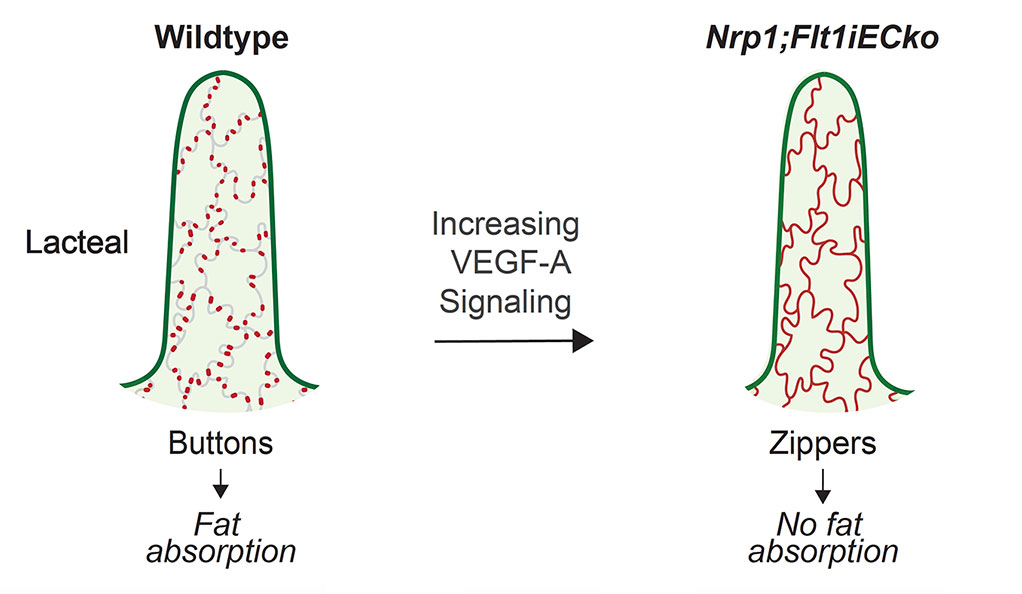
    Manipulating two genes enabled scientists to replace “buttons” on surface of lymphatic vessels to “zippers” which turn away fat molecules.

    Yale scientists set out to create a morbidly obese mouse. They failed miserably.

    What they found was much more interesting.

    “We created a mouse that eats fat but doesn’t get fat,” said Anne Eichmann, Ensign Professor of Medicine (Cardiology) and Professor of Cellular And Molecular Physiology.

    The “failure” led Eichmann’s team headed by Associate Research Scientist Feng Zhang to discover that the absence of two molecules helped “zip up” specialized vessels in lymphatic tissue and prevent the uptake of fat particles called chylomicrons, they report on August 10 in the journal Science. Instead of incorporating lipids as fat, mice lacking the two genes excreted lipids and gained little weight despite being fed a high-fat diet.

    Lipids are taken up in lymphatic tissue in the gut through portals in vessels called lacteals. In most cases, the entrance of lipids to the vessels are controlled through easily penetrated button-like structures. However, in mice lacking vascular endothelial growth factor 1 and neuropilin1 vessels become “zippered” and lipids are excreted rather than taken up by vessels. Zippering can be also induced in normal mice by inhibiting the Rho kinase ROCK.

    Eichmann noted that an inhibitor of ROCK is already used in a drug to treat glaucoma and could be tested for its effects on lipid uptake and weight gain as well.

    Primary funding for the research came from the National Institutes of Health and Inserm.

    Reference: “Lacteal junction zippering protects against diet-induced obesity” by Feng Zhang, Georgia Zarkada, Jinah Han, Jinyu, Alexandre Dubrac, Roxana Ola, Gael Genet, Kevin Boyé, Pauline Michon, Steffen E. Künzel, Joao Paulo Camporez, Abhishek K. Singh, Guo-Hua Fong, Michael Simons, Patrick Tso, Carlos Fernández-Hernando, Gerald I. Shulman, William C. Sessa and Anne Eichmann, 10 August 2018, Science.
    DOI: 10.1126/science.aap9331

    Never miss a breakthrough: Join the SciTechDaily newsletter.
    Follow us on Google and Google News.

    Cell Biology Medicine Molecular Physiology Obesity Yale University
    Share. Facebook Twitter Pinterest LinkedIn Email Reddit

    Related Articles

    Biologists Develop Breakthrough RNA-Based Therapy to Target West Nile Virus

    “DNA-Origami” Allows Scientists to Study Minute Protein Interactions

    Yale Research Shows Leptin Spurs Body to Shift from Burning Carbs to Fat

    Scientists Create a More Precise Technique to Edit Genomes of Living Organisms

    Yale Research Provides New Clues to How Cancer Cells Spread

    New Stem Cell Study May Lead to New Drug Targets for Autism Treatment

    Researchers Increase Energy-Burning Brown Fat Cells

    Mitochondria Can Either Spur or Stop Obesity

    Deltarasin Blocks Oncogenic Protein KRAS, Opens Up New Approaches to Cancer Therapy

    Leave A Reply Cancel Reply

    • Facebook
    • Twitter
    • Pinterest
    • YouTube

    Don't Miss a Discovery

    Subscribe for the Latest in Science & Tech!

    Trending News

    Quantum Fluctuations Break a Crystal’s Symmetry Rules

    Why Does an Irregular Heartbeat Strike 40 Years Early in Some People?

    Scientists Reveal How ADHD Could Fuel Creative Thinking

    Scientists Find Just 3 Minutes of Sprinting Can Transform Blood Chemistry

    Have We Found Alien Life? Here’s What Scientists Really Think

    Neuroscientist Challenges the Idea That Your Brain “Makes” Decisions

    Quitting Alcohol Can Change the Brain in Surprising Ways, Mouse Study Finds

    FDA-Approved Drug Shows Promise for Reversing Osteoarthritis Damage

    Follow SciTechDaily
    • Facebook
    • Twitter
    • YouTube
    • Pinterest
    • Newsletter
    • RSS
    SciTech News
    • Biology News
    • Chemistry News
    • Earth News
    • Health News
    • Physics News
    • Science News
    • Space News
    • Technology News
    Recent Posts
    • Strange Quantum Oscillations Reveal New Physics in an Exotic Material
    • Quantum Experiment Breaks a Long-Standing X-Ray Energy Limit
    • Astronomers Detect a Record-Breaking “Cosmic Laser” From 8 Billion Light-Years Away
    • Scientists Supercharge Natural Killer Cells To Attack Solid Tumors
    • Scientists Find a Youth-Associated Protein That Rejuvenates Brain Immune Cells in Mice
    Copyright © 1998 - 2026 SciTechDaily. All Rights Reserved.
    • Science News
    • About
    • Contact
    • Editorial Board
    • Privacy Policy
    • Terms of Use

    Type above and press Enter to search. Press Esc to cancel.