
Close Menu
    Facebook X (Twitter) Instagram
    SciTechDaily
    • Biology
    • Chemistry
    • Earth
    • Health
    • Physics
    • Science
    • Space
    • Technology
    Facebook X (Twitter) Pinterest YouTube RSS
    SciTechDaily
    Home»Biology»Yale Research Provides New Clues to How Cancer Cells Spread
    Biology

    Yale Research Provides New Clues to How Cancer Cells Spread

    By Ziba Kashef, Yale UniversityJanuary 30, 20171 Comment3 Mins Read
    Facebook Twitter Pinterest Telegram LinkedIn WhatsApp Email Reddit
    Share
    Facebook Twitter LinkedIn Pinterest Telegram Email Reddit
    Yale Study Provides New Clue to How Cancer Cells Spread
    New research from Yale University provides a new clue to how cancer cells spread.

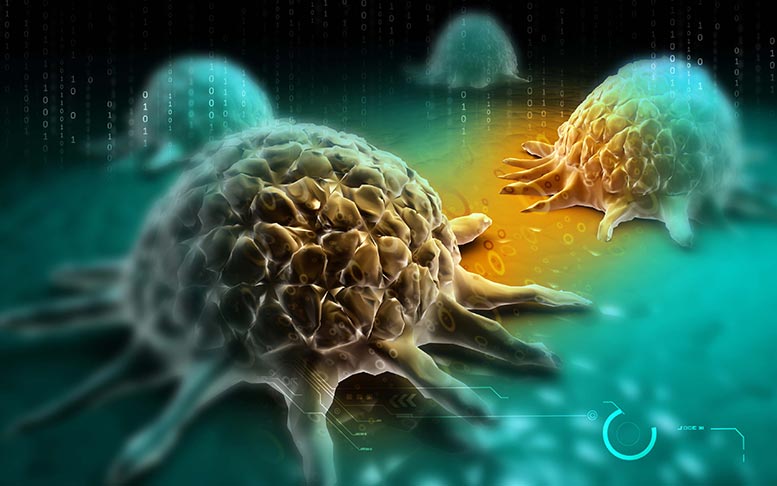
    New research from Yale University shows how a melanoma cell and a white blood cell can fuse to form a hybrid with the ability to metastasize, providing further insight into how melanoma and other cancers spread from solid tumors with implications for future treatment.

    Cancer turns deadly when malignant cells spread from a primary tumor to other organs and tissues. Building on a theory first proposed more than a century ago, senior research scientist and study author John Pawelek collaborated with colleagues at the University of Colorado Anschutz Medical Center and the Denver Crime Laboratory to examine how cancer spreads from solid tumors.

    The research team analyzed tumor biopsies from a patient with malignant melanoma who had received a bone-marrow transplant before developing cancer. They compared DNA from the primary melanoma and from lymph nodes where the cancer had spread. In both sites, they found a mixture of patient and donor DNA.

    The presence of the mixed patient-donor DNA strongly suggests that white blood cells that normally attack cancer cells instead fused with them, forming a genetic hybrid that then spread, said Pawelek, who is a member of Yale Cancer Center. “The cancer cell and white blood cell DNA were mixed into the same nucleus. The hybrid has both the white blood cell propensity to move into lymph nodes as well as the dividing characteristics of the primary tumor.”

    The current study confirms an earlier finding, published by Pawelek and colleagues in 2013, that also detected hybrid cells in a metastatic melanoma patient who had received a bone marrow transplant. Studying transplant patients allows researchers to distinguish sources of DNA.

    The finding points to fusion as a target for new cancer therapies. “We need to focus on how fusion between white blood cells and cancer cells actually occurs,” Pawelek noted. “There are a lot of steps involved in that process and those steps are all vulnerable to targeting.”

    Future therapies could aim to either prevent fusion of cells derived from bone marrow, for example, or limit the integration of fused genes into hybrids. Research focused on such pathways could produce new techniques for targeting the metastasis process itself, the researchers said.

    Other study authors are Greggory S. LaBerge, Eric Duvall, Zachary Grasmick, and Kay Haedicke.

    There was no funding for this project and the authors have no conflicts of interest to declare. The study will be published in the journal PLOS ONE.

    Never miss a breakthrough: Join the SciTechDaily newsletter.
    Follow us on Google and Google News.

    Cancer Cell Biology Disease Medicine Yale University
    Share. Facebook Twitter Pinterest LinkedIn Email Reddit

    Related Articles

    Scientists Provide New Insights Into the Origins of Genetic Diseases

    New Molecular Details of Cancer Cells Could Lead to Improved Treatment

    Biologists Develop Breakthrough RNA-Based Therapy to Target West Nile Virus

    Scientists Reveal Four Genes Linked to Cystic Diseases of the Kidney and Liver

    Biologists Identify a New Approach to Cancer Immunotherapy

    DNA Sequencing Technologies Help Characterized the Mutational Landscape of Melanoma

    Nanoparticles Stop Lymphoma in Mice

    A Potential Therapeutic Target for Treating Pulmonary Fibrosis

    New Drug CD47 Could Potentially Shrink and Cure All Tumors

    1 Comment

    1. Madanagopal.V.C. on January 31, 2017 4:50 am

      The article states that metastasis of cancer cells does not happen purely by the cells of malignant cells but due to the hybrid variety of cells that get manufactured along with white blood corpuscles which migrate them to different parts of the body. Here instead of identifying them as some foreign cells other cells recognizes them as their own because white corpuscles can travel any part of the body in blood stream. Now, the virus like mechanism acts and more and more of malignant cells are formed from different tissues of the body by this phenomena. Thank You.

      Reply
    Leave A Reply Cancel Reply

    • Facebook
    • Twitter
    • Pinterest
    • YouTube

    Don't Miss a Discovery

    Subscribe for the Latest in Science & Tech!

    Trending News

    Breakthrough Bowel Cancer Trial Leaves Patients Cancer-Free for Nearly 3 Years

    Natural Compound Shows Powerful Potential Against Rheumatoid Arthritis

    100,000-Year-Old Neanderthal Fossils in Poland Reveal Unexpected Genetic Connections

    Simple “Gut Reset” May Prevent Weight Gain After Ozempic or Wegovy

    2.8 Days to Disaster: Scientists Warn Low Earth Orbit Could Suddenly Collapse

    Common Food Compound Shows Surprising Power Against Superbugs

    5 Simple Ways To Remember More and Forget Less

    The Atomic Gap That Could Cost the Semiconductor Industry Billions

    Follow SciTechDaily
    • Facebook
    • Twitter
    • YouTube
    • Pinterest
    • Newsletter
    • RSS
    SciTech News
    • Biology News
    • Chemistry News
    • Earth News
    • Health News
    • Physics News
    • Science News
    • Space News
    • Technology News
    Recent Posts
    • After 37 Years, the World’s Longest-Running Soil Warming Experiment Uncovers a Startling Climate Secret
    • NASA Satellite Captures First-Ever High-Res View of Massive Pacific Tsunami
    • ADHD Isn’t Just a Deficit: Study Reveals Powerful Hidden Strengths
    • Scientists Uncover “Astonishing” Hidden Property of Light
    • Scientists Discover Stem Cells That Could Regrow Teeth and Bone
    Copyright © 1998 - 2026 SciTechDaily. All Rights Reserved.
    • Science News
    • About
    • Contact
    • Editorial Board
    • Privacy Policy
    • Terms of Use

    Type above and press Enter to search. Press Esc to cancel.