
Close Menu
    Facebook X (Twitter) Instagram
    SciTechDaily
    • Biology
    • Chemistry
    • Earth
    • Health
    • Physics
    • Science
    • Space
    • Technology
    Facebook X (Twitter) Pinterest YouTube RSS
    SciTechDaily
    Home»Space»Hayabusa Spacecraft Reveals Absolute Age of Asteroid Itokawa
    Space

    Hayabusa Spacecraft Reveals Absolute Age of Asteroid Itokawa

    By Saori Obayashi, Osaka UniversityAugust 27, 2018No Comments3 Mins Read
    Facebook Twitter Pinterest Telegram LinkedIn WhatsApp Email Reddit
    Share
    Facebook Twitter LinkedIn Pinterest Telegram Email Reddit
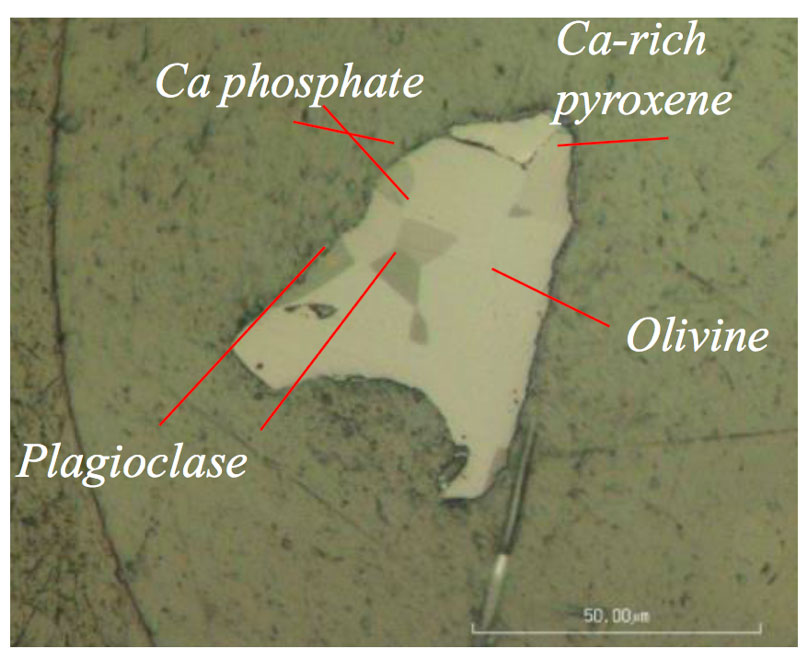
    Cross Section Area of Asteroid Itokawa
    The cross section area of the particle collected from the asteroid Itokawa using Hayabusa spacecraft. Osaka University

    Understanding the origin and time evolution of near-Earth asteroids (NEAs) is an issue of scientific interest and practical importance because they are potentially hazardous to the Earth. However, when and how these NEAs were formed and what they suffered during their lifetime remain enigmas.

    Japanese scientists, including those from Osaka University, closely examined particles collected from the asteroid Itokawa by the spacecraft Hayabusa, finding that the parent body of Itokawa was formed about 4.6 billion years ago when the solar system was born and that it was destroyed by a collision with another asteroid about 1.5 billion years ago. Their research results were published in the journal Scientific Reports.

    Focusing on a few micrometers of phosphate minerals, which are rarely found in Itokawa particles, the scientists performed precise isotope analyses of uranium (U) and lead (Pb) in Itokawa particles of about 50 μm in diameter using Secondary Ion Mass Spectrometry (SIMS).
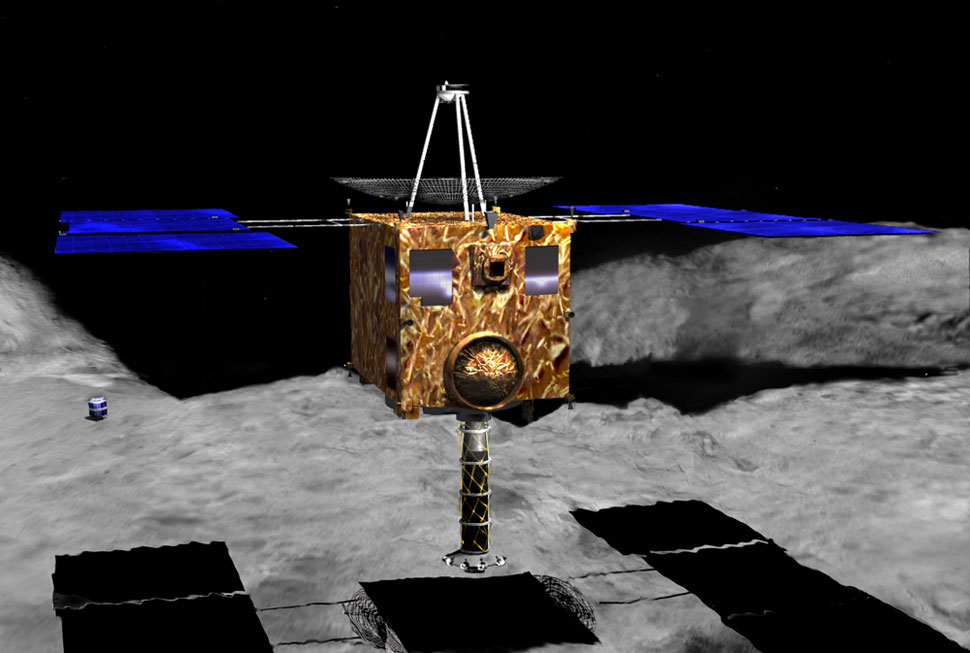
    Hayabusa Spacecraft
    Hayabusa spacecraft on sample return mission. Illustration by J. Garry from Wikipedia

    Lead author Kentaro Terada says, “By combining two U decay series, 238U-206Pb (with a half-life of 4.47 billion years) and 235U-207Pb (with a half-life of 700 million years), using four Itokawa particles, we clarified that phosphate minerals crystallized during a thermal metamorphism age (4.64±0.18 billion years ago) of Itokawa’s parent body, experiencing shock metamorphism due to a catastrophic impact event by another body 1.51±0.85 billion years ago.”

    It has been reported that the mineralogy and geochemistry of the Itokawa particles resemble those of LL (LL stands for Low (total) iron, Low metal) chondrites, which frequently fall to the Earth.
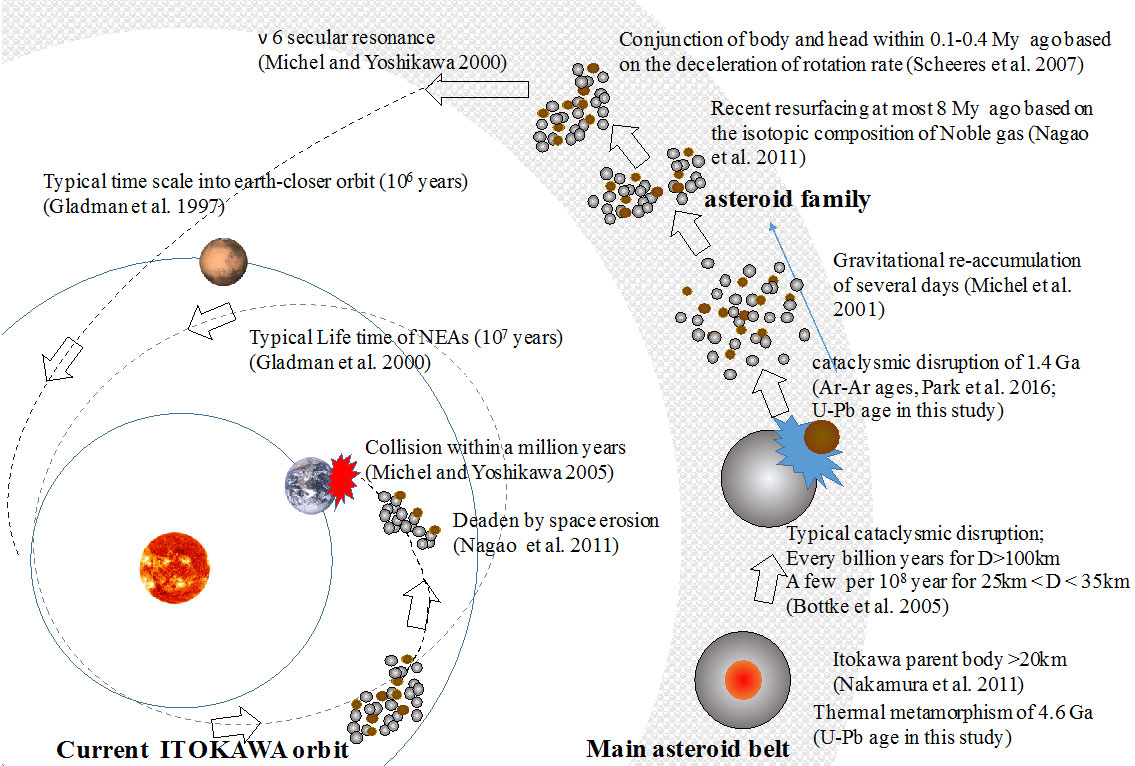
    Time Evolution of the Asteroid Itokawa
    The time evolution of the asteroid Itokawa. Osaka University

    However, the shock ages of Itokawa particles obtained from this study (1.5 billion years ago) are different from previously reported shock ages of shocked LL chondrites (4.2 billion years ago). This shows that the asteroid Itokawa had a time evolution different from that of the parent body of LL chondrites.

    The results of this study established constraints on the timescale of the first samples collected from the asteroid, providing concrete figures (absolute age) to the evolution of the NEAs whose orbits are well known. This will lead to the elucidation of the origins and histories of asteroids.

    Reference “Thermal and impact histories of 25143 Itokawa recorded in Hayabusa particles” by K. Terada, Y. Sano, N. Takahata, A. Ishida, A. Tsuchiyama, T. Nakamura, T. Noguchi, Y. Karouji, M. Uesugi, T. Yada, M. Nakabayashi, K. Fukuda and H. Nagahara , 7 August 2018, Scientific Reports.
    DOI: 10.1038/s41598-018-30192-4

    Never miss a breakthrough: Join the SciTechDaily newsletter.
    Follow us on Google and Google News.

    Asteroid Astronomy Cosmology Itokawa University of Osaka
    Share. Facebook Twitter Pinterest LinkedIn Email Reddit

    Related Articles

    Astronomers Discover Asteroid Captured from Another Star System

    Astronomers Discover Exiled Asteroid in Outer Reaches of Solar System

    New Fundamental Law Stipulates the Evolution of Galaxy Clusters

    NEOWISE Asteroid-Hunting Spacecraft Releases Fourth Year of Data

    Arecibo Radar Views Near-Earth Asteroid 3200 Phaethon

    A Small Object (A/2017 U1) from Deep Space Enters Our Solar System

    SwRI Astronomers Identify the Oldest Known Asteroid Family

    VLT Maps Out the Shattered Remains of an Asteroid Around a White Dwarf

    New NASA Animation Follows Long, Strange Trip of Asteroid Bennu

    Leave A Reply Cancel Reply

    • Facebook
    • Twitter
    • Pinterest
    • YouTube

    Don't Miss a Discovery

    Subscribe for the Latest in Science & Tech!

    Trending News

    Scientists May Have Solved a Long-Standing Melanoma Treatment Mystery

    This Flesh-Eating Fly Is Back in the U.S. – Scientists Are Tracking Where It Could Strike Next

    Scientists Have Uncovered a Troubling New Pattern Hidden in America’s Rivers

    “Entirely Surprising” – Scientists Have Found a Martian Meteorite Unlike Any Known Before

    “Find of the Year” – Archaeologists Discover the Smallest Ice Age Figurines Ever Found

    New Research Challenges Common Exercise Advice for Bone Health

    Avoiding These 3 Health Risks in Midlife Linked to 13 More Years Without Dementia

    Where Were All the Tiny Dinosaurs? Scientists May Finally Have an Answer

    Follow SciTechDaily
    • Facebook
    • Twitter
    • YouTube
    • Pinterest
    • Newsletter
    • RSS
    SciTech News
    • Biology News
    • Chemistry News
    • Earth News
    • Health News
    • Physics News
    • Science News
    • Space News
    • Technology News
    Recent Posts
    • Scientists Discover a Hidden Hormone Pathway That Protects the Liver From Damage
    • Quitting Alcohol Can Change the Brain in Surprising Ways, Mouse Study Finds
    • FDA-Approved Drug Shows Promise for Reversing Osteoarthritis Damage
    • A 2-Billion-Year-Old Clue Challenges a Popular Earth Science Theory
    • Paleontologists Reconstruct 56-Million-Year-Old Forests – and Find a Chilling Warning for Today
    Copyright © 1998 - 2026 SciTechDaily. All Rights Reserved.
    • Science News
    • About
    • Contact
    • Editorial Board
    • Privacy Policy
    • Terms of Use

    Type above and press Enter to search. Press Esc to cancel.