
Close Menu
    Facebook X (Twitter) Instagram
    SciTechDaily
    • Biology
    • Chemistry
    • Earth
    • Health
    • Physics
    • Science
    • Space
    • Technology
    Facebook X (Twitter) Pinterest YouTube RSS
    SciTechDaily
    Home»Space»NEOWISE Asteroid-Hunting Spacecraft Releases Fourth Year of Data
    Space

    NEOWISE Asteroid-Hunting Spacecraft Releases Fourth Year of Data

    By DC Agle, Jet Propulsion LaboratoryApril 23, 2018No Comments3 Mins Read
    Facebook Twitter Pinterest Telegram LinkedIn WhatsApp Email Reddit
    Share
    Facebook Twitter LinkedIn Pinterest Telegram Email Reddit
    NEOWISE Asteroid Hunter Spacecraft Releases Fourth Year of Data
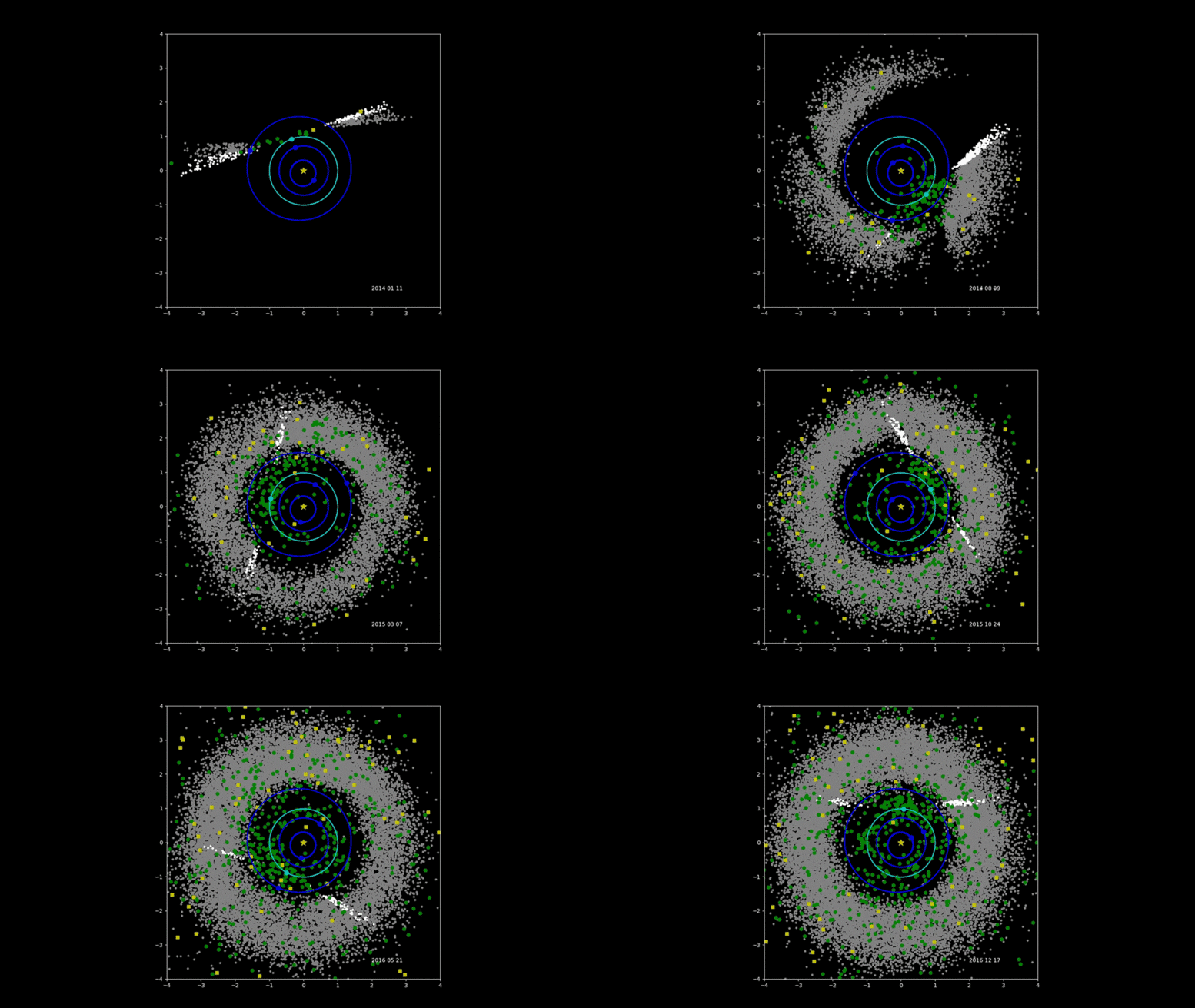
    This movie shows the progression of NASA’s Near-Earth Object Wide-field Survey Explorer (NEOWISE) investigation for the mission’s first four years following its restart in December 2013. Green dots represent near-Earth objects. Gray dots represent all other asteroids which are mainly in the main asteroid belt between Mars and Jupiter. Yellow squares represent comets. Credit: NASA/JPL-Caltech/PSI

    NASA’s Near-Earth Object Wide-field Infrared Survey Explorer (NEOWISE) mission has released its fourth year of survey data. Since the mission was restarted in December 2013, after a period of hibernation, the asteroid- and comet-hunter has completely scanned the skies nearly eight times and has observed and characterized 29,375 objects in four years of operations. This total includes 788 near-Earth objects and 136 comets since the mission restart.

    Near-Earth objects (NEOs) are comets and asteroids that have been nudged by the gravitational attraction of the planets in our solar system into orbits that allow them to enter Earth’s neighborhood. Ten of the objects discovered by NEOWISE in the past year have been classified as potentially hazardous asteroids (PHAs). Near-Earth objects are classified as PHAs, based on their size and how closely they can approach Earth’s orbit.

    “NEOWISE continues to expand our catalog and knowledge of these elusive and important objects,” said Amy Mainzer, NEOWISE principal investigator from NASA’s Jet Propulsion Laboratory in Pasadena, California. “In total, NEOWISE has now characterized sizes and reflectivities of over 1,300 near-Earth objects since the spacecraft was launched, offering an invaluable resource for understanding the physical properties of this population, and studying what they are made of and where they have come from.”

    The NEOWISE team has released an animation depicting detections made by the telescope over its four years of surveying the solar system.

    More than 2.5 million infrared images of the sky were collected in the fourth year of operations by NEOWISE. These data are combined with the year one through three NEOWISE data into a single publicly available archive. That archive contains approximately 10.3 million sets of images and a database of more than 76 billion source detections extracted from those images.

    Originally called the Wide-field Infrared Survey Explorer (WISE), the spacecraft launched in December 2009. It was placed in hibernation in 2011 after its primary astrophysics mission was completed. In September 2013, it was reactivated, renamed NEOWISE and assigned a new mission: to assist NASA’s efforts to identify and characterize the population of near-Earth objects. NEOWISE also is characterizing more distant populations of asteroids and comets to provide information about their sizes and compositions.

    NASA’s Jet Propulsion Laboratory in Pasadena, California, manages and operates the NEOWISE mission for NASA’s Planetary Defense Coordination Office within the Science Mission Directorate in Washington. The Space Dynamics Laboratory in Logan, Utah, built the science instrument. Ball Aerospace & Technologies Corp. of Boulder, Colorado, built the spacecraft. Science data processing takes place at the Infrared Processing and Analysis Center at Caltech in Pasadena. Caltech manages JPL for NASA.

    To review the latest data release from NEOWISE, please visit: http://wise2.ipac.caltech.edu/docs/release/neowise/

    Never miss a breakthrough: Join the SciTechDaily newsletter.
    Follow us on Google and Google News.

    Asteroid Astronomy Cosmology NEO NEOWISE
    Share. Facebook Twitter Pinterest LinkedIn Email Reddit

    Related Articles

    Arecibo Radar Views Near-Earth Asteroid 3200 Phaethon

    Large Near-Earth Asteroid Florence to Pass Earth on September 1

    Near-Earth Asteroid 2014 JO25 Set to Fly Past Earth on April 19

    Asteroid 2013 TX68 to Pass Earth on March 5

    VLT Maps Out the Shattered Remains of an Asteroid Around a White Dwarf

    Updated Radar Images Provide New Details on Asteroid 2015 TB145

    “Skull Shaped” Asteroid 2015 TB145 Will Flyby Earth This Halloween

    NEOWISE: One Year of Observations Mapped

    New NASA Animation Follows Long, Strange Trip of Asteroid Bennu

    Leave A Reply Cancel Reply

    • Facebook
    • Twitter
    • Pinterest
    • YouTube

    Don't Miss a Discovery

    Subscribe for the Latest in Science & Tech!

    Trending News

    The Universe Is Expanding Too Fast and Scientists Can’t Explain Why

    “Like Liquid Metal”: Scientists Create Strange Shape-Shifting Material

    Early Warning Signals of Esophageal Cancer May Be Hiding in Plain Sight

    Common Blood Pressure Drug Shows Surprising Power Against Deadly Antibiotic-Resistant Superbug

    Scientists Uncover Dangerous Connection Between Serotonin and Heart Valve Disease

    Scientists Discover a “Protector” Protein That Could Help Reverse Hair Loss

    Bone-Strengthening Discovery Could Reverse Osteoporosis

    Scientists Uncover Hidden Trigger Behind Stem Cell Aging

    Follow SciTechDaily
    • Facebook
    • Twitter
    • YouTube
    • Pinterest
    • Newsletter
    • RSS
    SciTech News
    • Biology News
    • Chemistry News
    • Earth News
    • Health News
    • Physics News
    • Science News
    • Space News
    • Technology News
    Recent Posts
    • Scientists Crack Alfalfa’s Chromosome Mystery After Decades of Debate
    • Ancient Ant-Plant Alliance Collapses As Predatory Wasps Move In
    • Scientists Discover Tiny New Spider That Hunts Prey 6x Its Size
    • Natural Component From Licorice Shows Promise for Treating Inflammatory Bowel Disease
    • New Research Finds Shocking Link Between Chili Peppers and Cancer
    Copyright © 1998 - 2026 SciTechDaily. All Rights Reserved.
    • Science News
    • About
    • Contact
    • Editorial Board
    • Privacy Policy
    • Terms of Use

    Type above and press Enter to search. Press Esc to cancel.