
Close Menu
    Facebook X (Twitter) Instagram
    SciTechDaily
    • Biology
    • Chemistry
    • Earth
    • Health
    • Physics
    • Science
    • Space
    • Technology
    Facebook X (Twitter) Pinterest YouTube RSS
    SciTechDaily
    Home»Space»New Method Uses Meteorites to Investigate Supernovae
    Space

    New Method Uses Meteorites to Investigate Supernovae

    By Hitoshi Yamaoka, NAOJSeptember 4, 20181 Comment3 Mins Read
    Facebook Twitter Pinterest Telegram LinkedIn WhatsApp Email Reddit
    Share
    Facebook Twitter LinkedIn Pinterest Telegram Email Reddit
    Falling Stars Hold Clues of Dying Stars
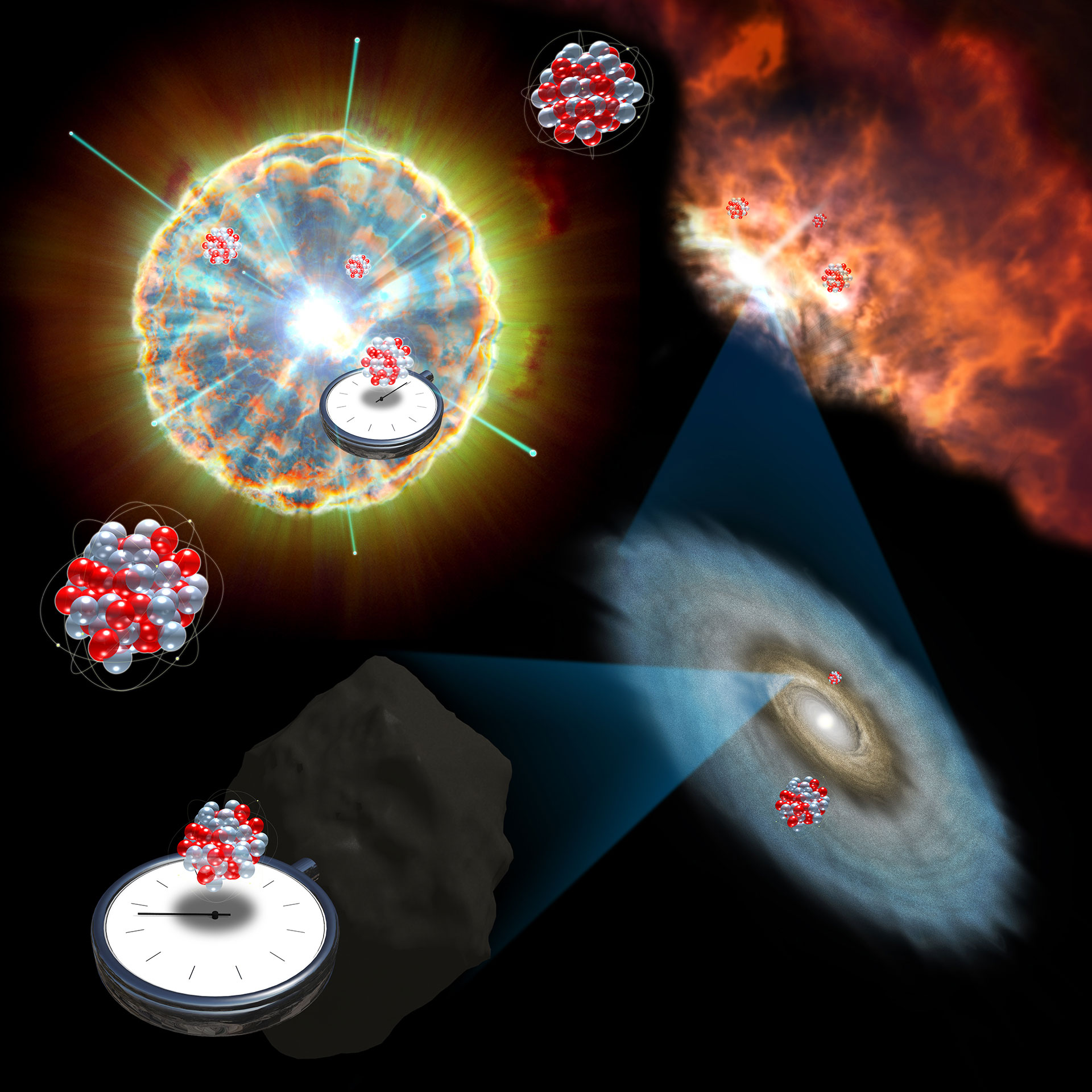
    Cosmic clocks. We can estimate the age of heavy elements in the primordial Solar System by measuring the traces left in meteorites by specific radioactive nuclei synthesized in certain types of supernovae. (Credit: NAOJ)

    An international team of researchers has proposed a new method to investigate the inner workings of supernovae explosions. This new method uses meteorites and is unique in that it can determine the contribution from electron anti-neutrinos, enigmatic particles which can’t be tracked through other means.

    Supernovae are important events in the evolution of stars and galaxies, but the details of how the explosions occur are still unknown. This research, led by Takehito Hayakawa, a visiting professor at the National Astronomical Observatory of Japan, found a method to investigate the role of electron anti-neutrinos in supernovae. By measuring the amount of 98Ru (an isotope of Ruthenium) in meteorites, it should be possible to estimate how much of its progenitor 98Tc (a short-lived isotope of Technetium) was present in the material from which the Solar System formed. The amount of 98Tc in turn is sensitive to the characteristics, such as temperature, of electron anti-neutrinos in the supernova process; as well as to how much time passed between the supernova and the formation of the Solar System. The expected traces of 98Tc are only a little below the smallest currently detectable levels, raising hopes that they will be measured in the near future.

    Hayakawa explains, “There are six neutrino species. Previous studies have shown that neutrino-isotopes are predominantly produced by the five neutrino species other than the electron anti-neutrino. By finding a neutrino-isotope synthesized predominantly by the electron anti-neutrino, we can estimate the temperatures of all six neutrino species, which are important for understanding the supernova explosion mechanism.”

    At the end of its life, a massive star dies in a fiery explosion known as a supernova. This explosion blasts most of the mass in the star out into outer space. That mass is then recycled into new stars and planets, leaving distinct chemical signatures which tell scientists about the supernova. Meteorites, sometimes called falling stars, formed from material left over from the birth of the Solar System, thus preserving the original chemical signatures.

    Reference: “Short-Lived Radioisotope 98Tc Synthesized by the Supernova Neutrino Process” by Takehito Hayakawa, Heamin Ko, Myung-Ki Cheoun, Motohiko Kusakabe, Toshitaka Kajino, Mark D. Usang, Satoshi Chiba, Ko Nakamura, Alexey Tolstov, Ken’ichi Nomoto, Masa-aki Hashimoto, Masaomi Ono, Toshihiko Kawano and Grant J. Mathews, 4 September 2018, Physical Review Letters.
    DOI: 10.1103/PhysRevLett.121.102701

    Never miss a breakthrough: Join the SciTechDaily newsletter.
    Follow us on Google and Google News.

    Astronomy Astrophysics Cosmology Meteorites Supernova
    Share. Facebook Twitter Pinterest LinkedIn Email Reddit

    Related Articles

    Five-Time Supernova Discovery May Solve a Century-Old Cosmic Mystery

    James Webb Telescope Spots the Most Distant Supernova Ever Seen

    Rare Dust Particle From Ancient Extraterrestrial Meteorite Challenges Astrophysical Models

    Unprecedented Find in Meteorite Challenges Astrophysical Models

    Twin Supernovae Open Up New Possibilities for Precision Cosmology

    Dark Energy Survey Reveals a Rare Superluminous Supernova

    Grains of Sand from Core-Collapse Supernova Found in Meteorites

    12 Billion-Year Old Supernova Discovered by Astronomers

    Links Between Core Collapse Supernovae and Star Formation Established

    1 Comment

    1. Tom on September 5, 2018 12:20 pm

      Please ALWAYS INFORM what is artistic picture, or what is actual/real view from a telescope. Youngsters tend to belive often that artistic picture on astrophysics pages are real photo !!!!!!!!! This is very important to clerly inform readers what is only computer artistic painting but NOT A REAL PHOTO from a telescope or radiotelescope!!!!!!!!!!!!!!!@!

      Reply
    Leave A Reply Cancel Reply

    • Facebook
    • Twitter
    • Pinterest
    • YouTube

    Don't Miss a Discovery

    Subscribe for the Latest in Science & Tech!

    Trending News

    Scientists Discover 132-Million-Year-Old Dinosaur Tracks on South Africa’s Coast

    Scientists Uncover the Secret Ingredient Behind the Spark That May Have Started Life on Earth

    Physicists Observe Matter in Two Places at Once in Mind-Bending Quantum Experiment

    Stanford Scientists Discover Hidden Brain Circuit That Fuels Chronic Pain

    New Study Reveals Why Ozempic Works Better for Some People Than Others

    Climate Change Is Altering a Key Greenhouse Gas in a Way Scientists Didn’t Expect

    New Study Suggests Gravitational Waves May Have Created Dark Matter

    Scientists Discover Why the Brain Gets Stuck in Schizophrenia

    Follow SciTechDaily
    • Facebook
    • Twitter
    • YouTube
    • Pinterest
    • Newsletter
    • RSS
    SciTech News
    • Biology News
    • Chemistry News
    • Earth News
    • Health News
    • Physics News
    • Science News
    • Space News
    • Technology News
    Recent Posts
    • 320 Light-Years Away, a Planet Confirms a Fundamental Cosmic Assumption
    • Astronomers Solve Decades-Long Mystery About Saturn’s Spin – “Something Strange Was Happening”
    • Scientists Uncover Strange New State of Matter Inside Uranus and Neptune
    • The Crown Jewel of Dentistry? Breakthrough Tech Could Transform Tooth Repair
    • The Surprising Non-Medical Factor That Determines Cancer Survival
    Copyright © 1998 - 2026 SciTechDaily. All Rights Reserved.
    • Science News
    • About
    • Contact
    • Editorial Board
    • Privacy Policy
    • Terms of Use

    Type above and press Enter to search. Press Esc to cancel.