
Close Menu
    Facebook X (Twitter) Instagram
    SciTechDaily
    • Biology
    • Chemistry
    • Earth
    • Health
    • Physics
    • Science
    • Space
    • Technology
    Facebook X (Twitter) Pinterest YouTube RSS
    SciTechDaily
    Home»Space»Rare Dust Particle From Ancient Extraterrestrial Meteorite Challenges Astrophysical Models
    Space

    Rare Dust Particle From Ancient Extraterrestrial Meteorite Challenges Astrophysical Models

    By Universities Space Research AssociationMay 3, 2024No Comments3 Mins Read
    Facebook Twitter Pinterest Telegram LinkedIn WhatsApp Email Reddit
    Share
    Facebook Twitter LinkedIn Pinterest Telegram Email Reddit
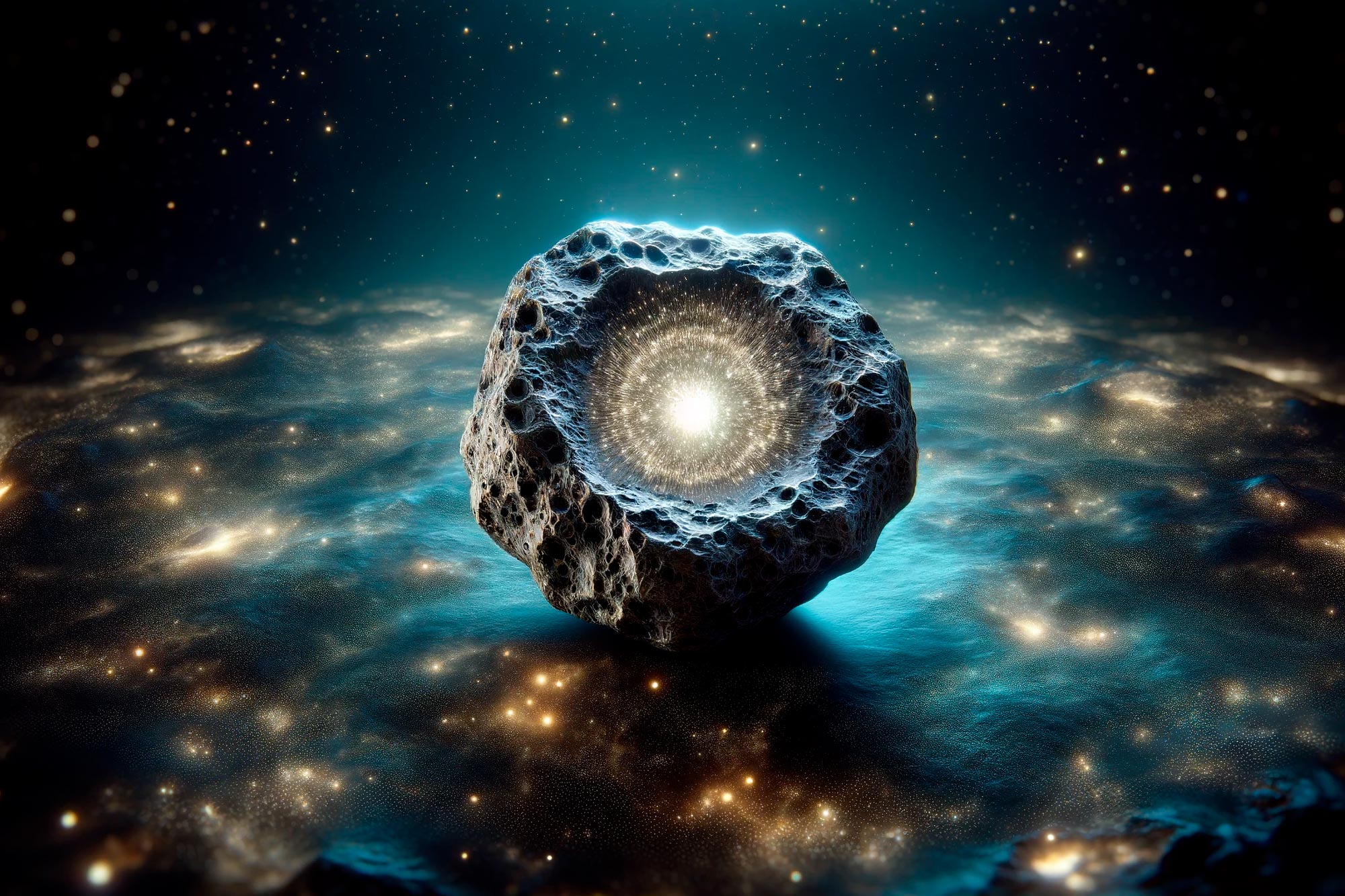
    Meteorite Composition Art Concept
    Researchers discovered a significant magnesium anomaly in a meteorite’s dust particle, challenging current astrophysical models and suggesting new insights into hydrogen-burning supernovas. (Artist’s concept.) Credit: SciTechDaily.com

    In a groundbreaking discovery published in the prestigious Astrophysical Journal, scientists have identified a rare dust particle lodged within an ancient extraterrestrial meteorite, shedding new light on the origins of stars beyond our solar system.

    Advanced Research Techniques

    Led by Dr. Nicole Nevill of the Universities Space Research Association at LPI, during her Ph.D. studies at Curtin University, the research team meticulously analyzed the dust particle, delving into its atomic composition with unparalleled precision using atom probe tomography.

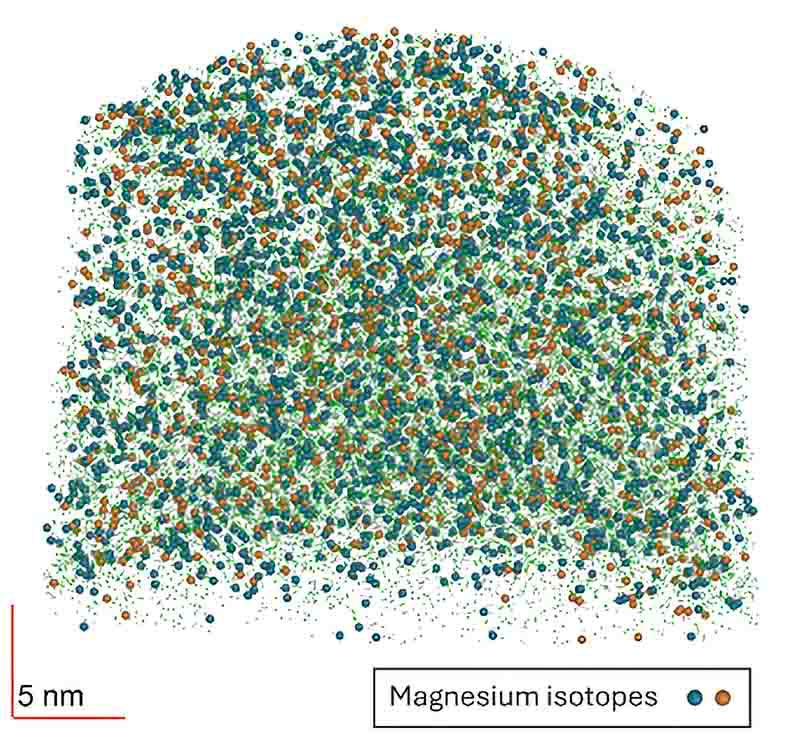
    Atom probe tomography is an instrument that breaks samples down to the atomic structure and reconstructs them in 3D resulting in the exact x,y,z coordinates of each atom in the specimen. It measures all ions on the periodic table except noble gases, has sub-nm spatial resolution, and a detection limit of 10 ppm. The instrument is very new to the field and Dr. Nevill was among the first to use it for planetary sciences.
    Hydrogen Burning Supernova Particle Atom Probe Analysis
    Atom probe analysis of a particle formed by a hydrogen burning supernova. This three­ dimensional ‘atom map’ shows two types of magnesium isotopes detected within the sample, with silicon and oxygen atoms within the particle displayed as smaller spheres. This work relies on the ability of the atom probe to count individual isotope.s of magnesium so that the isotopic ratio can be measured. Image credit: David Saxey, Geoscience Atom Probe Facility, Curtin University

    Challenging Existing Models

    “The results were literally off the chart as this was the highest magnesium anomaly ever discovered in a presolar silicate grain,” explains Dr. Nevill. “The results challenge current astrophysical models, indicating processes are occurring in stellar environments we do not yet fully understand.”

    This extreme magnesium anomaly can currently only be explained by a recently discovered type of star — a hydrogen-burning supernova. As the first known detailed chemical study of a presolar grain from a hydrogen-burning supernova, the results unlocked new insights into hydrogen-burning supernovas and their evolutionary conditions.

    New Insights into Star Formation

    Furthermore, this remarkable finding marks the first time presolar silicates have been studied using atom probe tomography, the highest spatial resolution technique in geochemical and geochronological research. The atom probe has expanded the range of measurable isotopes per presolar grain volume and achieves a new level of detail essential for helping us understand how these stars form.

    For more on this research, see Unprecedented Find in Meteorite Challenges Astrophysical Models.

    Reference: “Atomic-scale Element and Isotopic Investigation of 25Mg-rich Stardust from an H-burning Supernova” by N. D. Nevill, P. A. Bland, D. W. Saxey, W. D. A. Rickard, P. Guagliardo, N. E. Timms, L. V. Forman, L. Daly and S. M. Reddy, 28 March 2024, The Astrophysical Journal.
    DOI: 10.3847/1538-4357/ad2996

    Never miss a breakthrough: Join the SciTechDaily newsletter.
    Follow us on Google and Google News.

    Astronomy Astrophysics Meteorites Supernova Universities Space Research Association
    Share. Facebook Twitter Pinterest LinkedIn Email Reddit

    Related Articles

    Unprecedented Find in Meteorite Challenges Astrophysical Models

    New Method Uses Meteorites to Investigate Supernovae

    Grains of Sand from Core-Collapse Supernova Found in Meteorites

    Supernova Shock Wave Breaks Through a Cocoon of Gas

    Origins of Type Ia Supernovae

    Possible Evidence of Hadron Acceleration in Tycho Supernova Remnant

    Links Between Core Collapse Supernovae and Star Formation Established

    Lasers Mimic Supernova to Explain Cosmic Magnetic Fields

    SN Primo Is Farthest Type Ia Supernova Discovered

    Leave A Reply Cancel Reply

    • Facebook
    • Twitter
    • Pinterest
    • YouTube

    Don't Miss a Discovery

    Subscribe for the Latest in Science & Tech!

    Trending News

    Mezcal “Worm” in a Bottle Mystery: DNA Testing Reveals a Surprise

    New Research Reveals That Your Morning Coffee Activates an Ancient Longevity Switch

    This Is What Makes You Irresistible to Mosquitoes

    Shockingly Powerful Giant Octopuses Ruled the Seas 100 Million Years Ago

    Scientists Stunned by New Organic Molecules Found on Mars

    Rewriting Dinosaur Evolution: Scientists Unearth Remarkable 150-Million-Year-Old Stegosaur Skull

    Omega-3 Supplements Linked to Cognitive Decline in Surprising New Study

    First-of-Its-Kind Discovery: Homer’s Iliad Found Embedded in a 1,600-Year-Old Egyptian Mummy

    Follow SciTechDaily
    • Facebook
    • Twitter
    • YouTube
    • Pinterest
    • Newsletter
    • RSS
    SciTech News
    • Biology News
    • Chemistry News
    • Earth News
    • Health News
    • Physics News
    • Science News
    • Space News
    • Technology News
    Recent Posts
    • Scientists Map Thousands of Brain Connections With RNA Barcodes
    • This Gene Tweak Turns Strawberries Into Healthier, Tastier Superfruit
    • This New Chip Could Make GPUs Far More Efficient
    • This Tiny World in the Outer Solar System Should Be Airless, but It Has an Atmosphere
    • NASA’s Webb Space Telescope Reveals a Dark Airless Super-Earth That Looks Like Mercury
    Copyright © 1998 - 2026 SciTechDaily. All Rights Reserved.
    • Science News
    • About
    • Contact
    • Editorial Board
    • Privacy Policy
    • Terms of Use

    Type above and press Enter to search. Press Esc to cancel.